

Introduction
You're reviewing your portfolio or studying for a finance exam, and the question stops you cold: which of these assets is NOT an income investment? Growth stocks, crypto, a rental property, a bond fund. Suddenly the line between "income" and "everything else" feels blurry.
This confusion has real consequences. Misclassifying an asset can throw off retirement income planning, trigger surprise tax bills, or leave you believing your portfolio generates cash flow it doesn't actually produce.
This guide defines income investments walks through common examples, and pinpoints exactly which assets don't qualify — and why.
Key Takeaways
- Income investments pay recurring cash (interest, dividends, rent, or royalties) without selling the asset
- Growth stocks, cryptocurrency, collectibles, and raw land generate zero income while simply held
- The IRS's Net Investment Income definition is a useful tax baseline, but it differs from the investing definition
- Some assets, like oil and gas royalty interests, blend passive income with meaningful tax advantages
What Is an Income Investment?
An income investment is any asset held primarily to produce regular, recurring cash payments — interest, dividends, rent, or royalties — rather than solely for price appreciation.
The test is simple: does the asset return cash to you on a schedule, regardless of whether you sell it? A bond pays interest twice a year whether you hold or sell it next week. A dividend stock pays quarterly whether the share price rises or falls. That's the defining feature.
Price Fluctuation Doesn't Change the Classification
Income investments can still swing in market value. What matters is where your focus sits. As Matthew Diczok, head of fixed income strategy at Merrill and Bank of America Private Bank, puts it: when you're deriving income from an investment, "it doesn't matter as much if the value of the underlying asset fluctuates, regardless of whether it's a stock or a bond."
In other words, a bond's price can dip below face value, and it's still an income investment as long as it keeps paying interest.
Portfolio Income vs. Passive Income
Tax classification splits recurring cash flow into two buckets:
- Portfolio income: interest, dividends, and royalties not tied to an active trade or business
- Passive income: rents and income from businesses you don't materially participate in
The IRS's Net Investment Income definition — covering interest, dividends, annuities, rental and royalty income, and passive business income — offers a useful official baseline for what counts as investment income for tax purposes. It's a helpful reference point, though it's not a perfect match for the everyday investing definition since it also captures certain capital gains.
Common Types of Income Investments
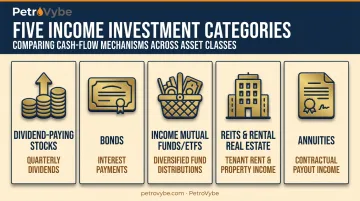
Several asset classes exist specifically to generate cash flow. Here's the lineup investors turn to most:
- Dividend-paying stocks: Regular shareholder payments (quarterly, typically) while retaining upside potential if the share price appreciates
- Bonds: Treasury, municipal, corporate, and high-yield bonds each pay interest on a set schedule, with risk and yield rising as credit quality falls
- Income-focused mutual funds and ETFs: Diversified, low-cost access to a basket of income-producing securities in one purchase
- REITs and rental real estate: Cash flow from tenant rent, with REITs required to distribute at least 90% of taxable income annually
- Annuities: Insurance contracts that convert a lump sum into guaranteed periodic payments, backed by the issuer's claims-paying ability
Oil and Gas Royalty and Working Interests
A lesser-known category worth understanding: oil and gas development projects that generate monthly passive income through royalty or working interests.
PetroVybe structures its natural gas development projects (like PetroVybe ONE, operating in Lavaca County, Texas) around this model. Accredited investors participate through limited partnership units, with Monthly Passive Distributions projected to exceed $10,000/month during peak production on a single unit.
The catch: distributions typically don't start until 2-3 years into the hold period, since building production capacity takes time.
What sets this category apart from stocks or bonds is the tax treatment layered on top of the income stream: a topic covered in more depth further below.
Which Is NOT an Income Investment? Key Examples
Now for the core question. Several common assets get lumped into "investment" conversations but generate zero recurring cash flow. Here's exactly which ones, and why:
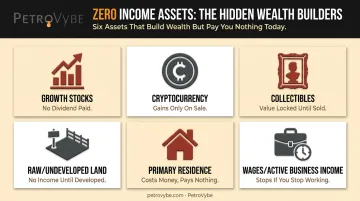
- Growth stocks: Non-dividend-paying equities held purely for capital appreciation, including many tech stocks. According to Investor.gov's definition of growth stocks, these are companies whose earnings grow faster than the market average, and they rarely pay dividends. No dividend means no scheduled payout.
- Cryptocurrency: Holding Bitcoin or Ethereum produces no interest, dividend, or rental cash flow. Gains happen only through price appreciation, realized when you sell. Staking is different: rewards count as taxable income once you have control over them, but plain holding does not.
- Collectibles: Art, wine, classic cars, and rare coins generate no recurring cash flow. Profit realizes only upon sale, and long-term gains on collectibles face a maximum 28% capital gains rate rather than any periodic payment.
- Raw or undeveloped land: Unless it's leased or otherwise monetized, vacant land produces no cash flow on its own. Lease it out and the rent becomes reportable income; sitting on it unused generates nothing until sale.
- A primary personal residence: Your home is a consumption asset, not an income investment, as long as it produces no rent. Rent out a room or the whole property, and it shifts into rental-income territory.
- Wages and active business income: The IRS explicitly excludes wages, self-employment income, and non-passive (materially participated) business income from its Net Investment Income definition. Earned income from labor is never classified as investment income, no matter how "recurring" your paycheck feels.
Income vs. Growth vs. Non-Income Investments: Key Differences
Growth investments prioritize capital appreciation over cash distributions. That makes them fundamentally different from income investments, even though both fall under the broad "investment" umbrella.
Some assets don't fit neatly into either box. Dividend growth stocks, for instance, pay a current dividend while also aiming to appreciate, making them a genuine hybrid.
| Category | Cash flow while held | Return depends on selling? |
|---|---|---|
| Income investment | Yes (interest, dividends, rent, royalties) | No |
| Growth investment | Rarely | Yes, mostly |
| Non-income asset | No | Yes, entirely |
Non-income investments share one trait: zero recurring cash flow. That single characteristic separates them cleanly from both income and growth categories, regardless of how much their value might climb over time.
Common examples include:
- Collectibles such as art or coins
- Cryptocurrency holdings
- Unleased raw land or undeveloped mineral rights
Quick Test: How to Tell If an Asset Is an Income Investment
Run any asset through these three questions:
- Does it pay out cash on a set schedule? (Monthly, quarterly, or annually)
- Is that payout independent of selling the asset?
- Would the payout continue even in a flat or falling market?
If you answer "yes" to all three, you're holding an income investment. A "no" to any one of them pushes the asset into growth or non-income territory.
Example: A dividend-paying utility stock pays quarterly cash regardless of share price movement, checking yes on all three counts. A cryptocurrency holding, by contrast, pays nothing on a schedule and only produces a return if you sell it at a higher price than you paid — three nos, squarely non-income.
Why This Classification Matters for Your Portfolio and Taxes
Getting this classification right isn't academic. It directly affects retirement planning, since only true income investments deliver spendable cash flow without forcing you to sell assets in a down market.
Beyond cash flow considerations, tax treatment diverges sharply, too. Portfolio and passive income can trigger the Net Investment Income Tax, while other income-generating structures offer offsetting deductions instead.
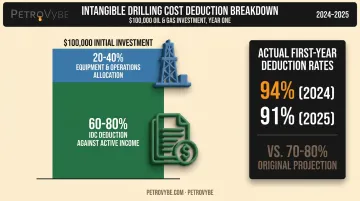
Oil and gas development interests are a prime example. The Intangible Drilling Cost (IDC) deduction, unlike most real estate deductions, isn't restricted to passive income. It applies against active income, including W-2 earnings and capital gains.
PetroVybe's investor partners have seen this play out directly:
| Year | Actual First-Year Tax Deduction Against Active Income |
|---|---|
| 2024 | 94% |
| 2025 | 91% |
That's a meaningful jump from the 70-80% range originally projected in earlier marketing materials. On a $100,000 investment, here's what that deduction looks like in practice:
- IDCs typically represent 60-80% of invested capital
- That amount offsets ordinary income in year one, on top of any monthly passive distributions
- Distributions begin separately, once production ramps up
The takeaway: work with a financial or tax professional to structure a mix of income, growth, and tax-advantaged investments. Companies like PetroVybe design their natural gas development offerings to combine passive income generation with substantial tax deduction potential for accredited investors. The result is a structure that doesn't fit neatly into a traditional "income vs. growth" binary.
Frequently Asked Questions
What is excluded from investment income?
Wages, self-employment income, and non-passive (materially participated) business income are excluded from investment income classifications like the IRS's Net Investment Income. These are treated as earned income instead.
What is a non-investment income?
Non-investment income refers to earned income from labor, such as wages, salaries, and active business income, rather than income generated by holding an asset. It's the direct counterpart to portfolio and passive income.
What is a type of income investment?
Common examples include dividend-paying stocks, bonds (Treasury, municipal, or corporate), REITs, annuities, and oil and gas royalty interests. Each pays recurring cash on a set schedule.
Is a savings account considered an income investment?
Savings accounts generate interest income, but they're typically classified as cash equivalents rather than true investments due to minimal growth potential. They function as a short-term holding spot for cash rather than a vehicle for building long-term wealth.
Are growth stocks considered income investments?
Generally, no. Growth stocks rarely pay dividends and focus on capital appreciation instead, meaning they fail the "recurring cash payout" test that defines income investments.
Can one asset be both a growth and an income investment?
Yes. Dividend growth stocks and certain REITs offer both regular payouts and price appreciation potential, blurring the line between the two categories. These hybrids reward patient investors on both fronts.