
But results vary enormously. A lot depends on how much due diligence you actually do, how much risk you can stomach, and whether you want to be hands-on or completely passive.
This guide walks through the exact steps to invest, the main types of small business investments, what actually drives returns, the mistakes that sink first-time investors, and a few alternative assets worth considering if you want to diversify beyond traditional small business equity.
Key Takeaways
- Equity, debt, and franchise ownership carry distinct risk and liquidity tradeoffs
- Review financials, market position, and ROI math before committing capital
- Plan for multi-year liquidity lock-ups before investing capital
- Diversify across business types, sectors, and private income assets to limit risk
How to Invest in Small Businesses: A Step-by-Step Guide
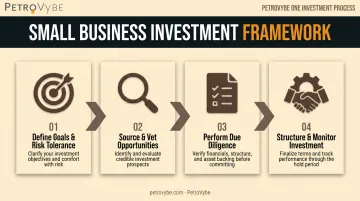
Step 1: Define Your Investment Goals and Risk Tolerance
Before browsing deals, decide what kind of investor you want to be. Are you chasing equity upside, steady interest income, or a semi-passive ownership role where you occasionally show up?
Each goal points toward different opportunities:
- Equity upside seekers gravitate toward crowdfunding platforms or direct startup investments
- Income-focused investors often prefer lending arrangements or revenue-share deals
- Hands-on owners typically look at franchises or direct business acquisitions
Liquidity matters just as much as goals. Most small business positions require 5 to 10 year holding periods before any meaningful exit. If you might need that cash back in 18 months, small business investing probably isn't the right vehicle.
Step 2: Source and Vet Potential Opportunities
Once you know what you're after, start sourcing deals. Common channels include:
- Equity crowdfunding platforms (Reg CF and Reg D offerings)
- Angel investor networks and syndicates
- Business brokers specializing in acquisitions
- Small Business Investment Companies (SBICs)
- Direct introductions through industry contacts
Crowdfunding has grown into a legitimate access point. The SEC reports 9,461 Reg CF offerings initiated between 2016 and the end of 2025, with 4,303 offerings reporting $1.546 billion in combined proceeds.
That volume doesn't guarantee quality, though. SEC data on Regulation Crowdfunding offerings shows over half of Reg CF companies had generated zero revenue at the time of filing.
Before shortlisting anything, research industry trends and competitive positioning. A profitable-looking laundromat in a shrinking town tells a different story than the same business in a growing suburb.
Step 3: Perform Financial and Legal Due Diligence
This is where most first-time investors either protect themselves or get burned. Review three core documents at minimum:
- Profit and loss statement - reveals true earnings after expenses
- Balance sheet - shows assets, liabilities, and net equity position
- Cash flow statement - confirms the business can actually pay its bills
If you're evaluating a franchise, add the Franchise Disclosure Document (FDD) to that list. The FTC requires franchisors to deliver a 23-item Franchise Disclosure Document at least 14 calendar days before you sign anything or hand over money. Item 19 (financial performance), Item 20 (unit openings and closures), and Item 21 (audited financials) deserve close attention.
Watch for these red flags:
- Customer concentration - one client representing 40%+ of revenue is a landmine
- Owner dependency - can the business run without the current owner?
- Existing debt load - hidden liabilities can wipe out projected returns fast
Once the numbers check out, calculate ROI: net gain divided by total investment cost, multiplied by 100. For deals with different payback timelines, Net Present Value helps you compare apples to apples by discounting future cash flows back to today's dollars.
Step 4: Structure the Investment and Monitor Performance
Deal structure shapes everything that follows. Typical arrangements include:
- Direct equity stake - ownership percentage tied to company performance
- Convertible note - debt that converts to equity under specified conditions
- Revenue share - fixed percentage of top-line revenue until a cap is reached
- Straight loan - fixed interest, defined repayment schedule
Whatever structure you choose, document it in a written agreement covering ownership percentage, reporting obligations, and voting rights if applicable.
Before finalizing anything, establish a reporting cadence with the owner (monthly or quarterly financials work well) and define an exit strategy upfront. That could mean a buyout clause, a resale provision, or a recapitalization event. Investors who skip this step often find themselves stuck with no clear path to liquidity.
Types of Small Business Investments to Consider
Equity Investments
Equity investors buy an ownership stake directly, or through a crowdfunding platform, in exchange for a share of future profits and appreciation. This is the highest-upside, highest-risk category on this list.
Equity also carries the least liquidity. Reg CF securities generally can't be resold for a full year after purchase, and Regulation D securities may need to be held indefinitely depending on the offering terms.
Debt Investments (Lending)
Debt investors lend capital in exchange for fixed interest payments, similar in principle to how SBA-guaranteed loans work on the borrowing side. A standard SBA 7(a) loan can reach $5 million, with the SBA guaranteeing up to 85% of amounts $150,000 or less and 75% above that threshold.
Debt is far more predictable than equity. You know your interest rate and repayment schedule going in. The tradeoff: your upside is capped no matter how well the business performs.
Franchise and Semi-Absentee Ownership
Buying into a franchise combines small business ownership with an established operating system, brand recognition, and built-in training. You're not building from scratch.
Franchises typically demand more capital upfront. The International Franchise Association pegs typical franchise fees between $20,000 and $50,000, but that's just the entry fee. Add build-out costs, equipment, inventory, and initial working capital, and total investment often runs into six figures. Time commitment is semi-passive at best, not fully hands-off like a crowdfunding position.
Private Placements and Passive Income Assets
Some investors look past traditional small business equity entirely and toward private, professionally managed development projects that generate passive income with added tax efficiency. Natural resource development is one example worth understanding, and it's covered in more depth in the alternatives section below.
Here's how the four approaches stack up at a glance:
| Investment Type | Risk / Return Profile | Liquidity | Typical Capital Needed | Time Commitment |
|---|---|---|---|---|
| Equity | Highest upside, highest risk | Lowest (1+ year hold) | Varies by deal | Passive |
| Debt | Fixed return, capped upside | Moderate (loan term) | Varies by loan size | Passive |
| Franchise | Moderate, operator-dependent | Low (illiquid business asset) | $20K+ entry, often six figures total | Semi-passive |
| Private Placement | Moderate-high, tax-advantaged | Low (multi-year hold) | Higher minimums | Passive |
Key Factors to Evaluate Before Investing
Risk-return tradeoff. Early-stage equity offers the highest potential return, but also the highest chance of total loss. Lending caps your upside but protects principal better. There's no free lunch here, just different tradeoffs to match your comfort level.
Liquidity. Unlike a public stock you can sell in seconds, most small business investments can't be sold quickly at all. You're often locked in for years, sometimes indefinitely, waiting for a specific exit event.
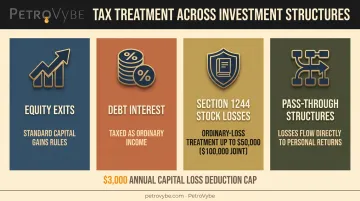
Tax treatment. Tax treatment depends heavily on how the deal is structured:
- Standard capital gains rules apply to most equity exits
- Interest from debt investments is taxed as ordinary income
- Net capital losses are deductible only up to $3,000 against other income, with carryforwards available
- Qualified Section 1244 stock losses can receive ordinary-loss treatment up to $50,000 ($100,000 on a joint return)
- Certain pass-through structures, like LLCs and S-corps, let losses flow directly to your personal return, offering flexibility that standard equity stakes don't provide
Common Risks and Mistakes to Avoid When Investing in Small Businesses
Small business investing rewards patience and punishes shortcuts. The most common mistakes:
- Skipping due diligence entirely. Investors who trust a pitch deck over verified financials, legal documents, and the owner's track record consistently get burned.
- Underestimating total capital needs. Businesses often need follow-on funding rounds, and investors who don't reserve capital for these get diluted or watch their stake become worthless.
- Overconcentrating in one deal. Putting your entire allocation into a single business or sector removes any cushion if that one bet goes wrong.
Business survival data underscores why concentration is so dangerous. According to BLS tracking of a 1994 establishment cohort, survival rates fell from 79.6% after one year to 48.9% after five years and just 36.3% after ten years.
This data measures survival, not profitability; even surviving businesses may not have delivered investor returns. Stress-test your loss assumptions accordingly, and never assume the remaining 36% were all winners.
Alternative Ways to Diversify Beyond Small Business Investing
Small business equity isn't the only way to build private wealth. A few alternatives worth weighing:
Public stocks and bonds offer far greater liquidity and lower minimums. You can exit a position in seconds during market hours. The tradeoff is less control and typically fewer tax advantages than private structures offer.
Real estate provides a tangible, appreciating asset with its own distinct risk-reward profile, separate from operating a business day to day.
**Private natural gas and oil development** is a third path, and one that operates quite differently from either. PetroVybe, a Texas-based development company, structures its offerings around exactly this kind of passive, tax-advantaged exposure for accredited investors.
Here's what that looks like in practice:
- Minimum investment: $100,000 in liquid capital, available exclusively to accredited investors with third-party verification
- Tax mechanism: IDC (intangible drilling cost) deductions apply against active income, including W-2 earnings and capital gains, with 2024 partners seeing a 91-94% deduction
- Asset base: ~400 acquired wells plus 57+ planned wells across a 58,000-acre basin in Lavaca County, Texas, backed by a $48 million PV-09 valuation and a clean 2025 audit
- Return targets: A 10-year MOIC window of 2.2x to 5.8x, targeted IRR near 26%, and monthly distributions projected to exceed $10,000 at peak production
This kind of structure isn't for every investor. It requires accredited status, a six-figure minimum, and a genuine 10-year holding horizon.

But for someone already comfortable with small business illiquidity, this offers a different asset class entirely, one backed by physical reserves rather than the operating cash flow of a storefront or service business.
Diversification works best when it spans genuinely different asset classes, not just different investments within the same risk category. Spreading capital this way protects against a single point of failure taking down your entire portfolio.
Frequently Asked Questions
What is the best business to invest in right now?
No single business is "best," as the right fit depends on your risk tolerance, capital, and goals. However, recession-resistant sectors with recurring revenue—such as essential services, healthcare, and energy—tend to perform more consistently.
How much money do I need to start investing in small businesses?
Crowdfunding platforms can start at a few hundred dollars per deal. Direct equity, franchise, or private placement investments typically require five to six figures or more, depending on the structure.
What's the difference between investing in a small business and starting one?
Investing means contributing capital for a return without day-to-day operational responsibility. Starting a business means building and running the entire operation yourself, from hiring to daily decisions.
Is investing in a small business a good way to diversify my portfolio?
Yes, small business investments can diversify a portfolio that's heavy in public stocks and bonds. Just balance them against your liquidity needs and consider pairing them with other alternative assets.
How do I find small businesses looking for investors?
Common channels include equity crowdfunding platforms, angel investor networks, local business brokers, and SBIC-backed funds. Each offers different deal sizes and vetting standards, so compare a few before committing.
What returns can I expect from investing in a small business?
Returns vary widely by investment type. Rather than relying on one industry-wide number, compare ROI and MOIC or IRR targets across each specific opportunity you're evaluating.