
The distinction isn't academic. It determines who signs the lease, who pockets the bonus payment, how the IRS treats your income, and what your interest is actually worth if you decide to sell. This guide breaks down both terms, shows where each shows up in real transactions, and introduces a third path worth knowing about: direct development investment.
Key Takeaways
- Mineral rights grant ownership plus the Executive Right to lease and collect bonuses
- Royalty rights are narrower, granting only a revenue share with no leasing authority
- Owners of royalty interests avoid drilling costs but have no vote in development decisions
- Both interests can be severed, sold, or inherited independently of each other
- Direct development investment can unlock deductions beyond standard percentage depletion
Mineral Rights vs Royalty Rights: Quick Comparison
Here's the fastest way to see how these two interests diverge:
| Category | Mineral Rights | Royalty Rights |
|---|---|---|
| Ownership Scope | Full ownership interest, including the right to lease, explore, and develop | Percentage of revenue only, no ownership of the resource |
| Control Over Leasing | Holds the Executive Right to negotiate and sign leases | No control over leasing decisions or terms |
| Cost Exposure | No drilling costs if leased out; retains royalty on production | Never responsible for drilling, completion, or operating costs |
| Income & Duration | Bonus payments plus ongoing royalty; held in perpetuity unless sold | Income only once production begins; perpetual (NPRI) or term-limited |
The pattern is simple: mineral rights carry authority and upside, along with the responsibility of managing it. Royalty rights strip away the decision-making and leave a simpler, narrower income stream.
What Are Mineral Rights?
Mineral rights are a real-property interest in the oil, gas, and other resources beneath a tract of land, separate from ownership of the surface itself. In states like Texas, this separation, known as "severance," happens constantly. A landowner sells the surface but keeps the minerals, or vice versa, and the two estates start living independent legal lives.
The Bundle of Rights
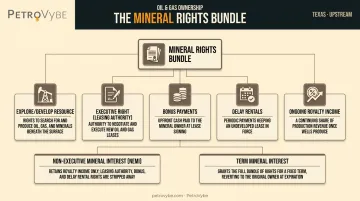
Owning minerals doesn't mean owning one thing. It means owning a bundle that typically includes:
- Explore and develop the resource beneath the surface
- Exercise the Executive Right to negotiate and sign oil and gas leases
- Collect bonus payments at signing
- Receive delay rentals during the lease's primary term
- Earn ongoing royalty income once production starts
That bundle can be broken apart. A Non-Executive Mineral Interest (NEMI) strips out the Executive Right while leaving other components intact. A Term Mineral Interest limits ownership to a set period, often extended only if production continues.
Multiple heirs frequently co-own mineral interests after inheritance. Each co-tenant can typically lease their own fractional share independently, and how these rights get divided shapes what an owner can actually do with them.
Use Cases: Where Mineral Ownership Shows Up
Most mineral owners fall into one of three buckets: they inherited family land, they bought property in fee simple, or they purchased mineral interests directly from another owner. In active basins like the Permian and Eagle Ford, owners with Executive Rights use that leverage to negotiate bonus payments and royalty rates with competing operators.
The financial stakes vary enormously by tract. According to Texas GLO's April 2025 bid tabulation, sealed-bid results from that month show just how wide the range gets.
A 480-acre tract in Loving County drew a $4.8 million bid, while a 160-acre tract in Reeves County brought in just $1.2 million. Location, acreage, and operator demand swing these numbers hard, and there's no flat per-acre price you can rely on.
What Are Royalty Rights?
Royalty rights are a non-possessory interest, meaning the holder gets a share of production revenue without any say in leasing, exploration, or development. Think of it as owning a slice of the cash flow without owning the resource that generates it.
The core appeal is simplicity: royalty income arrives free of drilling and operating costs. If a well fails to produce economically, the operator eats that loss, not the royalty owner.
Three Common Variations
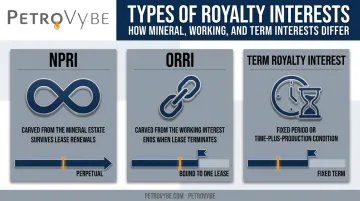
Royalty interests aren't all identical. The main types include:
- Non-Participating Royalty Interest (NPRI) - carved from the mineral estate, typically perpetual, and survives even when leases expire and get renewed
- Overriding Royalty Interest (ORRI) - carved from a working interest, tied to one specific lease, and it disappears when that lease ends
- Term Royalty Interest - limited to a fixed period or a time-plus-production condition
That duration difference matters more than most owners realize. An NPRI can outlast several leases over decades. An economically similar ORRI vanishes the moment the underlying lease terminates.
Use Cases: Where Royalty Interests Originate
Royalty interests commonly arise when a mineral owner sells their land but reserves the royalty, when a landman or geologist receives an ORRI as compensation, or through inheritance separate from any mineral interest.
Payment shows up monthly or quarterly, calculated from gross revenue minus allowable post-production costs, multiplied by the owner's decimal interest. What that decimal interest translates to on a check depends heavily on the royalty rate written into the lease.
Royalty rates vary by source and region:
| Source | Typical Royalty Rate |
|---|---|
| IRS Oil and Gas Audit Technique Guide | 1/8, or 12.5% |
| Academic sources (Texas, Oklahoma) | 18.75% |
| Recent state leases (New Mexico) | Up to 25% |
There's no single universal number, but this range gives you a realistic benchmark for evaluating what you're owed.
One catch: "cost-free" doesn't mean "deduction-free." Royalties avoid drilling and operating costs, but post-production costs like gathering, compression, and transportation can still reduce a check depending on the lease's exact language. Texas courts have ruled against operators who deducted these costs improperly, so the wording in the original lease matters enormously.
Mineral Rights vs Royalty Rights: Which One Is Right for You?
If you already own land or hold an inherited interest, the choice is less about picking one and more about understanding what you already have. If you're evaluating oil and gas exposure as an investor, the calculus is different.
Factors to Weigh
Ask yourself these questions before deciding what to do with an interest, or how to structure a new one:
- Do you want a say in leasing decisions, or would you rather stay hands-off?
- How much risk are you comfortable carrying if a well underperforms?
- Do you need liquidity now, or can you wait for long-term income?
- How involved do you want to be in managing the asset?
Choose mineral rights if you want leasing control and believe your land has long-term upside. **Choose or accept royalty rights** if you want simpler, cost-free income without the responsibility of negotiating leases or fielding operator calls.
A common real-world scenario: siblings inherit a family tract, and the estate splits mineral and royalty interests between them. One sibling ends up negotiating leases and collecting bonus payments. The other collects a royalty check with no decision-making authority at all. Same family, same land, two entirely different financial relationships with the same wells.
A Third Path: Direct Development Investment
There's another option worth considering, particularly for accredited investors who don't already own land: participating directly in development rather than owning a mineral or royalty interest at all.
This is where a company like PetroVybe fits in. Instead of buying or inheriting mineral acreage, accredited investors can take an equity position in an active natural gas development project. PetroVybe's current program covers roughly 400 acquired wells plus more than 57 planned new wells across a 58,000-acre basin in Lavaca County, Texas.
The tax mechanics differ substantially from what mineral or royalty owners typically see. Mineral and royalty income generally qualifies for a percentage depletion deduction, usually around 15% of qualifying gross income under IRC Section 613A, subject to production and income limits.
Direct development participation through a working-interest structure works differently. Intangible Drilling Costs (IDCs) can be deducted against active income, including W-2 earnings and capital gains, not just passive income.
PetroVybe's partners saw first-year deductions of 94% in 2024 and 91% in 2025 against active income, based on the company's own reported figures. That's a materially larger upfront tax benefit than percentage depletion alone provides, though actual results depend on individual tax circumstances and project execution.

This path suits investors who want oil and gas exposure and tax efficiency without needing to already own, buy, or manage mineral or royalty interests. For those who've inherited land, this doesn't replace owning minerals outright. It offers a different door into the same industry.
Conclusion
Mineral rights and royalty rights sit on a spectrum of control and involvement. Mineral rights carry ownership and leasing authority, along with the responsibility of negotiating deals. Royalty rights offer simpler, cost-free income with none of that decision-making burden. Neither is objectively better; the right answer depends on whether you already own land, inherited a fractional interest, or are simply looking for a way into oil and gas exposure.
Understanding this distinction protects landowners from under- or over-valuing what they hold. It also gives investors a clearer framework for comparing passive royalty income against alternatives like PetroVybe's direct development participation model, where intangible drilling cost deductions and long-term production upside can look meaningfully different from a simple royalty check.
Frequently Asked Questions
Are my mineral rights worth anything?
Value depends on location, proximity to active drilling, commodity prices, and whether the acreage is leased or producing. A professional appraisal or a direct buyer offer can give you a realistic market estimate.
What is a 3% royalty?
This typically refers to an overriding royalty interest (ORRI) or a small royalty carved from a lease. It entitles the holder to 3% of gross production revenue with no drilling or operating cost responsibility.
Are mineral royalties taxable?
Yes, royalty income is generally taxed as ordinary income. Owners may qualify for a percentage depletion deduction, often around 15% of qualifying gross income, subject to IRS limits.
What does it mean if someone has mineral rights?
It means they own the subsurface resource, including the right to lease, explore, and collect royalties, independent of whoever owns the surface land above it.
Can you own mineral rights without owning royalty rights?
Yes. An owner can sell or reserve their royalty interest separately from their mineral rights through the same or separate deeds, since the two convey independently.
Is it better to sell mineral rights or keep royalty rights?
It depends on liquidity needs and risk tolerance. Selling delivers a lump sum and removes future price risk, while holding preserves long-term income and control. Weigh today's offer against projected future value before deciding.