

This article is general education, not investment, tax, or legal advice. Natural gas headlines feel contradictory right now. Storage sits comfortably above average, yet 20-year LNG contracts keep getting signed. Spot prices hover near $2.82/MMBtu, while forecasters expect $3.44 for the full year. So which story is true?
Both are. Near-term supply is loose. Long-term demand is tightening. That tension, driven by LNG exports and AI-fueled electricity demand, is reshaping how investors think about natural gas exposure.
This article breaks down today's pricing, the mega-deals reshaping global gas flows, where prices head in 2026, and how accredited investors can position beyond simple commodity speculation.
Key Takeaways
- Henry Hub spot sits near $2.82/MMBtu, with storage 185 Bcf above the five-year average
- Multi-decade LNG deals with Eni, SEFE, and JERA are locking in export demand through 2045+
- AI data centers could push U.S. natural gas power generation up 130+ TWh by 2030
- EIA forecasts $3.44/MMBtu average for 2026, up from current spot levels
- Accredited investors can back development-stage gas projects instead of trading volatile futures
What's Driving Natural Gas Prices Today
The benchmark that matters is Henry Hub, and EIA's most recent reading puts spot gas at $2.82/MMBtu on August 18, 2026. That number moves daily based on weather, storage, and export demand.
Here's where it gets confusing for newcomers: gas gets quoted two ways.
- Mcf (thousand cubic feet): a volume measurement
- MMBtu (million British thermal units): a heat-content measurement
Using EIA's 2025 conversion factor of 1 Mcf = 1.037 MMBtu, a $3.00/Mcf price translates to roughly $2.89/MMBtu. Flip it around, and $2.82/MMBtu equals about $2.92/Mcf. Small differences, but they matter when comparing contract terms.
Seasonal Swings Still Rule the Prompt Market
Winter heating demand and summer cooling load create predictable price spikes. A cold snap in January or a heat dome in July can send spot prices climbing within days, regardless of where storage sits.
Storage and Production Levels
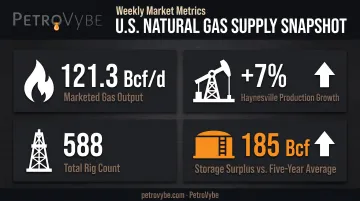
Weekly EIA storage reports are the market's pulse check. As of August 14, 2026, Lower 48 working gas stood at 3,169 Bcf, following a 16 Bcf weekly injection. That's 185 Bcf above the five-year average, a comfortable cushion that's been keeping a lid on spot prices.
Production tells a similar story:
- U.S. marketed gas output hit 121.3 Bcf/d in the first half of 2026, up 4.6 Bcf/d year over year
- Haynesville production grew 7% (+1.1 Bcf/d) over the same period
- Total rig count sat at 588 as of August 21, up 14 year over year, though gas-directed rigs remain a modest 126
More supply, more storage. That combination explains why spot prices haven't spiked despite all the demand headlines.
The AI and Electricity Demand Factor
Storage reports explain today's soft prices. They miss the structural demand shift building underneath.
The IEA reports U.S. data centers consumed roughly 187 TWh in 2024. That load is expected to drive nearly half of U.S. electricity demand growth through 2030. Natural gas is positioned to supply over 130 TWh of that additional generation.
PJM's own planning data backs this up: evaluated large-load requests suggest data-center demand could climb by up to 30 GW between 2025 and 2030 in that region alone.
PetroVybe CEO Peter Snell puts it plainly: "AI requires data centers, and data centers require one thing above all else: energy."
Natural gas currently supplies 42% of U.S. grid power. PetroVybe's internal analysis points to 6-10 Bcf/d of new gas demand tied to data-center buildouts by 2030.
That growth concentrates in basins already feeding the grid. PetroVybe's development footprint spans East Texas' Haynesville/Middle Bossier region and a 58,000-acre Gulf Coast position in Lavaca County, both in the path of power expansion tied to AI infrastructure.
Major Natural Gas Deals Reshaping the Market
While storage reports move prices day to day, multi-decade contracts are rewriting who buys American gas for the next generation.
Venture Global's LNG offtake agreements illustrate the pattern most clearly:
- Eni (July 2025): 2 million metric tons per year for 20 years from the CP2 facility
- SEFE Energy (July 2025): An additional 0.75 MTPA over 20 years, pushing SEFE's total to 3 MTPA
Neither deal discloses pricing publicly, but the duration signals something important: European buyers are locking in U.S. supply for two decades, not two years.
The Broader US-EU Push
The European Commission's original 2022 framework targeted about 50 bcm of additional U.S. LNG through 2030, specifically to reduce Russian gas reliance. That policy goal has since become a bargaining chip in broader trade talks.
Case in point: the 2025 Trump-EU trade framework floated $250 billion per year in combined U.S. energy purchases tied to tariff negotiations. Reuters called the scale "delusional." Political aspiration and signed supply contracts are not the same thing, and investors should treat them accordingly.
Gas as Geopolitical Leverage
Similar patterns are showing up globally:
- JERA (Japan): Agreed to buy up to 5.5 MTPA over 20 years starting around 2030, diversifying away from Australian supply
- Israel-Egypt: A deal potentially worth $35 billion, delivering up to 130 bcm through 2040
Natural gas has become a standard tool in trade and diplomatic negotiations, not just a commodity traded on exchanges.
Natural Gas Price Forecast: What to Expect in 2026
EIA's August 2026 Short-Term Energy Outlook puts full-year 2026 Henry Hub prices at $3.44/MMBtu, up from its $2.87 Q3 forecast. Looking further out, 2027 comes in at $3.31/MMBtu.
Why the expected climb from today's $2.82 spot price? LNG export capacity.
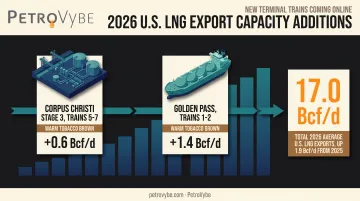
EIA identifies 2.0 Bcf/d of new capacity starting in 2026:
- Corpus Christi Stage 3 trains 5-7 add 0.6 Bcf/d
- Golden Pass trains 1-2 add 1.4 Bcf/d
Combined, this new capacity pushes 2026 average LNG exports to 17.0 Bcf/d, up 1.9 Bcf/d from 2025. More feedgas demand pulling from the same domestic supply pool tends to tighten pricing, even when storage looks comfortable.
Bullish factors for 2026:
- Rising LNG export capacity
- AI/data-center electricity demand growth
- Long-term sale-and-purchase agreement (SPA) commitments locking in future offtake
Bearish risks:
- A mild winter suppressing heating demand
- Continued production growth outpacing exports
- Geopolitical de-escalation reducing urgency for diversification deals
EIA's forecast does not publish a confidence range, so treat $3.44 as a point estimate, not a guarantee.
How Natural Gas Price Volatility Creates Investment Opportunity
Trading Henry Hub futures directly is a tough game for retail investors. Prices swing on weather forecasts, storage surprises, and geopolitical headlines, often within the same trading session. That volatility rewards professional traders and punishes everyone else.
There's a different approach: owning the development economics behind the gas itself, rather than betting on where the price lands next month.
For accredited investors, structured upstream partnerships can provide that exposure. PetroVybe is one example:
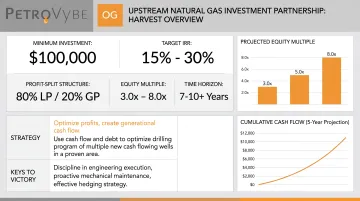
- Minimum investment: Participation begins at one unit of $100,000, with add-on subscriptions from $25,000. Accredited investor status required
- Tax results: Partners received a 94% deduction against active income in 2025, using IDC and depletion allowances. Prior result; not a promise of any future deduction.
- Return targets: About 4.5x MOIC over 10 years, an estimated 26% IRR, and a targeted 213% cash-on-cash return by Year 5
- Profit structure: An 80/20 split favoring investors under the company's "Protect and Scale" compound capital model. This treatment requires the investor to elect general partner status in the Subscription Agreement and may be limited in a given year by the excess business loss limitation under IRC §461(l).
The asset base behind these targets includes roughly 400 acquired legacy wells and 57+ planned new wells across a 58,000-acre Gulf Coast position.
A third-party PV-09 reserve valuation of $48 million and a clean 2025 independent audit back that position. Prepared by Lee Keeling & Associates, Tulsa, March 2026.
For investors already diversified across stocks, bonds, and real estate, natural gas development offers exposure tied to production economics and tax efficiency—not daily price swings on an exchange.
These are forecasted targets, not guaranteed returns. Actual results depend on commodity prices, drilling outcomes, and operating conditions.
Understanding Natural Gas Pricing Units
Getting comfortable with gas pricing units makes the rest of this market far less confusing.
Mcf vs. MMBtu:
- 1 Mcf = 1,000 cubic feet (a volume)
- 1 MMBtu = 1 million British thermal units (a heat measurement)
- Using 2025's average conversion factor, 1 Mcf ≈ 1.037 MMBtu
Example: Gas priced at $3.50/Mcf converts to roughly $3.38/MMBtu ($3.50 ÷ 1.037).
Spot, futures, and contract prices aren't interchangeable:
| Price Type | What It Means |
|---|---|
| Spot price | One-time price for immediate delivery at a specific location (like Henry Hub) |
| Futures price | Price locked in today for delivery in a future month, typically traded in 10,000 MMBtu contracts on CME |
| Contract price | Bilateral, often confidential pricing in long-term deals like Venture Global's sales and purchase agreements (SPAs) |
When you read that Venture Global signed Eni for "2 million tonnes per annum (MTPA) over 20 years," that's a contract volume commitment, not a public price. Don't confuse today's spot quote with what's actually embedded in those 20-year agreements.
Frequently Asked Questions
Is natural gas expected to go up in 2026?
EIA forecasts a full-year 2026 average of $3.44/MMBtu, above current spot levels near $2.82. Rising LNG export capacity and AI-driven electricity demand support the increase, though a mild winter or oversupply could keep prices lower.
What is today's natural gas price?
As of the latest EIA report, Henry Hub spot gas was priced at $2.82/MMBtu on August 18, 2026. Check EIA's Henry Hub spot price page for daily updates.
How much is 1,000 cubic feet of natural gas worth?
Using the 2025 conversion factor of 1 Mcf = 1.037 MMBtu, gas at $2.82/MMBtu converts to about $2.92/Mcf. Actual project pricing varies with gas composition and delivery point.
What is causing natural gas prices to be so volatile lately?
Weather swings, weekly storage reports, and geopolitical LNG deals all move prices independently. Add rising export capacity into the mix, and short-term price swings become harder to predict.
How do international LNG deals affect domestic US natural gas prices?
Long-term export commitments like the Eni and SEFE deals increase feedgas demand at U.S. liquefaction terminals. That added pull on the same domestic supply pool tends to tighten prices over time.
Can regular investors benefit from natural gas price trends?
Public markets offer futures and energy funds that track short-term prices. Accredited investors can instead take direct positions in development projects—PetroVybe targets long-term returns tied to production economics rather than daily price swings.
Informational requests only. PetroVybe projects are offered solely to verified accredited investors. Submitting this form does not create an investment or advisory relationship.