This article is general education, not investment, tax, or legal advice. The One Big Beautiful Bill Act just rewrote the math on facility investment. Section 168(n) creates a 100% first-year depreciation allowance for Qualified Production Property (QPP), letting manufacturers, refiners, and chemical producers deduct the full cost of a new production building immediately instead of spreading it across 39 years.
That's a real shift. Capital-intensive facility investments in manufacturing, refining, and agricultural or chemical production have historically locked up tax benefits for decades. Investors and operators waited years to see the deduction catch up to the cash already spent.
This post breaks down what qualifies as QPP, how the deduction actually works, where recapture risk hides, and why accredited investors evaluating energy and production-linked assets should care.
Key Takeaways
- QPP allows a 100% first-year deduction for qualifying nonresidential manufacturing, refining, or ag/chemical production property
- Break ground after Jan. 19, 2025 and before Jan. 1, 2029; place in service before Jan. 1, 2031
- Offices, R&D , finished-goods storage, and admin areas do not qualify
- Section 1245 recapture applies if use changes within 10 years of placed-in-service
- IRS Notice 2026-16 provides interim guidance taxpayers can rely on now
What Is Qualified Production Property (QPP)?
Under Section 168(n), QPP is new, nonresidential real property that a taxpayer constructs, places in service in the U.S., and uses as an integral part of a qualified production activity.
The "integral part" test drives most of the qualification analysis. Property qualifies only in the physical space where a qualifying activity actually occurs, so only the qualifying portion of a building's basis is eligible.
What Doesn't Count
Even inside or next to a production facility, these spaces are explicitly excluded:
- Offices and administrative areas
- Sales and customer service space
- R&D facilities
- Data centers
- Lodging and parking
- Finished-goods storage
The 95% Rule and Integrated Facilities
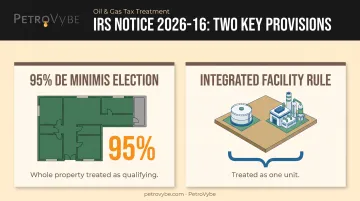
Two provisions in IRS Notice 2026-16 simplify how real-world facilities qualify:
- 95% de minimis election — if at least 95% of a building's physical space meets the integral-part test, the taxpayer can treat the whole property as qualifying
- Integrated facility rule — multiple buildings on the same or contiguous land (say, a raw-material storage building next to a processing plant) can be treated as one unit for qualification purposes
A related-party leasing exception also applies. Consolidated groups and commonly controlled pass-through entities can let a lessor reference the lessee's qualifying activity, generally under a 50%-or-greater ownership test.
How 100% Bonus Depreciation Works for QPP
The mechanics are simpler than the eligibility rules. A taxpayer elects to immediately deduct up to 100% of the adjusted basis of QPP in the year it's placed in service, instead of running it through 39-year straight-line recovery.
Critical dates to track:
- Construction must begin after January 19, 2025, and before January 1, 2029
- Property must be placed in service before January 1, 2031 (limited disaster-related extensions exist)
To make the election, the taxpayer attaches a statement to a timely filed return, including extensions, identifying the property, its total basis, and the dollar amount designated as QPP. Full or partial elections are allowed.
One meaningful advantage: QPP depreciation isn't subject to an AMT adjustment under Section 56, unlike some other accelerated deduction types.
Stacking QPP with Equipment Bonus Depreciation
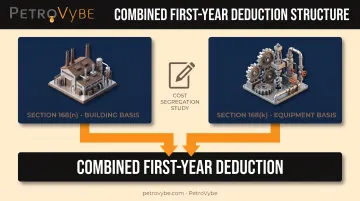
Section 168(n) covers the building. Section 168(k) still covers machinery and shorter-lived personal property. These aren't competing provisions. They're complementary cost pools.
PwC's 2026 analysis recommends cost segregation studies to separate the building basis (168(n)) from equipment basis (168(k)) before modeling deductions. Done right, a facility project can generate first-year deductions covering both the structure and the machinery inside it. That pairing changes project-level cash flow modeling.
Alongside stacking, partial elections give investors room to match the QPP deduction to taxable income in a given year instead of absorbing the full basis at once and managing recapture on the entire amount.
Qualifying Production Activities and Property Requirements
Section 168(n) recognizes three categories: manufacturing, refining, and production (limited to agricultural and chemical production).
The activity must meet a substantial transformation standard. It has to fundamentally change raw materials into a new, distinct product.
How that test plays out in practice:
- Wood pulp processed into paper qualifies
- Steel rods formed into screws and bolts qualify
- Simple packaging, labeling, or minor assembly does not
Support work in the same qualifying property can qualify with the primary transformation activity. That includes raw material receiving, storage, and quality control.
Recapture Rules and Risks to Watch
Here's where QPP diverges sharply from normal real property tax treatment. Instead of Section 1250 rules, QPP falls under Section 1245 recapture. That means depreciation previously claimed gets recaptured as ordinary income upon sale.
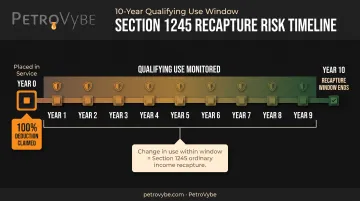
The bigger risk is the 10-year change-in-use window. If the property stops being used in a qualifying production activity within 10 years of being placed in service, prior depreciation is recaptured as ordinary income in that year.
Key nuances:
- Partial changes trigger partial recapture on only the affected portion of basis
- Temporary idling (maintenance shutdowns, for example) does not trigger recapture if qualified use is expected to resume
- Activity switches between qualifying uses are not disqualifying when there is no intervening non-qualifying use
This is a long-term commitment provision. Operators need a credible 10-year operating plan before making the election, not just a one-year tax play.
Why Bonus Depreciation on Production Property Matters for Energy & Natural Gas Investors
Notice 2026-16 specifically names LNG processing and chemical feedstock processing from natural gas as qualifying refining examples. That makes QPP directly relevant to gas infrastructure tied to growing electricity demand, particularly as AI and data center loads push power consumption toward gigawatt scale. An accounting firm illustration compares a $20 million production facility depreciated over 39 years (roughly $128,000 in annual tax savings at an assumed 25% rate) against the same facility under QPP, which produces an estimated $5 million tax saving in year one. That timing shift—moving decades of deductions into a single tax year—materially raises their present value. At PetroVybe, this same principle shows up in how natural gas development is structured for accredited investors, though through a different mechanism. PetroVybe partners have received substantial upfront deductions against active income, including W-2 earnings and capital gains, through Intangible Drilling Cost (IDC) and depletion allowances rather than Section 168(n).
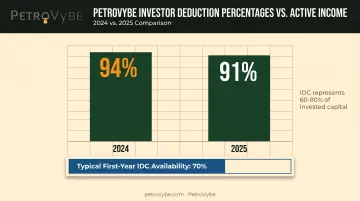
- PetroVybe partners realized a 94% deduction against active income in 2025. Prior result; not a promise of any future deduction.
- Roughly 70% is typically available in the first year against active income, with IDC representing a first-year deduction target of approximately 70–80% of invested capital in a new-drilling project
- These deductions are reported through the investor's K-1, taken in year one or spread over five years The underlying logic is the same as QPP: accelerating tax recognition changes how a capital-intensive project pencils out for the people funding it. PetroVybe does not treat the tax deduction as the reason to invest, though. It's one component of a broader picture that includes decline-curve strategy, projected distributions, and whether returns actually come from operating cash flow. PetroVybe's "Protect and Scale" approach targets a 10-year MOIC of roughly 2.2x to 5.8x and an estimated 26% IRR, built on reinvested operating cash flow rather than a bet on an eventual sale. That matches the principle behind QPP: reward productive, long-lived infrastructure, not short-term speculation—whether the asset is a refinery under Section 168(n) or a natural gas well under IDC rules. This treatment requires the investor to elect general partner status in the Subscription Agreement and may be limited in a given year by the excess business loss limitation under IRC §461(l).
Frequently Asked Questions
What is 100% bonus depreciation and how does it work?
Taxpayers can deduct the full cost of eligible property in the year it's placed in service, instead of spreading depreciation over many years. Section 168(k) covers equipment and personal property; Section 168(n) covers qualifying production real property.
What assets don't qualify for bonus depreciation?
Office and administrative space, R&D facilities, lodging, parking areas, and finished-goods storage are all explicitly excluded from QPP treatment, even when located inside a production facility.
What are the rules for 100% bonus depreciation on rental property in 2026?
Leased property generally doesn't qualify for QPP unless the taxpayer performing the production activity is the lessee under one of the specific related-party or consolidated-group exceptions.
How long do I need to keep using the property for its qualified purpose to avoid recapture?
Ten years from the placed-in-service date. If the property's use changes within that window, prior depreciation is recaptured as ordinary income under Section 1245.
Can existing or used property qualify as QPP?
Yes, but only if acquired within the eligible construction window and not used in a qualifying production activity between January 1, 2021, and May 12, 2025.
Does bonus depreciation for QPP trigger AMT adjustments?
No. QPP depreciation is computed without a Section 56 adjustment, so it does not create the AMT add-back that some other accelerated methods do.
Informational requests only. PetroVybe projects are offered solely to verified accredited investors. Submitting this form does not create an investment or advisory relationship.