This article is general education, not investment, tax, or legal advice. Texas is in the middle of the largest data center construction wave in its history, and the state's power grid can't keep pace. AI compute demand is pulling in gigawatts of new load faster than transmission lines can be built, and developers know it.
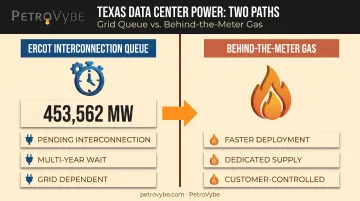
Rather than wait in line, many are skipping ERCOT's interconnection queue entirely. Instead, they're building private, on-site gas power plants that answer to no one but the customer they're built to serve.
This shift matters far beyond the data center industry. It's rewriting the demand curve for Texas natural gas, and it's creating a fresh investment thesis for anyone paying attention to where the gas is going to come from.
Key Takeaways
- Texas leads the nation in gas-fired capacity built specifically for AI data centers
- ERCOT's interconnection backlog is pushing hyperscalers toward private "behind-the-meter" gas generation
- U.S. data center gas demand is set to climb through 2030, tightening supply
- Rural communities are pushing back over emissions, noise, and water use near new sites
Why Data Centers Are Building Their Own Gas Power Plants
The math is simple: waiting for ERCOT isn't an option anymore.
As of early 2026, ERCOT was tracking 453,562 MW of active generation interconnection requests. Large-load interconnection requests stood at about 410 GW, roughly 87% of them data centers, according to ERCOT's own grid analysis reports. That's a queue measured in years, not months, for many projects.
Renewables Can't Solve the Reliability Problem
Wind and solar are cheap and plentiful in Texas, but they don't run at 2 a.m. when a server farm still needs full power. Battery storage helps, but not at the scale or duration data centers require for genuine 24/7 operation.
- Wind and solar output varies by hour, season, and weather
- Grid-scale batteries typically cover hours, not days, of continuous load
- Data centers need firm, dispatchable power around the clock
Nuclear Isn't Ready. Gas Is.
Small modular nuclear reactors get a lot of attention, but commercial deployment is still roughly a decade away. Gas turbines, by contrast, can be ordered, permitted, and running in a fraction of that time.
Hyperscaler attitudes have shifted accordingly. BlackRock CEO Larry Fink has publicly acknowledged that data centers can't run on renewables alone, a notable reversal from an industry that spent years chasing green energy commitments. Speed-to-power now outweighs sustainability pledges.
Gas already anchors Texas's grid, averaging 44% of ERCOT's electricity generation according to the EIA, far ahead of any single competing source. That installed base makes gas the practical default for new behind-the-meter capacity.
Major Texas Data Center Gas Plant Projects
A handful of Texas projects already show how large this gas-for-data-centers buildout is getting.
- GW Ranch, Pecos County (linked to Amazon): Permitted for large-scale gas-fired generation, with maximum annual emissions authorized at over 33 million tons of CO2e, according to TCEQ permitting records. That emissions ceiling alone has drawn national attention.
- CloudBurst/Energy Transfer, Central Texas: A firm gas-supply deal covers up to 450,000 MMBtu per day. The fuel is intended to support up to about 1.2 GW of behind-the-meter power near San Marcos, with operations targeted for Q3 2026.
- Chevron/Microsoft, Reeves County: A 20-year power agreement built around Project Kilby, expected to scale to roughly 2.67 GW using primarily GE Vernova turbines, with first power anticipated in 2028.
- Crusoe/Stargate, Abilene: A campus planned for 1.2 GW total capacity, with its first 200+ MW phase energized in early 2025.
- Fermi America, Amarillo: Preliminary state approval for the first 6 GW of a planned 11 GW "Project Matador" campus, one of the largest private gas-power buildouts announced in the country.
These are announcements and signed agreements at different stages, not all operating capacity today. Together, they point to a buildout measured in the tens of gigawatts across just a handful of Texas counties.
Simple-Cycle Turbines: A Faster but Dirtier Solution
Speed comes at a cost. Developers racing to power up quickly are increasingly choosing simple-cycle gas turbines over combined-cycle units.
The difference matters:
- Combined-cycle plants capture waste heat with a steam turbine, squeezing more electricity from the same fuel
- Simple-cycle plants skip that step entirely, sacrificing efficiency for faster installation
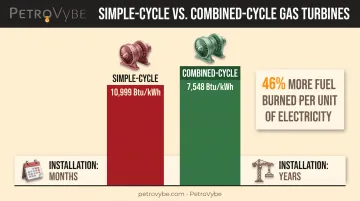
- Simple-cycle units can often come online in months, while combined-cycle equipment slots are backlogged for years
The efficiency gap is significant. EIA reports 2024 heat rates of 10,999 Btu/kWh for simple-cycle turbines versus 7,548 Btu/kWh for combined-cycle units, according to the EIA's electric power annual data. That's roughly 46% more fuel burned per unit of electricity, and proportionally higher emissions.
This trade-off isn't unique to Texas. Similar simple-cycle buildouts are showing up across Ohio and Tennessee, largely because combined-cycle turbine slots are backlogged for years. When speed is the priority, simple-cycle wins, even with the higher emissions.
Community and Environmental Pushback
Rural landowners near proposed sites are not all on board. Many have raised concerns about:
- Loss of dark skies from constant plant lighting
- Round-the-clock turbine noise
- Declining quality of life in areas that were previously quiet ranchland
Permit data shows why the stakes feel high locally. GW Ranch's permit alone authorizes maximum annual emissions of:
- 2,830 tons of nitrogen oxides
- 999 tons of particulate matter
- Over 33 million tons of CO2e
Those ceilings come from TCEQ's own permitting documents. They are permitted maximums, not guaranteed annual output, but they still set the legal limit.
That mix of local impact and emissions scale has drawn a state-level response. In June 2026, Governor Abbott directed the PUC and ERCOT to ensure data centers "operate in ways that reduce costs for residential electricity customers, do not drain water needed for our communities, and take into consideration the needs of our neighborhoods."
The same directive also pushes large loads to shoulder more of their own infrastructure costs.
Policy Shifts Favoring Gas Over Renewables
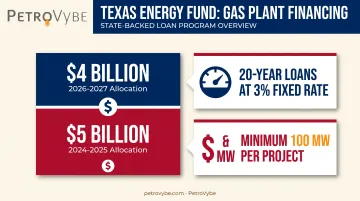
Texas lawmakers have put real money behind dispatchable generation. The Texas Energy Fund backs new gas plants with:
- $5 billion appropriated for fiscal years 2024–2025
- $4 billion more for 2026–2027
- 20-year loans at a fixed 3% rate
- Minimum 100 MW of new capacity per project
Legislative attempts to slow renewable deployment mostly failed to pass in 2025. The underlying tension remains, and it carries real cost implications for ordinary ratepayers.
Aurora Energy Research modeled the consumer impact of restricting renewables growth. The result: a 14% increase in wholesale power prices by 2035, or roughly a 10% increase in residential power bills, according to Aurora's published research. That policy tilt toward gas, intentional or not, strengthens the long-term demand outlook for producers.
What This Means for Natural Gas Investors
Data center demand is changing the supply-and-demand picture for gas in a way the industry hasn't seen in years.
East Daley Analytics projects up to 6 Bcf/d of additional U.S. data-center gas demand by 2030, based on 290 tracked projects representing roughly 81 GW of new power capacity. S&P Global expects 55 to 65 GW of new grid-based gas capacity nationally between 2025 and 2030, roughly double its pre-AI-boom projections. This is demand growth stacked on top of already-strong Gulf Coast LNG export expansion.
That's where PetroVybe's positioning comes in. The company develops natural gas assets across East Texas and the Gulf Coast Basin, including a 58,000-acre Lavaca County position with roughly 400 acquired legacy wells and 57-plus planned new wells.
There is no direct supply contract with a named data center. The thesis is broader: gas demand is rising, and early-stage development assets are positioned to benefit as that demand plays out.
For accredited investors, PetroVybe ONE offers:
- Participation begins at one unit of $100,000, with add-on subscriptions from $25,000.
- Up to a 94% tax deduction against active income (2025 partner cycle), through IDC and depletion allowances. Prior result; not a promise of any future deduction.
- Forecasted 10-year MOIC of approximately 2.2x–5.8x with a targeted IRR near 26%
- Passive quarterly distributions projected to peak above $10,000/month during production
- Zero operational involvement required from the investor. This treatment requires the investor to elect general partner status in the Subscription Agreement and may be limited in a given year by the excess business loss limitation under IRC §461(l).
First distributions typically take 2–3 years, since drilling, permitting, and production ramp-up don't happen overnight. This is a long-hold strategy built around compounding gas production, not a quick flip.
Frequently Asked Questions
Is it true that Texas has its own power grid?
Yes. Texas runs its own grid under ERCOT, separate from the Eastern and Western Interconnections. That isolation is why on-site generation is a common workaround for long interconnection waits.
What companies make gas turbines for data centers?
GE Vernova, Siemens Energy, and Mitsubishi Power dominate the market. GE Vernova's backlog alone climbed to 116 GW in 2026, and developers now face wait times of one to seven years depending on the turbine model.
Where is the new gas power plant located in Texas?
Major projects span Pecos County, Armstrong County, New Braunfels, and Abilene. New sites keep getting announced as more data center campuses break ground.
Why are data centers choosing gas over renewables?
Gas runs 24/7 regardless of weather, while wind and solar depend on conditions no operator controls. For a data center that can't afford downtime, dispatchable power is the safer choice.
Will these gas plants raise electricity prices for regular Texans?
Possibly. Aurora Energy Research found that restricting renewable growth alongside rising gas demand could push wholesale power prices up 14% by 2035, adding roughly 10% to typical power bills.
How can investors benefit from the data center gas demand boom?
Accredited investors can get direct exposure to early-stage natural gas development through vehicles like PetroVybe ONE, which pairs tax-advantaged deductions with passive income tied to rising Texas gas demand.
Informational requests only. PetroVybe projects are offered solely to verified accredited investors. Submitting this form does not create an investment or advisory relationship.