
This article is general education, not investment, tax, or legal advice. For over a decade, Rule 506(c) sat mostly unused. Issuers had the legal right to publicly advertise private placements starting in 2013, but most avoided it entirely. March 2025 SEC guidance changed that calculus.
A new no-action letter created a practical path for issuers to verify accredited investors without demanding tax returns or bank statements. Most accredited investors still don't know that some private placements can be advertised publicly while others legally cannot.
This post breaks down general solicitation rules, the real differences between Rule 506(b) and 506(c), how verification actually works, and what the 2025 guidance means for issuers and investors alike.
Key Takeaways
- General solicitation is public advertising of a securities offering, allowed only under exemptions such as Rule 506(c)
- SEC March 2025 guidance added a "Minimum Investment Method" issuers can use to verify accredited investors
- Under Rule 506(c), issuers must take reasonable steps to verify accreditation—self-certification alone is not enough
- Rule 506(b) caps non-accredited investors at 35 sophisticated buyers (unlimited accredited); the limit is not 50 or 200
What Is General Solicitation in Private Placements?
General solicitation means publicly advertising a capital raise to a broad, unrestricted audience. The SEC defines it as any communication that conditions the market or arouses public interest in a security.
Common examples of general solicitation:
- Mass emails to unknown recipients
- Public social media posts about the offering
- Unrestricted public websites advertising the raise
- Print, TV, or radio advertisements
- Public seminars (outside limited demo-day exceptions)
What doesn't count as general solicitation: Communications limited to investors with whom the issuer already has a pre-existing, substantive relationship formed before the offering began. That relationship must give the issuer enough information to evaluate the investor's financial sophistication—not just a LinkedIn connection.
Because that bar is high, most private placements historically avoided general solicitation entirely. Issuers defaulted to Rule 506(b), which restricts marketing but still allows accredited investors plus up to 35 sophisticated non-accredited investors. Under 506(b), issuers can rely on self-certification instead of formal verification documentation.
Rule 506(b) vs. Rule 506(c): The Two Paths for Private Placements
These two rules solve different problems, and issuers must pick one before they start marketing.
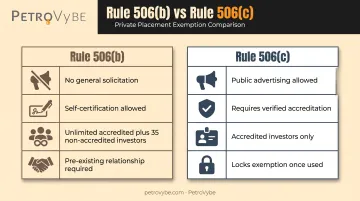
Rule 506(b): The Quiet Path
- Prohibits general solicitation entirely
- Permits accredited investors plus up to 35 sophisticated non-accredited investors
- Relies on self-certification — investors simply attest to their status
- Requires a pre-existing relationship before any offer is made
Rule 506(c): The Public Path
Adopted in 2013 under the JOBS Act, Rule 506(c) permits broad public advertising. In exchange, sales are restricted exclusively to verified accredited investors.
- Requires "reasonable steps to verify" accreditation — self-certification is not enough
- Shifts the burden to the issuer via documentation or third-party confirmation
- Locks the offering into 506(c) once public advertising begins — you cannot claim both exemptions for the same raise
The Usage Gap Is Massive
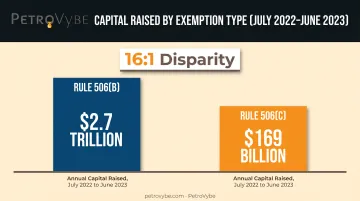
Despite being legal since 2013, Rule 506(c) has been dramatically underused. SEC Commissioner Hester Peirce cited figures showing Rule 506(b) offerings raised roughly $2.7 trillion annually versus about $169 billion for 506(c) during the period from July 2022 to June 2023.
That's a 16-to-1 disparity. Issuers avoided the public path because verification felt invasive and burdensome.
Is the Private Placement Investor Limit 50 or 200?
Neither number is correct. Rule 506(b) allows unlimited accredited investors plus up to 35 non-accredited sophisticated investors.
The confusion stems from two unrelated thresholds:
- 35 non-accredited investors — the actual 506(b) cap, often misremembered as "50"
- 2,000 holders of record (or 500 non-accredited) under Exchange Act Section 12(g) — this triggers public reporting obligations, not an investment cap
These thresholds solve different regulatory problems. Mixing them up is the most common private placement misconception.
Verifying Accredited Investor Status Under Rule 506(c)
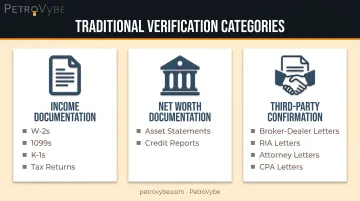
Traditional verification methods, outlined in 17 CFR 230.506, fall into three categories:
- Income documentation — W-2s, 1099s, K-1s, or tax returns from the two most recent years
- Net worth documentation — asset statements paired with a credit report dated within three months
- Third-party confirmation letters — from a broker-dealer, registered investment adviser, attorney, or CPA
Issuers found these methods burdensome to administer. Investors found them invasive: few people want to hand tax returns to a company they just met at a conference. That friction kept Rule 506(c) on the shelf for over a decade.
The Minimum Investment Method
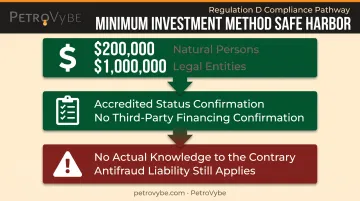
The March 2025 no-action letter (responding to Latham & Watkins) eased that burden with a new safe harbor. Under this approach, an issuer can treat the size of the check itself as verification:
- $200,000 minimum for natural persons
- $1,000,000 minimum for legal entities
This must be paired with two written representations from the investor:
- Confirmation of accredited status
- Confirmation that the investment is not financed by a third party
Two limits still apply:
- Issuers must have no actual knowledge that contradicts those representations
- Public statements can still trigger antifraud liability
Used correctly, the path is simply a lighter-touch verification option for larger checks.
2025 SEC Guidance: A New Safe Harbor for General Solicitation
Congress removed the general solicitation ban in the 2012 JOBS Act, and the SEC created Rule 506(c) in 2013. Adoption stayed low for more than a decade. The five traditional verification methods often cost more effort than many offerings could justify.
In March 2025, two Compliance & Disclosure Interpretations reset that framework:
- CDI 256.35: Skipping the five traditional methods is not fatal. Issuers may rely on a principles-based verification standard.
- CDI 256.36: A high enough minimum investment can support fewer steps—sometimes only confirming the funds are not third-party financed.
What This Means in Practice
Under that guidance, issuers can discuss a specific raise more openly across channels such as:
- Podcasts and webinars tied to the offering
- Digital outreach campaigns
- Public websites that describe investment terms
- Media appearances that reference the raise directly
The change lands hardest for real-asset and natural resource issuers that already set high minimums. For oil and gas development offerings aimed at accredited investors writing $100,000+ checks, CDI 256.36 can justify a lighter verification file while still supporting broad 506(c) marketing.
Risks, Compliance, and What Investors Should Know
Public advertising isn't automatically a red flag. But it does raise the compliance bar, and investors should confirm the issuer is actually meeting it.
Before investing in a publicly marketed private placement, check:
- Does the issuer hold proper operating licenses for its stated activity?
- Is there third-party engineering or financial validation of asset claims?
- Does the subscription process require genuine accreditation verification, not just a checkbox?
- Are financials independently audited?
PetroVybe, a Texas-based natural gas development company, shows how transparency measures can pair with 506(c) obligations. Its PetroVybe ONE project cites a $48 million PV-09 reserve valuation from a licensed third-party engineering firm and a clean 2025 audit from independent auditor Weaver. Prepared by Lee Keeling & Associates, Tulsa, March 2026. The operator also holds a Texas Railroad Commission operators license.
Its subscription process requires investors to represent accredited status and produce third-party verification from a CPA, tax attorney, or licensed financial adviser before receiving offering documents. Public-facing outreach, including podcast appearances and a CNBC Morning Call interview, fits the general solicitation activity Rule 506(c) permits when those verification steps are in place.
For accredited investors evaluating energy development opportunities, public visibility should come with documented verification and third-party validation. That pairing is the compliance standard to look for.
Frequently Asked Questions
What are the rules for private placements?
Private placements rely on exemptions like Rule 506(b) or 506(c) under Regulation D. Most investors must be accredited (506(b) also allows up to 35 sophisticated non-accredited investors), and issuers must file a Form D with the SEC.
Is the private placement investor limit 50 or 200?
Neither figure is accurate. Rule 506(b) allows unlimited accredited investors plus up to 35 sophisticated non-accredited investors.
Is a private placement good or bad for a stock?
It depends. Private placements can dilute existing shareholders, but they often signal fresh capital for growth. Impact hinges on pricing terms and how proceeds are used.
What is the difference between Rule 144A and a private placement?
Rule 144A governs resales of restricted securities to qualified institutional buyers. Rule 506 governs the initial private placement exemption for issuers raising capital.
What is the SEC's 2025 guidance on general solicitation?
The March 2025 no-action letter created the Minimum Investment Method. A $200,000 (individual) or $1 million (entity) commitment can support simpler accredited-investor verification under Rule 506(c).
Can non-accredited investors participate in a private placement that uses general solicitation?
No. Rule 506(c) offerings using general solicitation must be limited exclusively to verified accredited investors, unlike Rule 506(b), which permits some non-accredited participation.
Informational requests only. PetroVybe projects are offered solely to verified accredited investors. Submitting this form does not create an investment or advisory relationship.