

This article is general education, not investment, tax, or legal advice. Once you've built substantial wealth, the game changes. Wealth creation gives way to wealth protection, tax efficiency, and legacy building. The rules that got you here won't necessarily keep you here.
High-income earners face a 37% top federal tax rate in 2025, and that's before state taxes take their cut. Meanwhile, inflation quietly erodes cash sitting in low-yield accounts. Add over-concentration in stocks, bonds, and real estate, and you've got a recipe for stalled growth.
This article covers five strategies designed for accredited investors and high-income earners: diversification, tax efficiency, estate planning, risk management, and income splitting.
Key Takeaways
- Traditional 60/40 portfolios often underperform at higher asset levels versus portfolios that include alternatives
- Direct energy development can deliver large first-year tax deductions against active W-2 income and capital gains
- Proactive estate planning is required to fully use the 2025 exemption of $13.99 million per individual
- Liquidity planning and insurance protect your portfolio from forced sales during downturns
- Income splitting and heir education strengthen multi-generational wealth transfer
Strategy 1: Diversify Beyond Traditional Stocks, Bonds, and Real Estate
A standard 60/40 portfolio worked well for decades. At higher net worth levels, it often falls short.
Concentration risk grows as your assets grow. If most of your wealth sits in public markets and real estate, you're exposed to the same macro shocks, interest rate moves, and correlated downturns that hit everyone else's portfolio.
What Alternatives Actually Offer
In 2024, alternative asset classes showed mixed but instructive results:
- U.S. private equity returned 8.1%, with growth equity at 8.8% and buyouts at 7.9%
- U.S. venture capital returned 6.2%, though vintage-year dispersion ranged from 0.7% to 25.3%
- Hedge funds returned roughly 10% through Q3 2024, trailing global equities' 19% but beating global bonds' 4%
Cambridge Associates' 2024 benchmark data confirms these aren't apples-to-apples comparisons with a 60/40 benchmark. They're evidence that alternatives behave differently than public markets, which is the point of adding them.
Where Energy Development Fits
Direct energy development is one alternative that delivers that uncorrelated behavior. Natural resource investments sit largely outside public markets. They don't move with the S&P 500. They don't move with bond yields. Their returns come from a different source entirely: physical production and commodity pricing.
At PetroVybe, this plays out through PetroVybe ONE, a natural gas development project spanning 58,000 acres in Lavaca County, Texas, with roughly 400 producing wells and 57+ planned new wells. It's a tangible, uncorrelated addition to a portfolio built mostly on paper assets.

Watch for False Diversification
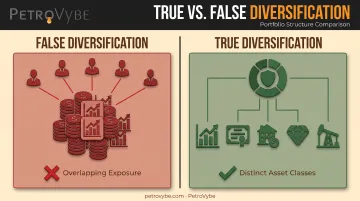
Adding alternatives only works if you can see the full picture. A common trap is spreading money across multiple advisors and assuming that creates diversification. Often it doesn't.
- Different advisors may hold overlapping index funds or sector exposure
- Scattered accounts make it harder to see your true asset allocation
- True diversification requires a consolidated view of all holdings, not just more accounts
Strategy 2: Prioritize Tax-Efficient Investment Structures
High-income earners face a specific problem: salaries, bonuses, and other ordinary income hit the top marginal rate, and capital gains leave few shelter options beyond deferral.
For 2025, the 37% bracket kicks in above $626,350 for single filers and $751,600 for married couples filing jointly. That's a steep hill to climb without a strategy.
Common Tax Tools
Most high-net-worth plans already use some mix of:
- Tax-deferred retirement accounts
- Municipal bonds for tax-free income
- Donor-advised funds for charitable giving with immediate deductions
- Qualified Opportunity Zones for capital gains deferral
Where IDC Deductions Change the Math
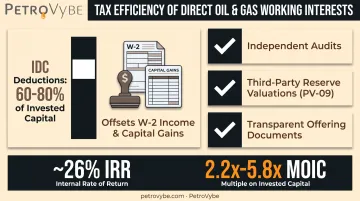
Direct oil and gas working interests offer something most of these tools don't: Intangible Drilling Cost (IDC) deductions that can offset active income, including W-2 wages and capital gains. This treatment requires the investor to elect general partner status in the Subscription Agreement and may be limited in a given year by the excess business loss limitation under IRC §461(l).
Under IRC 469, a working interest with unlimited liability isn't classified as a passive activity, regardless of material participation. That distinction matters. It means qualifying losses aren't boxed into the passive-loss basket.
PetroVybe partners reported 94% first-year deductions in 2025 against active income IDCs typically represent a first-year deduction target of approximately 70–80% of invested capital in new-drilling projects, deductible either in the first year or spread over five years. Prior result; not a promise of any future deduction. Depletion allowances add a separate layer on top. This treatment requires the investor to elect general partner status in the Subscription Agreement and may be limited in a given year by the excess business loss limitation under IRC §461(l).
These figures reflect actual reported outcomes, not guarantees. Deduction eligibility depends on basis, at-risk rules, and other taxpayer-specific factors. Always confirm treatment with a tax professional.
Why Third-Party Validation Matters
Alternative tax-advantaged investments live and die on credibility. Before committing capital, look for:
- Independent audits (PetroVybe's 2025 audit was completed by Weaver)
- Third-party reserve valuations, such as PV-09 reports, prepared by Lee Keeling & Associates, Tulsa, March 2026, which quantify proved reserves
- Transparent offering documents, including a Private Placement Memorandum and Limited Partnership Agreement
PetroVybe's projects carry a $48 million PV-09 valuation from a licensed third-party engineering firm, paired with a targeted ~26% IRR and 2.2x–5.8x MOIC over a 10-year hold. Tax savings plus an asset-backed return target build wealth; deferral alone only moves the bill.
Strategy 3: Build a Comprehensive Estate and Legacy Plan
The federal estate tax can claim up to 40% of assets above the exemption threshold. Without planning, that's a massive transfer of wealth from your heirs to the government.
Use the 2025 Exemption Window
For 2025, each individual has a $13.99 million lifetime exemption, plus a $19,000 annual gift exclusion per recipient. Married couples can double both figures through proper planning.
Annual exclusion gifting alone lets you move meaningful wealth out of your taxable estate every single year, tax-free, without touching your lifetime exemption.
Direct payments of tuition or medical expenses on behalf of family members also sit outside both the lifetime exemption and the annual exclusion—an exemption-free transfer many families underuse.
Trust Structures Worth Knowing
Two structures come up repeatedly in high-net-worth estate plans:
- ILITs (Irrevocable Life Insurance Trusts). Keep life insurance death benefits outside your taxable estate when the transfer happens more than three years before death.
- SLATs (Spousal Lifetime Access Trusts). Remove assets from your estate while still allowing indirect spousal access.

Keep Documents Current
Estate plans go stale fast. Update wills and beneficiary designations after:
- Marriage, divorce, or death in the family
- Major tax law changes
- Significant asset acquisitions, business sales, or new partnership interests
Revisit titles and beneficiaries whenever holdings change so the legal plan still matches the estate you actually own.
Strategy 4: Manage Risk with Insurance and Liquidity Planning
Even a well-built portfolio can be undone by a liquidity crunch. If your estate tax bill lands and your wealth is tied up in illiquid assets, you can be forced to sell at the wrong time.
Life Insurance as an Estate Tool
Life insurance held properly (typically inside an irrevocable life insurance trust (ILIT)) provides cash to cover estate tax liabilities without forcing heirs to liquidate a business, real estate, or investment portfolio. It also protects family income if a primary earner passes unexpectedly.
How Much Cash Should You Hold?
The CFP Board recommends 3-6 months of fixed expenses as a general liquidity guideline. High-net-worth households often need more, simply because their fixed obligations (property taxes, staff, multiple mortgages) run higher in dollar terms.
The balancing act:
- Too little cash means forced asset sales during market downturns
- Too much cash means inflation erodes purchasing power
Match your reserve to actual near-term needs, not a generic formula. Review it annually.
Strategy 5: Split Income and Prepare the Next Generation
Income splitting shifts earnings to family members in lower tax brackets, legally reducing the household's overall tax bill.
Doing It the Right Way
The IRS requires that family compensation be reasonable and for services actually performed. You can't simply write a check and call it a salary.
- Children under 18 can earn wages exempt from Social Security and Medicare taxes when the business is a sole proprietorship or a parents-only partnership
- Pay must match market rates for the actual work performed
- Documentation matters: track hours, duties, and payment records
Preparing Heirs for What's Coming
Generational wealth often disappears within two generations, not because the money vanishes overnight, but because heirs aren't prepared to manage it.
- Start financial education early: budgeting, saving, basic investing
- Involve heirs in family financial discussions before they inherit, not after
- Work with a wealth manager or family office fluent in HNW structures—trusts, estate vehicles, and tax-advantaged alternatives such as direct oil and gas partnership units
The goal isn't just transferring assets. It's transferring the judgment to manage them.
Frequently Asked Questions
What are the 7 secrets of high-net-worth investors?
High-net-worth investors often share seven habits: diversification beyond public markets, tax efficiency, disciplined long-term investing, professional advisory teams, proactive estate planning, philanthropy, and ongoing financial education.
What creates 90% of millionaires?
Real estate, long-term equity ownership, and business building are the main wealth engines tied to U.S. millionaire households in Federal Reserve Survey of Consumer Finances data—not a single product or short-term trade.
How much liquid net worth qualifies someone as high-net-worth?
The commonly used benchmark is $1 million or more in investable assets, excluding your primary residence. Ultra-high-net-worth typically starts around $30 million, per Capgemini's wealth report.
Are alternative investments like oil and gas development suitable for high-net-worth investors?
They can fit accredited investors with $100,000+ in liquidity who want tax efficiency and diversification beyond public markets. Confirm accreditation, liquidity, and risk tolerance with an advisor before investing. Participation begins at one unit of $100,000, with add-on subscriptions from $25,000.
How often should a high-net-worth financial plan be reviewed?
Review at least annually. Add check-ins after major tax-law changes, a business sale, an inheritance, or another event that materially changes your balance sheet or cash flow.
Informational requests only. PetroVybe projects are offered solely to verified accredited investors. Submitting this form does not create an investment or advisory relationship.