

Many royalty owners assume the IRS taxes a sale the same way it taxes their monthly royalty checks (as ordinary income at their marginal rate). That assumption alone can cost tens of thousands of dollars in overpaid tax, or create a mismatch when the IRS expects to see the transaction on Schedule D instead.
This guide breaks down how the IRS actually taxes the sale of a mineral or royalty interest: the capital gains rules, how to calculate cost basis (including the step-up for inherited interests), which forms to file, and legitimate strategies that can reduce what you owe.
Key Takeaways
- Selling your full mineral or royalty interest is taxed as a capital gain, not ordinary income
- Cost basis and holding period drive your tax bill; inherited interests often get a stepped-up basis
- A carved-out slice of future production is taxed as ordinary income, not capital gain
- 1031 exchanges, installment sales, and IDC-eligible reinvestment can defer or offset tax owed on the sale
Royalty Interest vs. Mineral Interest: Why the Distinction Matters for Taxes
A mineral interest and a royalty interest sound similar, but the IRS treats them differently depending on what rights you actually hold and sell.
Mineral interest: Ownership of the minerals themselves, in place underground. It carries the right to explore, lease, develop, and produce, plus the right to negotiate lease bonuses and delay rentals.
Royalty interest: A right to a percentage of production revenue, without any obligation to fund drilling, equipment, or operating costs. Royalty owners collect a check when there's production and owe nothing when there's a dry hole.
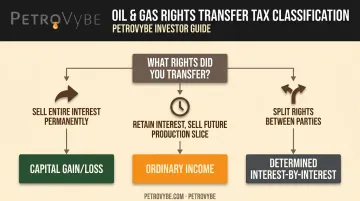
Both qualify as real property interests for federal tax purposes. That classification matters because it opens the door to capital gains treatment and, in certain cases, 1031 exchange eligibility. What actually determines your tax outcome is how much of the "bundle of rights" changes hands:
- Sell every right permanently (the full mineral or royalty interest): generally capital gain or loss
- Retain the underlying interest but sell only a slice of future production: typically ordinary income
- Split rights between multiple parties: treatment gets determined interest by interest
One distinction owners often miss: tax on the sale of your interest is separate from tax on the production itself. If wells are actively producing before or after you sell, county ad valorem taxes and state severance taxes apply to that production income. This holds true independent of whatever capital gains or ordinary income tax applies to the transaction.
How the Sale Is Taxed: Capital Gains Rules Explained
When you sell your complete mineral or royalty interest, the IRS generally treats it as a disposition of Section 1231 property (real property used in a trade or business and held more than a year), or as a straight capital asset if held purely for investment.
Either way, proceeds typically flow through as capital gain or loss. You'll report this on Form 8949 and Schedule D, or on Form 4797 when Section 1231 applies.
Long-Term vs. Short-Term: Why the One-Year Mark Matters
Hold the interest one year or less before selling, and any gain is short-term, taxed at your ordinary income rate. Hold it more than one year, and you qualify for long-term capital gains rates, currently 0%, 15%, or 20% depending on taxable income.
Under IRS-projected 2026 capital gains thresholds, a single filer stays in the 15% bracket up to $545,500 of taxable income before the 20% rate applies.
Inherited interests get a built-in advantage here. Regardless of how long you personally held the property, the IRS automatically treats inherited assets as long-term.
Royalty Sale vs. Working Interest Sale
- Royalty interest sale: Straight capital gain or loss treatment. There's no depreciation to recapture, because royalty owners don't take depreciation deductions.
- Working interest sale: Can also generate capital gain, but a portion may be recaptured as ordinary income under Sections 1245 or 1254 if you previously claimed IDC, depletion, or depreciation deductions.
When the IRS Calls It Ordinary Income Instead
Here's where owners get tripped up. If you retain your royalty "for the life of the property" but sell only the right to collect a limited number of future production payments (a structure known as a carved-out production payment), the IRS does not treat that as a capital gain.
The Supreme Court settled this in Commissioner v. P.G. Lake, ruling that a lump sum paid for short-lived oil payment rights functioned as a substitute for future ordinary royalty income, not a sale of an appreciating asset.
| Scenario | Structure | Tax Treatment |
|---|---|---|
| Sell entire mineral interest outright | Complete transfer of ownership | Capital gain/loss (Schedule D) |
| Retain royalty, sell 5 years of future production | Carved-out production payment | Ordinary income, subject to depletion |
Same underlying asset, two very different outcomes depending on what you actually transferred.
Calculating Your Cost Basis and Taxable Gain
Your taxable gain is sale price minus adjusted cost basis. Get the basis wrong, and you'll either overpay or invite scrutiny.
The Default Is a Zero Basis, With Three Exceptions
If you can't document what you paid for the mineral rights, the IRS defaults to treating your basis as effectively zero, meaning the entire sale price becomes taxable gain. That default rarely favors sellers, but three situations change it:
- Your original purchase contract specifically allocated a dollar value to the minerals
- The minerals and surface were valued separately for property tax or closing purposes
- You have other documented evidence of value at the time you acquired the interest
Without one of these, expect the IRS to disallow any basis you claim, taxing the full sale price as gain.
Inherited Interests Get a Stepped-Up Basis
If you inherited your mineral or royalty interest, your basis generally resets to fair market value as of the date of death (or the alternate valuation date, if the executor elected it). This step-up often shrinks taxable gain well below what a purchased interest would show.
Many heirs never document this value and later scramble to reconstruct it. Pull the estate's Form 706 or probate records if they exist, or commission a retrospective appraisal from a licensed mineral appraiser who can value the interest as of the date of death.
One more factor adjusts this number regardless of how you acquired the interest: any depletion previously claimed against the property reduces the adjusted basis, which increases the taxable gain recognized upon sale.
Two Worked Examples
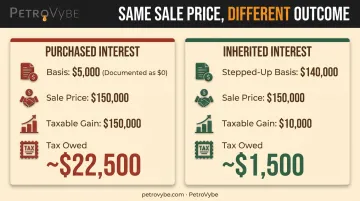
Purchased interest, low basis:
- Purchased mineral rights for $5,000 twenty years ago (no documented allocation)
- Sold this year for $150,000
- Basis: $0. Taxable gain: $150,000
- Tax at the 15% long-term rate: roughly $22,500
Inherited interest, stepped-up basis:
- Inherited mineral rights three years ago; appraised at $140,000 at date of death
- Sold this year for $150,000
- Basis: $140,000. Taxable gain: $10,000
- Tax at the 15% long-term rate: roughly $1,500
Same sale price, wildly different tax bills, because one seller can document basis and the other can't.
Reporting Requirements: Forms, Schedules & Deadlines
Selling a mineral or royalty interest triggers specific paperwork, separate from what you'd file for ongoing royalty checks.
- Form 8949: Reports transaction-level detail, including description of the property, dates acquired and sold, sale price, and basis
- Schedule D: Summarizes capital gains and losses, including totals from Form 8949
- Form 4797: Used instead if the interest qualifies as Section 1231 business property, particularly when depletion or intangible drilling cost (IDC) recapture applies
These forms follow your standard tax return deadline: April 15 for the year of the sale, or October 15 if you file an extension. Substantial gains may also trigger quarterly estimated tax payments to avoid IRS underpayment penalties.
The buyer may or may not issue a Form 1099-S or 1099-B. Don't rely on receiving one. You remain responsible for accurately reporting the sale whether or not it's reported to the IRS by a third party.
This differs sharply from ongoing royalty income:
- Retained royalty interest: Reported on Schedule E, taxed as ordinary income, with a depletion allowance
- Retained working/operating interest: Reported on Schedule C if you bear operating risk directly
- Sold interest: Reported on Form 8949/Schedule D, or Form 4797
Mixing these up is a common error, especially in a year when you sold mid-year and also collected royalty checks earlier in that same year.
Tax-Saving Strategies When Selling a Mineral or Royalty Interest
Several legitimate strategies can reduce or defer tax owed on a mineral or royalty sale. None eliminate tax entirely, but each changes the timing or character of what you owe.
1031 Exchanges and Installment Sales
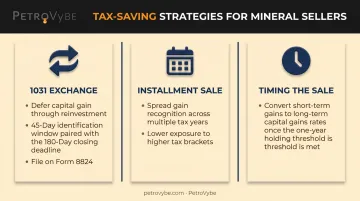
- Section 1031 like-kind exchange: Defer capital gains tax by reinvesting proceeds into another qualifying mineral, royalty, or real property interest. Meet the 45/180-day deadlines and file Form 8824 through a qualified intermediary.
- Installment sale: Spread the sale price and taxable gain across multiple years to stay in a lower capital gains bracket. Depreciation or depletion recapture is still taxed in the year of sale.
- Timing the sale: Waiting until you pass the one-year holding mark converts short-term rates into long-term capital gains rates. Harvested losses elsewhere can offset the gain further.
Reinvesting Into IDC-Eligible Development Programs
A less commonly discussed option: redirecting sale proceeds into a direct natural gas or oil development investment where Intangible Drilling Cost (IDC) deductions can offset a large share of active income, including the capital gain generated from your mineral sale.
This is the structure behind PetroVybe's development programs. Unlike a passive royalty interest, where deductions are generally trapped against passive income only, PetroVybe's IDC-eligible structure lets accredited investors apply first-year deductions against active income sources, including W-2 wages and capital gains.
In practical terms, a portion of the gain from selling your mineral rights could be offset by IDC deductions from a new development investment made in the same tax year.
This route isn't for every seller. It requires:
- Accredited investor status
- A minimum investment, typically $100,000
- A long time horizon, since development programs run on multi-year drilling and production cycles rather than immediate liquidity
Weigh it alongside, not instead of, the strategies above.
A note before you act: these are general planning concepts, not individualized tax advice. Every seller's basis, holding period, entity structure, and income situation differs. Talk to a CPA or tax attorney experienced with oil and gas transactions before finalizing your approach.
Frequently Asked Questions
What is the meaning of a "sale" for tax purposes when it comes to mineral or royalty interests?
A sale means permanently transferring ownership of the interest for payment. The IRS treats this differently than leasing the property or retaining the interest and collecting ongoing royalty income.
Is selling a royalty interest taxed differently than selling a mineral interest?
Both generally receive capital gains treatment when you sell the complete interest. The nuances come from what rights, if any, you retain versus what you actually transfer.
Do I owe capital gains tax if I inherited the mineral rights I'm selling?
Yes, but likely far less than a purchased interest. Inherited interests get a stepped-up basis to fair market value at the date of death, which typically shrinks the taxable gain by a wide margin.
What tax forms do I need to file after selling mineral rights or royalties?
Report the sale on Form 8949 and Schedule D (or Form 4797 for Section 1231 property). Ongoing royalty income from a retained interest goes on Schedule E instead.
Can I use a 1031 exchange when selling a royalty interest?
Yes, a qualifying royalty or mineral interest can be exchanged for like-kind real property to defer capital gains tax. You'll need to file Form 8824 and meet the 45-day identification and 180-day closing deadlines.
How can I reduce the taxes I owe on the sale of my mineral or royalty interest?
Consider a 1031 exchange, an installment sale, or reinvesting proceeds into an IDC-eligible development program, such as the partnership structures PetroVybe offers, to offset active income and capital gains. Work with a qualified tax professional to determine which strategy fits your specific situation.