Introduction
"Oil well shares" mean two very different things depending on who you ask. Most people picture a stock ticker, a few shares of ExxonMobil sitting in a brokerage account. Accredited investors know it can also mean owning a real, fractional stake in one specific producing well.
That gap costs investors real money. Most default to public oil stocks because it's the path they know. That choice means missing out on direct working interests, which can carry meaningful intangible drilling cost deductions against active income and stronger long-term multiples in well-run development programs.
This guide covers what oil well shares actually are and the four types of wells behind any direct investment. It also walks through how the buy-in process works, what real profitability looks like after taxes, and the risks worth weighing before committing capital.
Key Takeaways
- Oil well shares range from liquid public stocks to illiquid single-well interests.
- Working interests unlock IDC tax deductions; royalty interests remain passive and cost-free.
- Direct participation requires accredited investor status, generally $200K+ income or $1M+ net worth.
- Development wells carry lower geological risk than wildcats and anchor most private programs.
- Operator execution, not the tax pitch, is what actually determines whether returns materialize.
What Are Oil Well Shares?
Oil well shares cover any ownership claim on a well's production revenue and its costs. That spans two very different investments: a handful of shares in a major producer's stock, or a direct fractional interest in one specific well's output.
Direct participation isn't new. Exploration companies have sold ownership certificates since the early 1900s.
Arkansas Oil Ventures issued nearly 2 million shares in 1952 to fund a drilling program that ultimately came up dry. That failure is a reminder that the practice, and its risks, predates modern private placements by decades. What's changed is the structure: today's version runs through Regulation D private placements with accredited investor requirements, not walk-in stock counters.
Public Oil Company Shares vs. Direct Well Ownership
Buy stock in ExxonMobil or ConocoPhillips and you get daily liquidity on a major exchange. ExxonMobil produced 4.3 million oil-equivalent barrels per day in 2024, spread across a global portfolio, so your exposure to any single well gets diluted to almost nothing.
Direct well shares work differently:
- You own an interest tied to one project or a defined group of wells, not a diversified global portfolio
- Tax treatment differs materially, with deductions flowing to you personally rather than through corporate accounting
- Entry requires accredited investor status and a holding period measured in years, not seconds
Types of Direct Oil Well Ownership Interests
Three structures dominate direct participation:
- Working interest: bears a proportional share of drilling and operating costs in exchange for a revenue share and the strongest available deductions, primarily intangible drilling costs (IDCs)
- Royalty interest: a cost-free share of production revenue, generally passive, without the front-loaded deductions a working interest carries
- Direct participation programs (DPPs): pool accredited investor capital into a specific drilling project or portfolio of wells managed by one operator
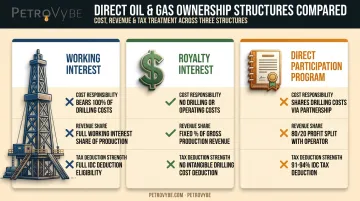
Most private oil and gas offerings today are structured as working interests or DPPs, since royalty interests rarely offer the tax leverage investors are usually chasing.
What Are the 4 Types of Oil Wells?
Not every well serves the same purpose, and the type behind your investment shapes both risk and payout timeline.
| Well Type | Purpose | Risk / Role |
|---|---|---|
| Exploratory (wildcat) | Drilled in unproven areas to discover new reserves | Highest risk, highest potential reward |
| Development | Drilled within a proven field near existing production | Lower geological risk |
| Injection | Injects water or gas to maintain reservoir pressure | Supports recovery, not direct revenue |
| Disposal | Manages produced saltwater and byproducts | Supports operations, no direct revenue |
- Exploratory wells chase reserves in areas without a production history. The upside can be large, but so can the odds of a dry hole.
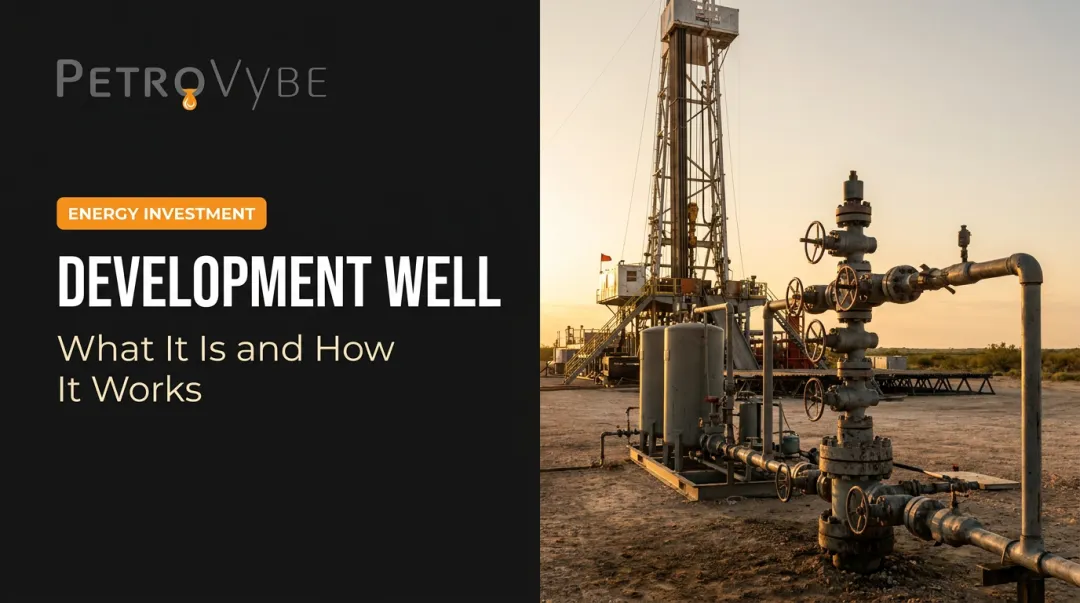
- Development wells sit near proven production, drawing on reserves with data already in hand. This lower geological risk is why most direct-investment programs concentrate here.
- Injection wells keep reservoir pressure up by pushing water or gas back into the formation, extending output from surrounding producers.
- Disposal wells handle the saltwater and byproducts that come up alongside oil and gas. They don't generate revenue directly, but a field can't run without them.
Development wells are the foundation of most accredited-investor programs for a simple reason: the geology is already proven, cutting out the biggest variable in wildcat drilling.
How to Buy Shares in an Oil Well
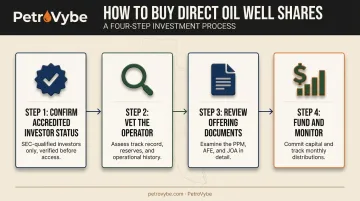
Buying into a direct oil well interest looks nothing like opening a brokerage account. Most working-interest and DPP offerings are Regulation D private placements, which means the process runs through a specific set of steps.
Confirm Accredited Investor Status
SEC rules require investors to meet specific income or net worth thresholds before subscribing to most private oil and gas offerings:
- Individual income over $200,000 (or $300,000 jointly with a spouse) in each of the last two years, with reasonable expectation of the same this year
- Net worth exceeding $1 million, excluding your primary residence
- Certain professional licenses, such as Series 7, 65, or 82, also qualify
Verification typically comes from a CPA, tax attorney, or licensed financial advisor, not a self-certification checkbox.
Vet the Operator
Track record matters more here than in almost any other alternative asset class. Look for:
- Decades of drilling and prospect-selection experience, not just a polished pitch deck
- Independent third-party reserve or engineering validation
- A documented history of cost discipline on prior projects
- Transparent, recurring reporting practices rather than a single annual update
PetroVybe, for instance, backs its projects with a $48 million PV-09 reserve valuation from a licensed third-party engineering firm, the kind of independent validation worth confirming with any operator.
Review the Offering Documents
Before wiring a dollar, work through the paperwork with a CPA and attorney:
- Private Placement Memorandum (PPM): outlines risk factors, fees, and terms
- Authorization for Expenditure (AFE): separates intangible drilling costs from tangible costs
- Joint Operating Agreement (JOA): governs how operating decisions and costs get shared
Fund and Monitor
Minimum investments for direct oil well participation programs commonly start around $100,000, well above the price of a few shares of public stock. PetroVybe's own partnership units, for example, use this same $100,000 threshold.
Once subscribed, investors should understand the cash-call process for ongoing development or workover costs. Some structures reserve the right to call additional capital if operating expenses run over budget.
Once the well comes online, expect recurring production or property statements and an annual K-1 for tax filing.
How Profitable Is Owning an Oil Well?
Profitability hinges on four variables: well type, decline curve, commodity prices, and operator execution. Change any one of those, and the return profile shifts.
Well-selected development programs commonly target a 10-year MOIC in the 2.2x-5.8x range with an IRR near 26%, though these figures are project-specific forecasts, not guarantees.
The Tax Mechanics That Change the Math
Direct working interests carry deductions public stock simply can't offer:
- Intangible drilling costs (IDCs): can be expensed against active income, including W-2 wages, often in the same year capital is deployed
- Tangible drilling costs: depreciated over 5-7 years
- Percentage depletion: a 15% allowance on gross production income for qualifying independent producers
PetroVybe partners received a 94% tax deduction against active income in 2024 and 91% in 2025, figures documented through the company's offering materials and K-1 filings. That kind of first-year deduction lowers the effective cost basis before a single barrel gets sold.
Tax benefits mean little if the underlying commodity has no demand behind it. According to the IEA's Global Energy Review 2025, global oil demand grew 0.8%, or 830,000 barrels per day, in 2024, while natural gas demand rose even faster. That steady growth doesn't guarantee any single well's returns, but it does support production economics in gas-heavy basins, including the Lavaca County, Texas acreage PetroVybe develops for natural gas liquids.
What Passive Really Means
Once a well is producing, distributions typically arrive monthly. PetroVybe, for instance, projects monthly passive distributions peaking above $10,000 per unit during the production phase, backed by a documented $48 million proved reserves valuation (PV-09) independently confirmed by a third-party engineering firm.
None of this is guaranteed. Dry holes, cost overruns, and commodity price swings can erode projected profitability fast. That's exactly why operator selection, more than the tax benefits, is the single biggest variable in whether a direct oil well investment actually pays off.
Risks to Weigh Before Investing in Oil Well Shares
Direct oil well shares aren't a substitute for a diversified stock portfolio, and they come with risks public shareholders rarely face.
- Dry-hole risk and cost overruns: Wells can come up dry, or costs can run well past the original budget before a single barrel is produced, eating into projected returns from day one.
- Commodity price volatility: Monthly revenue, payback period, and ultimate MOIC all move with oil and gas prices. A well modeled at one price deck can underperform badly if prices fall during the production window.
- Illiquidity: Unlike ExxonMobil or ConocoPhillips shares, direct well interests typically lock up capital for 5-10+ years, with no public resale market if an investor needs cash sooner.
Weigh these against the tax advantages and passive income potential before committing capital. An operator with third-party reserve validation, independent audits, and proven geological expertise won't eliminate these risks, but it materially changes the odds.
Why PetroVybe for Direct Oil Well Share Investing
Operator selection is everything in this asset class, and PetroVybe's leadership bench is built around that exact variable.
- Chief Geophysicist Michael Stamatedes brings a 48-year track record and a 75.2% well-success rate, nearly double the sub-40% industry average, directly shaping decline curve and reserve projections.
- President & COO Blaine Yeary scaled a $5 billion asset from zero to 35,000 barrels of oil equivalent per day over eight years, experience now applied to PetroVybe's Texas well portfolio.
- CFO Clayton Riddle led a 9x year-over-year EBITDAX increase at a prior development company and has helped raise capital for upstream drilling ventures.
- Founder & CEO Peter Snell previously led a 5x year-over-year EBITDAX turnaround at an oil and gas development company before founding PetroVybe.

That leadership experience directly shapes where PetroVybe drills. The company concentrates its development program in Natural Gas Liquids across South Texas and the Gulf Coast Basin, a region positioned to meet rising AI-driven electricity demand.
NGLs command premium pricing at lower production costs than crude oil alone. That's why PetroVybe ONE, which spans roughly 400 acquired wells and 57+ planned new wells across a 58,000-acre Lavaca County basin, emphasizes liquids-rich development wells over higher-risk exploratory drilling.
Accredited investors considering direct oil well shares get substantial upfront tax deductions through PetroVybe's structure, backed by a leadership team with a documented history of scaling production assets.
Frequently Asked Questions
How do I buy shares in an oil well?
Confirm your accredited investor status, vet the operator's track record and reserve validation, then review the PPM, AFE, and JOA with a CPA and attorney before wiring your subscription.
How profitable is owning an oil well?
Returns vary widely by well type and operator, but well-selected development programs often target a 10-year MOIC of roughly 2.2x-5.8x and an IRR near 26%. Deductions on intangible drilling costs and depletion can further boost after-tax profitability.
What are the 4 types of oil wells?
Exploratory (wildcat) wells search for new reserves, development wells extract known reserves near existing production, injection wells maintain reservoir pressure, and disposal wells manage produced saltwater and byproducts.
What is the difference between a working interest and a royalty interest?
A working interest bears its share of drilling and operating costs in exchange for revenue and strong tax deductions. A royalty interest is cost-free and passive but does not carry the same front-loaded deduction benefits.
How much money do I need to invest in oil well shares?
Direct participation programs typically require a minimum of $100,000, while publicly traded oil stocks can be purchased for the price of a single share. Private offerings like direct participation programs require accredited investor status, though public stock purchases do not.
Are oil well shares a good investment for reducing taxes?
Working interests can offset active income through IDC deductions and percentage depletion, sometimes covering 70% or more of first-year investment. This benefit applies to direct working interest structures, not publicly traded oil stocks.