This article is general education, not investment, tax, or legal advice. Every producing well started as a bet on rock nobody had seen yet. Before pumps, pipelines, or profits, someone had to drill a hole and find out if anything valuable was actually down there. That's exploration drilling, and it's the single riskiest, most decision-critical phase in the entire energy development lifecycle.
Many investors and companies struggle with the same problem: committing capital to a prospect that looks promising on paper but has never been physically tested underground. Without accurate exploration data, you're not investing, you're guessing.
This article breaks down what exploration drilling is, the three main methods used, the step-by-step process, and why it matters so much to natural gas development and the investors funding it.
Key Takeaways
- Exploration drilling confirms commercial oil, gas, or minerals before major capital is committed
- Core, rotary, and percussive (RC) methods each solve different geological and sampling needs
- Data quality from exploration wells directly shapes investment risk and long-term returns
- Proven geological teams can beat industry-average success rates by a wide margin
What Is Exploration Drilling?
Exploration drilling is the process of boring into the earth to recover rock cores, cuttings, and fluid samples that reveal whether a formation holds a commercially viable deposit. Geologists study rock structure and history, run seismic surveys to pick a location, then drill and test an exploratory well.
A new-area well is often nicknamed a "wildcat." If it hits something significant, it becomes a discovery.
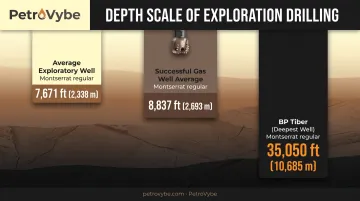
Depth varies enormously by target and region. Historical U.S. Energy Information Administration (EIA) data from 2010 put the average exploratory well at 7,671 feet (about 2,338 meters) across all outcomes, with successful gas wells averaging 8,837 feet, per EIA's exploratory well statistics.
That's a historical baseline, not a modern forecast, but it shows the scale of what "exploration" actually means underground.
For context on extremes: the deepest recorded petroleum exploration well by vertical rock depth was BP's Tiber well, reaching about 35,050 feet (10,685 meters) below the seabed. Depth records get confusing because water depth, vertical rock depth, and total borehole length are measured differently, so any "deepest well" claim needs a qualifier.
Why Exploration Drilling Matters
The entire point is reducing uncertainty before writing a big check. A prospect might look geologically perfect on seismic data and still turn out dry. Exploration drilling is the only way to know for certain.
Getting those samples out safely depends heavily on drilling mud. It:
- Transports rock cuttings to the surface for analysis
- Cools and lubricates the drill bit
- Controls downhole pressure to prevent blowouts or fluid loss
- Seals permeable rock and stabilizes the borehole
Once a well shows promise, appraisal wells follow to map out the size and shape of the deposit. Only after that does anyone make a final drill-or-abandon call on full development.
Three Main Types of Drilling Used in Exploration
Different rock, different tool. Choosing the wrong drilling method wastes time and money, or worse, produces misleading samples.
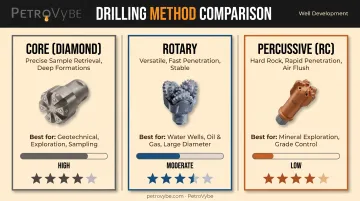
Core Drilling
Core drilling uses a diamond-impregnated, hollow bit to pull up an intact cylindrical rock sample. It's the gold standard for detailed geological data because the sample stays undisturbed, showing exact structure, contacts, and mineral content.
Diamond drilling is the specialized form of this method, used when you need high-integrity samples in hard rock where other tools would shatter or blend the evidence.
Rotary Drilling
Rotary drilling spins a bit using torque to cut through softer formations quickly. Circulating fluid carries cuttings to the surface continuously. It's the standard method in petroleum exploration because it moves fast and supports logging, testing, and further coring once a target zone is reached.
Percussive (Reverse Circulation) Drilling
This method hammers through hard rock while compressed air pushes cuttings up through an inner tube for quick sampling. It's common in early-stage mineral exploration because it covers ground fast. Teams often use it to screen large areas before committing budget to slower, higher-integrity core holes.
Side-by-side, the tradeoffs look like this:
| Method | Best For | Relative Cost | Sample Quality |
|---|---|---|---|
| Core (diamond) | Hard rock, detailed structure | Higher | Highest — intact, continuous |
| Rotary | Fast penetration, softer rock | Moderate | Good — cuttings-based |
| Percussive (RC) | Rapid mineral surveys | Lower | Lower — split chips, contamination risk |
A well-designed sample splitter still doesn't guarantee representative RC samples. The biggest sampling errors often happen before the splitter ever sees the material. A documented QA/QC plan protects interpretation quality more than choosing the cheapest meter rate.
The Exploration Drilling Process, Step by Step
Exploration drilling isn't a single event. It's a sequence of gates, and each one can send a project forward, back, or into the abandonment pile.
- Reconnaissance and surveys. Geologists and geophysicists study regional geology and basin history, run seismic and gravity surveys, and identify promising formations before any drill touches the ground.
- Drilling and sample extraction. Crews log cuttings and cores in real time, then ship them to labs for detailed analysis.
- Data interpretation and resource modeling. Geologists and reservoir engineers combine well data with seismic interpretation to estimate deposit size and quality, then judge commercial viability.
- Appraisal and the final decision. Delineation wells refine the picture, and the team makes a develop, appraise-further, or abandon call.
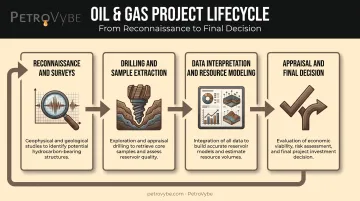
This process loops. New drilling data can invalidate the original seismic read. A technically successful well can still fail the commercial test if recovery, cost, or price assumptions don't hold.
Why Exploration Drilling Matters for Energy Investors
Here's the part that matters most if you're the one funding the well: the quality of exploration data and the experience of the geological team directly determine your risk and your potential return.
Historical EIA data suggest a roughly 61% success rate across U.S. exploratory wells in 2010, meaning nearly 4 in 10 wells came up dry. That's an industry-wide historical benchmark, not a prediction for any specific project. Team experience changes those odds substantially.
PetroVybe's Chief Geophysicist, Michael Stamatedes, is a former ExxonMobil geology leader with a 48-year track record. Prior-company work includes more than 3 trillion cubic feet of natural gas discoveries and production of 270 billion cubic feet of gas plus 15 million barrels of oil.
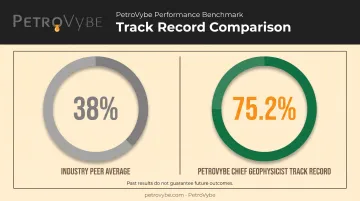
His documented success rate picking profitable well locations is 75.2%, above a typical industry peer average below 40%. Disclaimer: these results were achieved at prior companies. Those results were achieved at prior companies and are not a guarantee of future PetroVybe outcomes.
When you evaluate opportunities like this, three structural points matter:
- Third-party validation matters. PetroVybe's projects carry a $48 million PV-09 reserves valuation determined by a licensed third-party engineering firm, adding a layer of independent scrutiny beyond internal projections. Prepared by Lee Keeling & Associates, Tulsa, March 2026.
- Tax treatment ties directly to drilling costs. Intangible drilling costs (IDCs)—wages, fuel, and supplies used to drill and prepare a well—are deductible under IRS rules. PetroVybe's 2025 partners saw 94% deductions against active income; individual results vary and are not guaranteed. Prior result; not a promise of any future deduction.
- Direct participation puts investors at the entry point. Rather than buying into a stock or fund, PetroVybe's structure gives accredited investors a direct partnership position in the exploration and development itself, through projects across the Gulf Coast Basin and East Texas. This treatment requires the investor to elect general partner status in the Subscription Agreement and may be limited in a given year by the excess business loss limitation under IRC §461(l).
If natural gas development belongs in your diversified portfolio, review PetroVybe's current projects in Lavaca County and beyond to see how exploration data and third-party validation show up in the investment structure.
Frequently Asked Questions
What is exploratory drilling?
Exploratory drilling is the process of boring into the earth to locate and assess oil, gas, or mineral deposits before any development decisions are made. It's the first physical test of a geological prospect.
What are the three types of drilling?
Core, rotary, and percussive (reverse circulation) drilling are the three primary exploration methods. Each suits different rock conditions, from hard-rock coring to fast rotary penetration to rapid RC sampling.
What is a diamond drill?
A diamond drill uses an industrial diamond-impregnated bit to cut through hard rock and pull up intact core samples. It's prized for detailed, undisturbed geological data in tough formations.
How deep can exploration wells go?
Exploration wells range from a few thousand feet to more than 20,000 feet, depending on the target formation. Historical U.S. averages sit around 7,600 feet, though individual wells vary widely.
Why is exploration drilling important for investors?
Exploration data reduces uncertainty about whether a deposit is commercially viable, directly shaping the risk and return profile of any energy investment tied to that prospect.
What happens after exploration drilling is complete?
Appraisal wells follow to map the size and shape of a discovery. Resource modeling then determines whether the deposit moves toward full-scale development or gets shelved.
Informational requests only. PetroVybe projects are offered solely to verified accredited investors. Submitting this form does not create an investment or advisory relationship.