
This article is general education, not investment, tax, or legal advice. Someone hands you an assignment document. It says you're receiving — or giving up — "all right, title, and interest" in an oil and gas lease. Sounds straightforward. It rarely is.
Assignments of working interest are one of the most common transactions in the oil patch, yet they're also one of the most misunderstood. Many owners and even investors sign these documents without grasping what's actually transferring: not just future income, but operational duties, plugging liability, and contractual obligations that can outlast the paperwork itself.
This guide breaks down what a working interest assignment is, why they happen, which clauses matter most, and where the hidden risks live.
Key Takeaways
- An assignment transfers operational rights and cost obligations, not just royalty checks
- The original lease still governs; the assignment doesn't replace it
- Assignments can be full or partial — limited by wellbore, depth, or acreage
- Poorly drafted language has triggered real disputes lasting years
- Recording and regulatory filing protect the assignee's legal position
What Is an Assignment of Working Interest?
A working interest is the operational ownership share in an oil and gas lease. It carries the right to explore and produce, along with the obligation to pay a proportionate share of drilling, operating, and plugging costs. Unlike a royalty interest, working interest is a cost-bearing position.
An assignment is the legal instrument that transfers some or all of that working interest from one party (the assignor) to another (the assignee). It's both a contract and a conveyance — meaning courts read it first for plain language, then apply property law to determine what actually changed hands.
Here's where confusion often starts: "all right, title, and interest" doesn't automatically mean 100% of a lease. Depending on the surrounding language, it may transfer only what the assignor actually owned, functioning more like a quitclaim than a full conveyance.
Precision matters. The document needs to state:
- The exact working interest percentage and net revenue interest
- Which leases, lands, depths, or formations are included
- Any excluded wells, acreage, or equipment
Assignments are typically recorded in county land records to preserve the chain of title. For federal leases, that's not enough — Bureau of Land Management transfers require a separate approval process, generally within 90 days, with specific bonding and qualification requirements before the transfer is recognized.
Working Interest vs. Royalty Interest in an Assignment Context
Working interest and royalty interest diverge sharply on cost and liability:
- Working interest: Drilling expenses, operating costs, plugging obligations, and potential environmental exposure
- Royalty interest: Typically none of the above — a cost-free share of production revenue
That distinction carries real weight in an assignment. When working interest transfers, those active obligations move with it — unless the assignment expressly limits them. An assignee who skips the fine print can inherit liabilities they never priced into the deal.
How and Why Assignments of Working Interest Happen
Working interest assignments show up constantly in oil and gas transactions, driven by:
- Acquisitions and mergers — buyers absorbing sellers' leasehold positions
- Joint ventures and farmouts — one party earning interest by funding drilling
- Divestitures — operators shedding mature, low-priority assets
- Portfolio restructuring — companies reallocating capital toward core basins
The U.S. Energy Information Administration reported $234 billion in announced U.S. exploration-and-production M&A in 2023, the highest inflation-adjusted total since 2012. Corporate deals represented 82% of that spending. That figure reflects deal value, not a count of individual assignments, but it confirms leasehold ownership in U.S. shale basins is changing hands at a rapid pace.
Partial Assignment Types
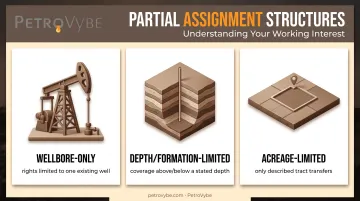
Not every assignment transfers a full interest. Common structures include:
- Wellbore-only — rights limited to production from one specified existing well
- Depth or formation-limited — coverage restricted to, say, the Woodford Formation or rights above a stated depth
- Acreage-limited — only a described tract transfers, while the assignor keeps the rest
The ORRI Factor
Many assignments reserve an overriding royalty interest (ORRI) for the assignor — a percentage carved out of the working interest that isn't charged with development costs. This dilutes the assignee's net revenue interest, so always confirm whether the reservation is a fixed fraction or a formula tied to total lease burdens.
Multi-Lease Exhibit Risks
A single assignment often covers multiple leases through attached exhibits. If those exhibits contain inconsistent legal descriptions, the scope of the transfer becomes genuinely disputable, as several Texas court cases have shown.
Key Clauses to Review Before Signing an Assignment
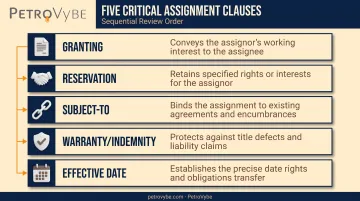
Five clauses determine what actually moves and who's on the hook.
| Clause | What It Does |
|---|---|
| Granting | Defines exactly what interest transfers — percentages, leases, depths, wells |
| Reservation | States what the assignor keeps, often an ORRI or excluded acreage |
| Subject-to | Identifies existing burdens, JOA terms, and lease obligations that survive |
| Warranty/Indemnity | Allocates title and liability risk between the parties |
| Effective date | Determines who bears revenue and costs from a specific point forward |
Read the Whole Instrument
The Texas Supreme Court's 2024 decision in Occidental Permian v. Citation 2002 is a useful case study here. The court read the entire instrument together, including its exhibits, and held that broad granting language controlled even where subject-to clauses might have suggested a narrower reading.
No clause stands alone. A generous grant can be quietly narrowed by a reservation. A subject-to clause might just be notice of an existing burden rather than a reduction in what's conveyed. Read the whole document, not just the paragraph that looks favorable.
Effective date language deserves particular attention. Assignments are often executed on one date but made effective weeks earlier, so the assignee can inherit revenue and cost responsibility for a period before they signed anything.
Risks, Liabilities, and Due Diligence
Working interest liability doesn't always stay with the party who caused it.
Plugging and environmental exposure varies by state. Texas places the statutory plugging duty on the well operator. Oklahoma goes further, making any working interest owner and the operator jointly and severally liable for plugging costs. Assume nothing — check the specific state rule governing the lease.
Contract liability can survive the sale. In Seagull Energy E&P, Inc. v. Eland Energy, Inc., the Texas Supreme Court held that an assignor remained liable under an operating agreement even after assigning its working interest, because no release or novation had been obtained. The assignor got stuck with a bill for $268,418.90 owed by the party it had sold to.
Before accepting an assignment, ask:
- Is there an existing Joint Operating Agreement, and does it require consent to assign?
- Are there unpaid joint-interest billings or suspended revenue?
- Has the underlying lease actually been recorded and kept current?
- What do the exhibits say, and do they match the granting clause?
- Is there a plugging liability or environmental history attached to the wells?
Ambiguous conveyance language isn't a hypothetical risk. In Piranha Partners v. Neuhoff, an exhibit listed a well, a quarter-section, and a lease without clarifying which one limited the grant. The dispute went all the way to the Texas Supreme Court.

Professional title review before signing is cheap compared to years of litigation after.
Tax and Investment Considerations of Working Interest Assignments
Working interest income is treated differently than royalty income for tax purposes, and that difference is a major reason accredited investors pursue it.
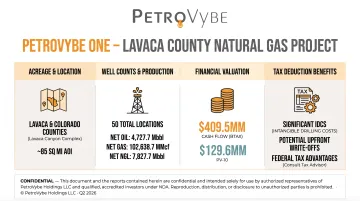
Because working interest holders bear operating costs, they can typically deduct intangible drilling costs (IDCs) — wages, fuel, hauling, and other no-salvage-value drilling expenses — against active income, including W-2 earnings and capital gains. That's a meaningful distinction from passive royalty income, which doesn't carry the same deduction profile. This treatment requires the investor to elect general partner status in the Subscription Agreement and may be limited in a given year by the excess business loss limitation under IRC §461(l).
Two caveats matter:
- IDC and depletion percentages aren't universal. They depend on the specific well, entity structure, and election made.
- Working interest held without limited liability generally isn't treated as a passive activity under IRC Section 469, which is exactly why it can offset active income. This treatment requires the investor to elect general partner status in the Subscription Agreement and may be limited in a given year by the excess business loss limitation under IRC §461(l).
Rather than negotiating a direct lease assignment, with all the title review, consent requirements, and liability questions described above, some accredited investors gain working interest exposure through a structured development program instead.
That's the model PetroVybe runs. Through PetroVybe ONE, accredited investors can participate in a natural gas development project that includes:
- A 58,000-acre position in Lavaca County, Texas
- Roughly 400 acquired wells and 57-plus planned new wells
- Reserve base valued at about $48 million (PV-09, prepared by Lee Keeling & Associates, Tulsa, March 2026) by a licensed third-party engineering firm
- A clean 2025 independent audit
Partners received a 94% deduction against active income in 2025, based on the project's IDC and depletion structure. Prior result; not a promise of any future deduction. Those figures come from PetroVybe's own K-1 reporting, not a generic industry estimate. This treatment requires the investor to elect general partner status in the Subscription Agreement and may be limited in a given year by the excess business loss limitation under IRC §461(l).
Results vary by program. Structured offerings with third-party engineering validation still give accredited investors a path to working interest economics without personally managing granting clauses, JOA consents, or plugging liability.
Frequently Asked Questions
What is an assignment in oil and gas?
An assignment is the legal instrument that transfers some or all leasehold rights—usually working interest—from an assignor to an assignee. The original lease still governs those underlying rights.
What is the purpose of an assignment of interest in a partnership?
It moves a partner's rights and obligations to another party. A working interest assignment does the same under an oil and gas lease: operational rights and cost responsibility shift to the assignee.
Does an assignment of working interest replace the original lease?
No. The lease remains the source document defining the rights that exist. The assignment only transfers some or all of those rights; it does not create new ones.
Can a working interest be assigned only in part?
Yes. Partial assignments limited by wellbore, depth, or acreage are common in the industry. They must be drafted with precise legal descriptions to avoid ambiguity disputes later.
What happens to liability after a working interest is assigned?
Prior-period obligations may stay with the original owner, depending on the transfer documents, consents, and state law. A signed assignment alone does not guarantee a clean release.
Why is recording an assignment important?
Recording preserves the chain of title and gives public notice of the transfer. In Texas, for example, an unrecorded conveyance can be void against a later purchaser for value who had no notice of it.
Informational requests only. PetroVybe projects are offered solely to verified accredited investors. Submitting this form does not create an investment or advisory relationship.