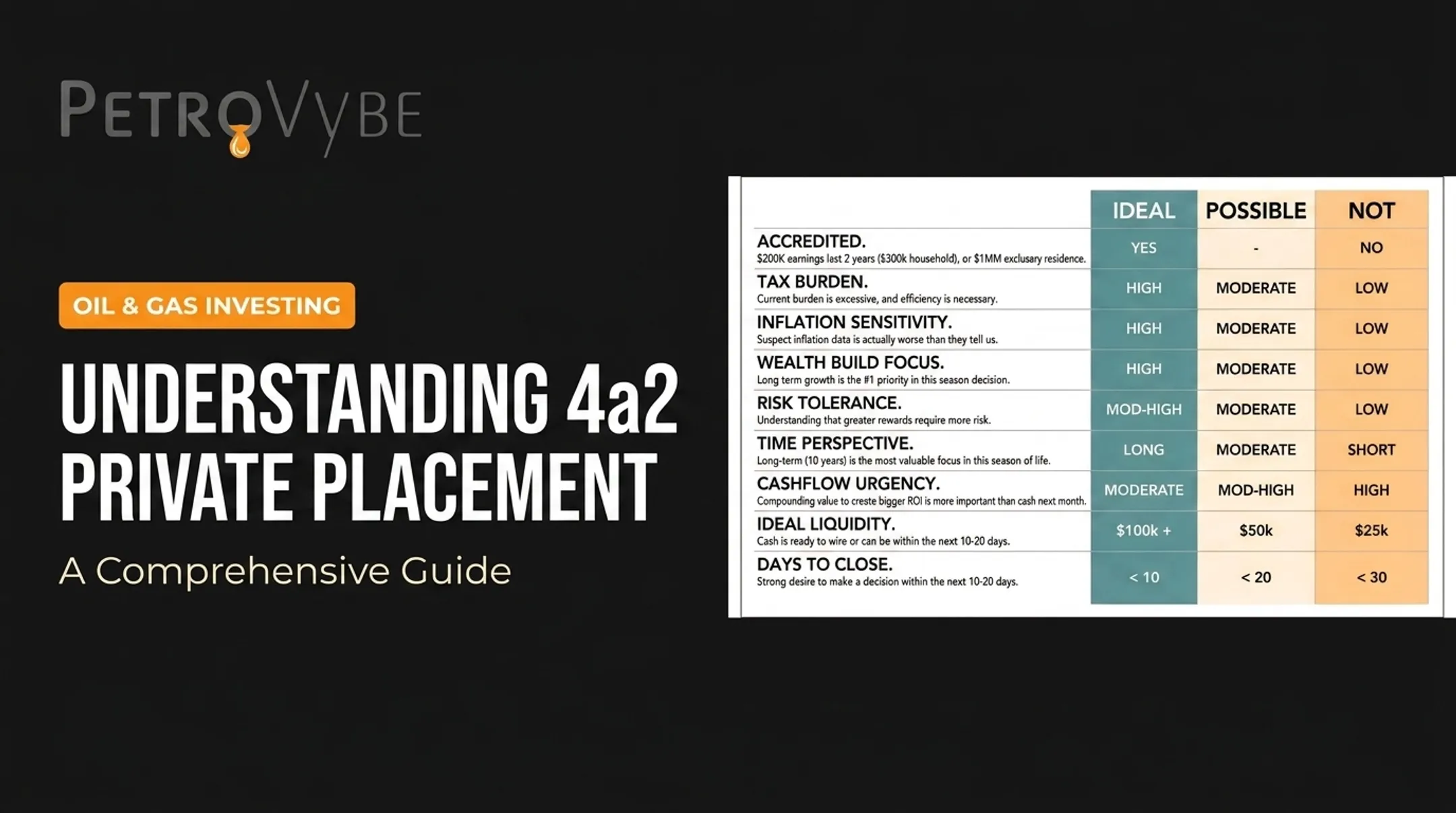

This article is general education, not investment, tax, or legal advice. Accredited investors are pouring more capital into private markets than ever, chasing returns that stocks, bonds, and traditional real estate can't match. Direct equity in energy projects, private credit funds, and specialized partnerships now compete for a spot in serious portfolios.
But here's the problem: most investors don't actually understand the legal scaffolding that makes these deals possible. What's an accredited investor, really? Why can some companies advertise their offerings while others can't say a word publicly? What happens if something goes wrong?
This guide breaks down the framework governing private placements, including Regulation D, investor qualification rules, required disclosures, and the risks you need to watch for before you wire a dollar.
Key Takeaways
- Private placements skip SEC registration under Section 4(a)(2) or Regulation D, avoiding full public-offering scrutiny
- Rule 506(b) and 506(c) are the two dominant paths, each with different investor and marketing rules
- Accredited investor status hinges on income, net worth, or specific professional licenses
- These securities are illiquid — plan to hold for years, not months
- State Blue Sky laws and antifraud rules still apply even with a federal exemption
What Is a Private Placement Under Securities Law?
A private placement is the sale of securities to a select group of investors instead of the general public. The legal foundation rests on Securities Act Section 4(a)(2), which exempts transactions "not involving any public offering" from SEC registration.
Why does this exemption exist? Registration is expensive and slow. Congress decided that when investors are sophisticated enough to fend for themselves, companies shouldn't have to shoulder the same disclosure burden required for a public stock sale. The tradeoff: less regulatory oversight, more reliance on investor judgment.
Private Placement vs. Public Offering (IPO)
The differences aren't cosmetic: they shape how you evaluate a deal:
| Factor | IPO / Public Offering | Private Placement |
|---|---|---|
| Core document | Prospectus (part of SEC registration statement) | Private Placement Memorandum (PPM) |
| Public review | Filed and reviewed by SEC, publicly available | Not reviewed by any regulator |
| Marketing | Open advertising allowed | Restricted or prohibited, depending on exemption |
| Investor pool | Anyone can buy | Limited to accredited/sophisticated investors |

A PPM is the customary disclosure document in private deals, but federal law doesn't universally mandate one for every accredited-only offering. It's standard practice, not always a legal requirement.
The Regulatory Framework: Regulation D and Section 4(a)(2)
Section 4(a)(2) is the statutory exemption. Regulation D supplies the safe harbors: concrete rules issuers can follow to stay clearly inside the exemption.
Rule 506(b): The Traditional Path
- Unlimited accredited investors, plus up to 35 non-accredited but sophisticated investors
- No general solicitation or advertising allowed
- Non-accredited purchasers must receive specified disclosure information
- Bad-actor disqualification provisions apply
Rule 506(c): Advertising Allowed, Standards Raised
- General solicitation and public advertising are permitted
- Every single investor must be accredited — no exceptions for sophisticated non-accredited investors
- The issuer must take reasonable steps to verify accredited status (tax returns, bank statements, or a CPA, attorney, or licensed-advisor letter)
- Prior verification can support a written representation for up to five years if nothing changes
Rule 504: The Smaller-Offering Path
- Offerings capped at $10 million in any 12-month period, raised from $5 million by a 2020 SEC amendment
- Allows non-accredited investors
- Excludes reporting companies, investment companies, and certain development-stage issuers
- State securities laws still apply — Rule 504 doesn't get the same federal preemption that 506 offerings receive
Two compliance points cut across these paths. Integration can combine offerings inside a six-month window when calculating dollar caps, so issuers cannot artificially split a raise to dodge limits.
Every Regulation D issuer must also file Form D with the SEC within 15 calendar days of the first sale. The filing is publicly searchable on SEC EDGAR, and it is one of the easiest ways for an investor to confirm a company is operating inside the framework it claims.

Who Qualifies as an Accredited or Sophisticated Investor?
The SEC's dollar thresholds for accredited investors are largely unchanged, but who can qualify expanded in 2020.
Individuals qualify by:
- Net worth over $1 million, excluding primary residence (alone or with a spouse/partner)
- Income over $200,000 individually or $300,000 jointly in each of the past two years, with reasonable expectation of the same this year
- Holding a Series 7, 65, or 82 license in good standing
- Qualifying as a "knowledgeable employee" of certain private funds
These categories were added by SEC Release No. 33-10824, effective December 2020.
Accredited vs. sophisticated is easy to mix up:
- Accredited investor: Meets formal SEC tests (income, net worth, license, or knowledgeable-employee status)
- Sophisticated investor: Under Section 4(a)(2), has enough financial knowledge and risk-bearing ability to evaluate the deal, even without hitting those dollar thresholds
That split matters when you pick an exemption. Rule 506(b) can include sophisticated non-accredited investors in limited numbers. Rule 506(c) does not.

PetroVybe structures its PetroVybe ONE offering under Rule 506(c), so every investor must verify accredited status through a qualified third party (CPA, tax attorney, or licensed financial advisor) before funds move. There is no sophisticated-but-not-accredited path into that offering.
Key Legal Documents and Investor Protections
Three documents typically govern your relationship with the issuer:
- Private Placement Memorandum (PPM) — discloses risks, business background, and management credentials. PetroVybe's PPM, for example, covers commodity price volatility, drilling cost uncertainty, and reserve estimate risk, plus standard warnings that capital can be lost and past performance guarantees nothing.
- Subscription Agreement — the contract you sign to actually invest, paired with an accredited investor questionnaire that confirms your eligibility.
- Limited Partnership Agreement (LPA) — if the structure is a partnership, this governs your rights, profit splits, and obligations as a partner.
Antifraud provisions apply no matter what exemption you're using. Exemption from registration is not exemption from honesty. If an issuer lies or omits material facts, federal and state antifraud law still applies.
Resale Restrictions You Need to Know
Private placement securities are "restricted securities." Under Rule 144:
- Six months minimum holding period if the issuer is an SEC reporting company
- One year minimum if it's not
In practice, many private deals — including long-hold energy partnerships — aren't designed for quick resale at all. Treat these as buy-and-hold positions, not trades.
Risks and Red Flags to Watch For
Illiquidity is the headline risk. You may not be able to sell your position for years, and there's often no established secondary market even after the minimum holding period passes.
Other risks to weigh:
- Limited disclosure compared to registered offerings: there's no SEC review of the PPM's accuracy
- Reliance on the issuer's own projections and reserve estimates, which carry inherent uncertainty
- No guarantee that forecasted returns materialize
Watch for these warning signs, straight from SEC investor guidance:
- Missing legends or sloppy, incomplete offering documents
- No Form D filing on EDGAR
- Promises of guaranteed high returns (no investment is risk-free)
- Claims that the SEC "approved" the offering (it doesn't approve private deals, ever)
- Pressure to invest quickly with "once-in-a-lifetime" framing

Third-party validation helps separate legitimate deals from scams. Independent engineering reports, audited financials, and verified investor review platforms don't eliminate risk, but they give you something to check against the issuer's own claims.
PetroVybe, for instance, points to a $48 million PV-09 reserve valuation from a licensed third-party engineering firm and a clean 2025 audit from Weaver, plus verified reviews on Invest Clearly. Prepared by Lee Keeling & Associates, Tulsa, March 2026. That is evidence you can weigh, not a substitute for reading the PPM yourself.
Frequently Asked Questions
What are the requirements for private placement?
Requirements vary by exemption, but generally include limiting sales to accredited or sophisticated investors, restricting general solicitation (for 506(b)), filing Form D within 15 days, and often providing a PPM.
How long does a private placement last?
Offerings typically run until the funding target is reached, ranging from a few weeks to over a year. Some issuers, like PetroVybe, target closing windows as short as 7 to 21 days.
Are private placements only for accredited investors?
No. Rule 506(b) and Rule 504 allow limited non-accredited participation. Rule 506(c) requires every investor to be accredited, with no exceptions.
Can private placement securities be resold?
Generally not right away. These are restricted securities under Rule 144, requiring a six-month or one-year holding period depending on the issuer's reporting status, and many private deals have no active secondary market at all.
Is a private placement memorandum legally required?
Not universally. Federal rules require specific disclosures when non-accredited investors participate under 506(b), but a PPM is standard industry practice rather than a blanket legal mandate for accredited-only deals.
Do private placements need to comply with state law too?
Yes. Rule 506 offerings get federal preemption from state registration, but states can still require notice filings, fees, and retain full authority to pursue fraud. Rule 504 offerings don't get that preemption and must comply with state securities laws directly.
Informational requests only. PetroVybe projects are offered solely to verified accredited investors. Submitting this form does not create an investment or advisory relationship.