RSUs are taxed as ordinary income the moment they vest, based on fair market value that day. Not at grant. Not at sale. Default employer withholding rarely covers your true liability, especially once you factor in state tax, the Additional Medicare Tax, and the fact that a large vest can push your entire year's income into the top bracket.
This guide walks through how RSUs are actually taxed in 2026, the core levers you can pull to reduce that bill, and a lesser-known offset strategy—direct investment in oil and natural gas development—that can meaningfully reduce tax owed on active income in a big vesting year.
Key Takeaways
- RSUs are taxed as ordinary W-2 income at vesting, valued at fair market value, not at grant or eventual sale
- Standard 22% supplemental withholding almost always underestimates what high earners actually owe
- Holding vested shares 12+ months unlocks 0%, 15%, or 20% long-term capital gains rates—and adds concentration risk
- Retirement maxing, charitable bunching, and active-income offsets like IDC deductions can cut your RSU-year tax bill significantly
How RSUs Are Taxed in 2026: The Foundation
RSUs trigger two separate taxable events, and mixing them up is the single most common mistake:
- At vesting — the fair market value of the shares is added to your W-2 as ordinary income
- At sale — any gain or loss from the vesting-date price is taxed as a capital gain or loss
For 2026, the federal brackets look like this:
| Rate | Single | MFJ |
|---|---|---|
| 32% | $201,776–$256,225 | $403,551–$512,450 |
| 35% | $256,226–$640,600 | $512,451–$768,700 |
| 37% | $640,601+ | $768,701+ |
A single large vest can jump you two brackets in one year (IRS 2026 inflation adjustments).
The Underwithholding Trap
Employers withhold RSU income as "supplemental wages" at a flat 22% federal rate (37% only on amounts over $1 million in a calendar year per employee). If your actual marginal rate is 35%, you're short by 13 percentage points on every dollar vested below that $1 million threshold.
Quick math: A $300,000 vest withheld at 22% sets aside $66,000. If your true marginal rate is 35%, you actually owe $105,000. That's a $39,000 shortfall—due in April, plus potential underpayment penalties.

Medicare Surtax and Cost Basis Pitfalls
That shortfall can grow further once the 0.9% Additional Medicare Tax kicks in on wages above $200,000 (single) or $250,000 (MFJ). It often isn't withheld until you cross $200,000 with a single employer, so dual-income households get surprised at filing time.
Your cost basis at vesting equals the FMV already taxed as W-2 income. Report that basis wrong on your return and you pay tax twice on the same dollars.
Core Strategies to Reduce Your RSU Tax Burden in 2026
Smooth Your Income Timing
Don't let a bonus, option exercise, and RSU vest all land in the same quarter. Coordinate with your spouse's income too. Spreading these events across the calendar can keep you from stacking marginal income unnecessarily into the 35% or 37% brackets.
Fix Your Withholding
- Adjust your W-4 to add extra withholding ahead of known vest dates
- Make quarterly estimated payments if withholding alone won't cover the gap
- Use the IRS Tax Withholding Estimator before your next big vest
Sell Immediately or Hold?
Two common paths after a vest:
- Sell at vest: Locks in minimal additional gain and cuts concentration risk right away
- Hold 12+ months: Future appreciation may qualify for long-term capital gains rates (0/15/20%) instead of ordinary rates. You still carry the stock-specific risk
Max Out Pre-Tax Accounts
In a big vesting year, front-load these to directly reduce AGI:
- 401(k): $24,500 elective deferral limit for 2026 (under 50)
- HSA: $4,400 individual / $8,750 family
- Mega Backdoor Roth: ~$35,250 more in after-tax contributions within the $72,000 Section 415(c) cap (Fidelity, 2026)

Harvest Losses to Offset Gains
If you're selling appreciated RSU shares, pair the sale with tax-loss harvesting elsewhere in your portfolio. You can offset unlimited capital gains this way, plus up to $3,000 of ordinary income annually. Watch the wash-sale rule: rebuying "substantially identical" stock within 30 days disallows the loss.
Advanced Strategy: Offsetting RSU Ordinary Income with Direct Energy Investments
Here's the problem with most of the strategies above: they nibble at the edges. Maxing a 401(k) might shave $24,500 off your AGI. If you just vested $500,000 in RSUs and owe six figures in tax, that's a rounding error.
Intangible Drilling Cost (IDC) deductions work differently. Under IRC Section 469(c)(3), a direct working interest in an oil or natural gas property isn't treated as a passive activity—regardless of how involved you actually are. That means losses from IDCs can offset active income, including W-2 wages and capital gains, not just passive income like most real estate deals.
This is the key distinction:
| Investment Type | Passive? | Offsets W-2 income? |
|---|---|---|
| Direct working interest in oil/gas | No | Yes (if at-risk/basis met) |
| Limited-partnership oil/gas interest | Yes | No, unless materially participating |
| Rental real estate (passive) | Yes | No |
PetroVybe structures its natural gas development program to give accredited investors this kind of direct participation. The program is backed by:
- Roughly 400 producing wells and 57+ planned wells
- A 58,000-acre position in Lavaca County, Texas
- IDC costs that typically run 60–80% of invested capital
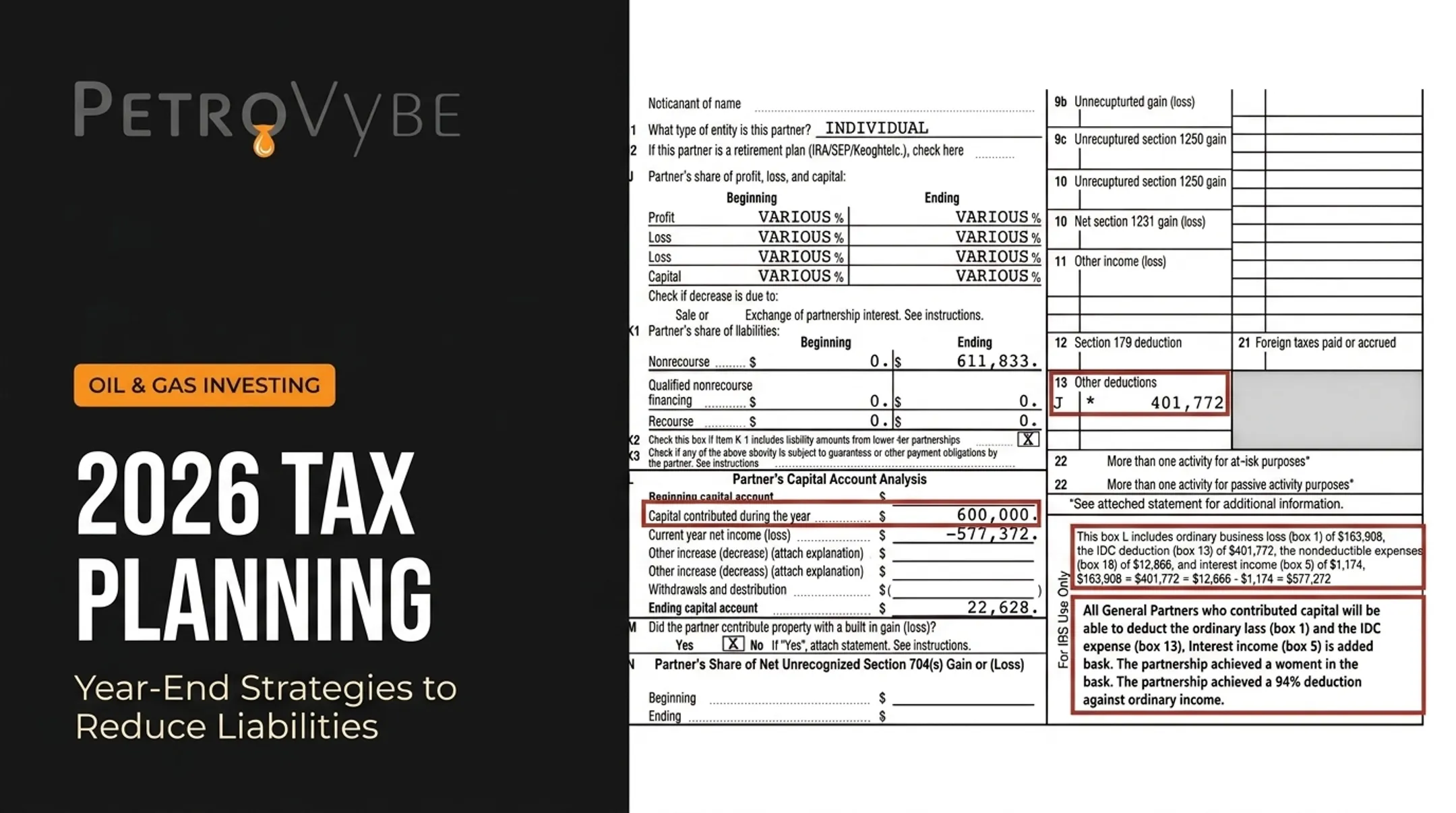
Partners in PetroVybe's 2024 and 2025 programs reported 94% and 91% deductions against active income, respectively, applied through K-1 reporting.

These are historical results tied to those specific program years—not a guarantee of future performance. Actual deduction percentages vary by project and investor circumstances.
This route fits a narrow profile: accredited investors with $100,000+ in liquidity who are facing a high tax bill from RSU vesting and want exposure outside of stocks and bonds. It's not a fit for anyone still building liquidity or without accredited status.
Charitable Giving and Multi-Year Planning
Donate Appreciated Shares Directly
Instead of selling RSU shares and donating cash, gift appreciated shares directly to a donor-advised fund. You avoid capital gains tax entirely on the appreciation and still deduct the full fair market value, subject to AGI limits.
Sequence that works: Sell just enough vested shares to cover the tax withholding gap in cash, then donate the remaining shares in-kind to the DAF.
Bunch Deductions in High-Vesting Years
Combine several years' worth of planned giving into your biggest vesting year to clear the standard deduction threshold.
The 2026 SALT cap increase to $40,400 for single and joint filers makes itemizing more attractive than it's been in years—especially if you're paying significant state income tax on the vest (Fidelity, 2026).

Build a Rolling Projection
Map out your vesting schedule 2-3 years ahead:
- Known grant values and vest dates
- Expected household income by year
- Planned charitable contributions and maxed retirement contributions
- Target sale windows for held shares
A written projection lets you time sales, gifts, and withholding decisions before each vest hits.
Avoiding Double Taxation and Common RSU Mistakes
The most expensive mistake: your broker's 1099-B often reports the wrong cost basis—sometimes $0, sometimes the grant-date value instead of the vesting-date FMV. If you file without correcting this, you'll pay capital gains tax on income that was already taxed as wages.
Fix it:
- Check your 1099-B against your vesting records so you catch $0 or grant-date basis errors early
- Adjust the basis on Form 8949, typically using Code B, to report the correction
- Use the vesting-date FMV (already on your W-2) as the corrected cost basis
Another common trap: broker default lot selection. Many default to first-in, first-out (FIFO), which can trigger unnecessary gains on your oldest, most-appreciated shares. Specify which tax lots you're selling so you control the gain.
Frequently Asked Questions
What is the best tax strategy for RSUs?
The strongest results usually come from stacking moves: withholding adjustments, maxing retirement accounts, timed sales, and tax-advantaged oil and gas investments. No single tactic carries high earners as far as that combination.
How do I avoid getting double taxed on RSUs?
Correct the cost basis on Form 1099-B using your vesting-date fair market value, since that amount was already taxed as ordinary income. Skipping this step means paying tax twice on the same dollars.
Should I sell my RSUs immediately or hold them?
Selling immediately locks in minimal additional gain and reduces stock concentration risk. Holding 12+ months shifts gains to lower long-term capital gains rates but exposes you to market swings.
How much of my net worth should be in company stock?
Common guidance caps single-stock exposure at 10–15% of investable assets. Many advisors prefer closer to 5–10% when concentration risk is high.
Can I defer RSU income to a later tax year?
Generally no. RSU income is taxed at vesting unless your employer offers a Section 409A-compliant deferral election made before the shares vest.
Do I owe state taxes on RSU income if I move states?
Often yes. States like California tax RSU income based on residency during the vesting period, so moving before vesting doesn't eliminate tax on workdays performed there.