
Here's the thing many investors miss — that tax bill isn't fixed. It's mostly a function of timing and planning, not an unavoidable cost of investing. A sale executed in December instead of January, or structured differently altogether, can mean a five- or six-figure difference in what you owe.
This article breaks down how capital gains liability actually builds, what drives the size of your bill, and specific moves you can make today — from simple timing adjustments to tax-advantaged structures.
TL;DR
- Capital gains tax is set by realized sales, income thresholds, and holding periods, not one flat rate
- Holding period, income bracket, asset type, and timing of realization are the biggest cost drivers
- Cut the bill by timing sales, using tax-advantaged accounts, and shifting into alternative investments
- Decide hold periods and sale timing before you sell; year-end scrambles rarely lower what you owe
How Capital Gains Tax Liability Typically Builds Up
Capital gains tax isn't charged once a year like a subscription fee. It accumulates transaction by transaction, triggered at the point of sale. That can be a routine trade in your brokerage account or a one-time event like selling a business or a concentrated stock position.
That liability can build two ways:
- Gradually — through routine portfolio rebalancing, dividend reinvestment sales, or periodic profit-taking
- Episodically — through a single large event: selling a home, a business, or a stock position that's appreciated for years
Many investors don't realize their full exposure until tax season, when short-term gains, long-term gains, and the Net Investment Income Tax (NIIT) all combine unexpectedly on one return. By then, the window to adjust has usually closed.
Key Drivers of Your Capital Gains Tax Bill
Not all gains are taxed the same. A few variables decide whether you land in the 0% bracket or hand over more than a third of your profit.
Holding Period and Income Bracket
Hold an asset for one year or less, and the gain is taxed at ordinary income rates, up to 37%. Hold it for more than one year, and you move into the long-term capital gains brackets of 0%, 15%, or 20%, based on taxable income (IRS Topic 409).
Your total taxable income sets the bracket:
- Stack a large gain on salary or business income, and it can push you into the 20% long-term rate
- Modified AGI above $200,000 (single) or $250,000 (married filing jointly) can also trigger the 3.8% NIIT surtax
Asset Type and Timing
- Collectibles and the taxable portion of certain QSBS gains face a 28% rate cap, regardless of your normal bracket
- Bunching multiple gains into one year can push you into a higher bracket than spreading sales across two or three years
- Investor type changes the pressure point: a business sale is one large event; active trading creates constant short-term gains

Strategies for Capital Gains Tax Reduction
Effective strategies fall into three buckets: decisions you make before selling, active portfolio management during the year, and broader structural choices about where your money sits.
Strategies That Reduce Costs Before You Sell
- Hold for more than one year. This single move can cut your rate from as high as 37% down to 15% or 20%.
- Time sales for low-income years. Between jobs, during a sabbatical, or in early retirement, your taxable income may land in the 0% long-term bracket.
- Gift appreciated assets to family in lower brackets. Basis carries over under IRS Publication 551, so a sale at their income level can shrink the tax hit.
- Donate appreciated securities directly to charity. You avoid the capital gain and generally deduct fair market value, subject to AGI limits (IRS Publication 526).
Strategies Through Active Portfolio Management
Four portfolio moves can change your tax bill without waiting for a life event:
- Tax-loss harvesting — Offset realized gains with losses from underperforming positions. Up to $3,000 per year in net losses can offset ordinary income; unused losses carry forward indefinitely.
- Tax-gain harvesting — In a low-income year, deliberately sell appreciated assets at the 0% rate to reset cost basis, then rebuy if you want to stay invested.
- Wash-sale rule — Selling at a loss and buying a "substantially identical" security within 30 days before or after disallows the loss and adds it to your new basis.
- Account placement — Keep tax-inefficient holdings (actively managed funds, taxable bonds) inside retirement accounts so turnover does not trigger annual tax bills.

Strategies That Change the Broader Investment Context
Sometimes the real driver of your tax bill isn't the sale itself — it's the account or asset class you're using.
- Tax-advantaged accounts (401(k)s, IRAs, HSAs): gains grow tax-deferred or tax-free
- Section 1031 exchanges: defer gains on investment real estate by rolling proceeds into a new property within 45- and 180-day identification/closing windows (IRS Form 8824 instructions)
- Direct oil and gas development: upfront deductions that can offset both capital gains and W-2 income, not just passive income
Most passive investments restrict losses to offsetting only passive income. Intangible Drilling Cost (IDC) deductions, governed under IRC §263(c) and Treasury Reg. 1.612-4, work differently for direct working-interest holders — those losses are not boxed in by the usual passive-activity limits under IRC §469.
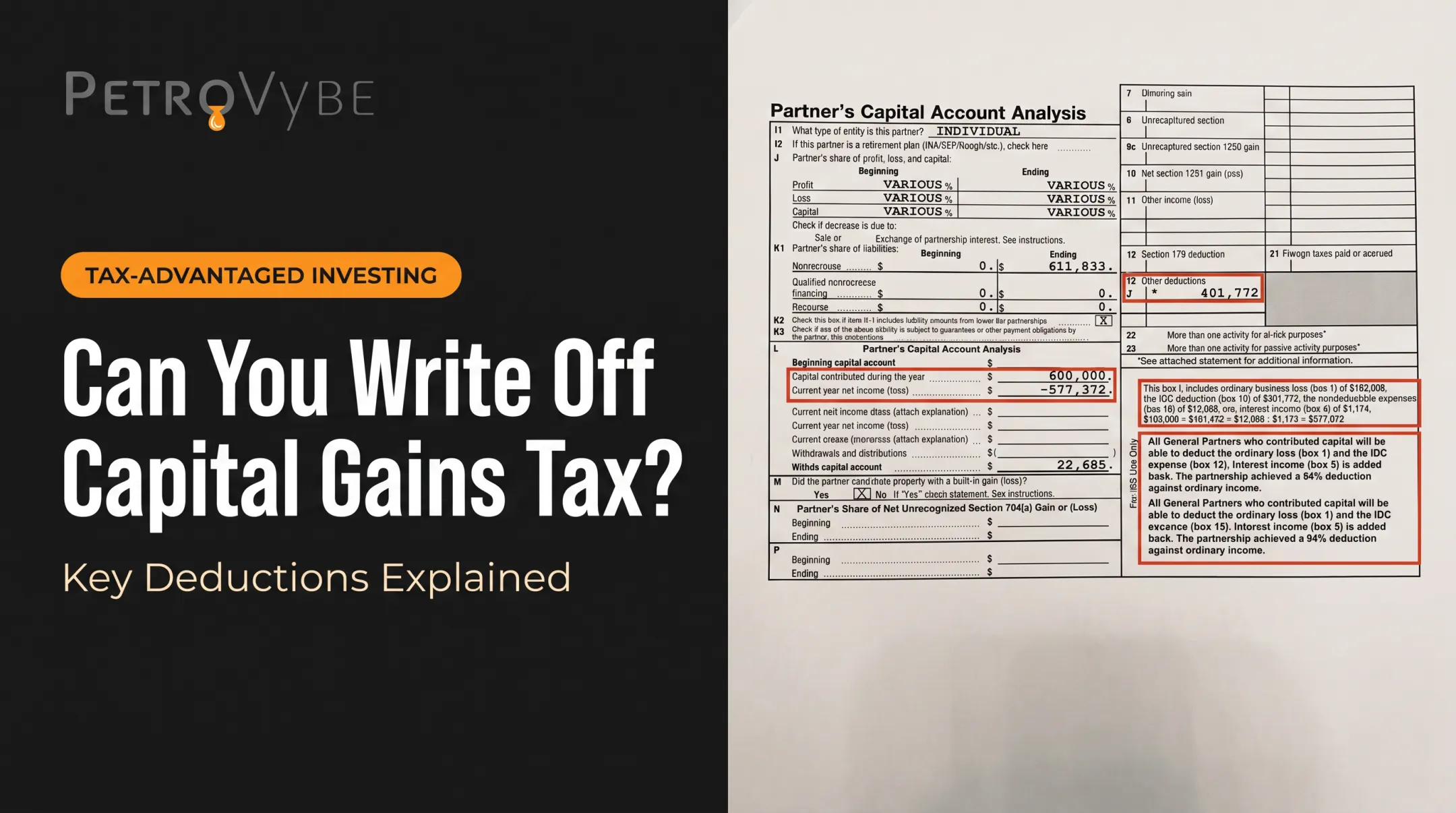
PetroVybe structures its natural gas development partnerships around this mechanic. Partners in its 2024 and 2025 offerings received deductions against active income — including W-2 earnings and capital gains — through IDC and depletion allowances on development wells across a 58,000-acre position in Lavaca County, Texas:
- 91% and 94% deductions against active income in the 2024 and 2025 offerings, respectively
- A $100,000 investment might generate $60,000–$80,000 in first-year IDC deductions alone
- Deductions claimable in year one or spread over five years via K-1

Unlike a 1031 exchange, this is not a short-term deferral. PetroVybe targets a 10-year hold with a forecasted 2.2x–5.8x MOIC, so it fits investors who want a large tax offset paired with a long-term, illiquid position. Offerings are limited to accredited investors — generally those with $1 million-plus net worth or $200,000+ individual income.
Reducing Your Capital Gains Tax Bill Comes Down to Timing
Your capital gains bill depends on when, how, and why the liability gets triggered. You do not need to stop selling assets—you need control over timing, lot selection, and structure on each sale.
Pair smart timing with active loss harvesting and the right account or asset structure, and review the plan with a qualified tax advisor. Those moves create savings that compound across tax years, not a single one-time break.
Frequently Asked Questions
What are some strategies to reduce my capital gains tax?
Core approaches include holding assets past one year for lower rates, tax-loss harvesting to offset gains, donating appreciated securities to charity, and using tax-advantaged accounts like IRAs and 401(k)s.
How long do I need to hold an asset to get the long-term capital gains rate?
More than one year. Assets held one year or less are taxed as short-term gains at ordinary income rates up to 37%, while long-term gains max out at 20%.
Can I offset capital gains with losses from other investments?
Yes, through tax-loss harvesting. You can deduct up to $3,000 of net losses against ordinary income annually, and carry forward any unused losses indefinitely.
Does selling my home trigger capital gains tax?
Often not, thanks to the Section 121 exclusion: up to $250,000 (single) or $500,000 (married filing jointly) of gain is excluded if you meet the ownership and use tests.
Are there investments that offer tax deductions against capital gains?
Yes. Direct oil and gas working-interest investments, like PetroVybe's development partnerships, allow Intangible Drilling Cost deductions to offset active income — including capital gains and W-2 wages, not just passive income.
What is the wash-sale rule and how does it affect my strategy?
If you sell a security at a loss and buy a substantially identical one within 30 days before or after, the IRS disallows the loss deduction and adds it to your new position's basis instead.