
This article is general education, not investment, tax, or legal advice. Tax rules change and apply differently to every taxpayer. If your income climbed this year, you may be about to meet the NIIT for the first time. Many investors don't realize the 3.8% Net Investment Income Tax exists until they see it added to their capital gains bill.
The problem is compounding. Since 2013, the number of taxpayers hit by NIIT has more than doubled, from 3.1 million to 7.3 million in 2021, according to the Congressional Research Service. The thresholds never adjust for inflation, so more high earners get pulled in every year.
This guide breaks down what counts as net investment income, which deductions actually reduce your NIIT bill, and strategies (including active-income alternatives like direct oil and gas development) to lower your total exposure.
This applies to you if you're an accredited investor, a high W-2 earner, or someone realizing significant capital gains above IRS thresholds.
Key Takeaways
- NIIT is a flat 3.8% surtax on investment income above MAGI thresholds ($200K single, $250K MFJ, $125K MFS)
- Narrow NIIT deductions only: advisory fees, allocable state/local taxes, investment interest, rental expenses
- MAGI reduction plus upfront-deduction investments (such as Intangible Drilling Costs) lowers total NIIT exposure
- Unlike NIIT deductions, oil and gas IDC deductions offset active income, not just investment income. This treatment requires the investor to elect general partner status in the Subscription Agreement and may be limited in a given year by the excess business loss limitation under IRC §461(l).
What Is the Net Investment Income Tax (NIIT)?
Congress created the NIIT in 2010 as part of the Health Care and Education Reconciliation Act, with the tax taking effect on January 1, 2013. It layers a flat 3.8% surtax on top of whatever capital gains or ordinary tax you already owe.
The tax applies once your Modified Adjusted Gross Income (MAGI) crosses these thresholds:
| Filing Status | MAGI Threshold |
|---|---|
| Single / Head of Household | $200,000 |
| Married Filing Jointly | $250,000 |
| Married Filing Separately | $125,000 |
None of these numbers are inflation-adjusted. A $200,000 salary went a lot further in 2013 than it does today, which explains why a Congressional Research Service report shows NIIT revenue jumped from $16.5 billion in 2013 to a preliminary $59.8 billion in 2021.
How the Calculation Actually Works
NIIT applies to the lesser of two numbers:
- Your net investment income (NII)
- Your MAGI minus the applicable threshold
Example: A single filer with $280,000 MAGI and $50,000 of NII has $80,000 of excess MAGI ($280,000 − $200,000). Since $50,000 is less than $80,000, the tax applies to the $50,000. That's a $1,900 NIIT bill on top of everything else.

What Income Counts Toward NIIT?
Not all income is treated equally under the NIIT. Which bucket a dollar falls into decides whether the 3.8% surtax applies—and which deduction strategies can lower it.
Income Subject to NIIT
- Capital gains (short and long-term)
- Dividends and taxable interest
- Rental and royalty income (including oil and gas royalties)
- Passive business income
- Nonqualified annuity income
- Income from trading financial instruments or commodities
Income Excluded from NIIT
- Wages and W-2 income
- Social Security benefits
- Qualified retirement plan distributions (401(k), IRA)
- Tax-exempt interest (municipal bonds)
- Self-employment income
- Active, nonpassive business income
The active-versus-passive line is where NIIT liability often turns. A landlord who qualifies as a real estate professional and a passive rental investor can owe very different NIIT bills on identical rental income.

What Deductions Are Allowed Against Net Investment Income?
Most taxpayers get tripped up here: NIIT deductions are narrow and specific. They only reduce the income side of the equation, not your MAGI.
Deductions that reduce NII include:
- Investment interest expense — deductible only to the extent allowed under IRC 163(d)
- State, local, and foreign income taxes allocable to investment income
- Investment expenses properly allocable to NII — many miscellaneous itemized deductions (including advisory and brokerage fees) remain suspended through 2025
- Rental and royalty expenses — maintenance, repairs, loan interest, depletion — deducted before rents count as NII
- Realized capital losses, which offset realized gains dollar-for-dollar before the net figure hits NII
What Doesn't Count
Personal itemized deductions largely don't apply to NIIT:
- Mortgage interest on your primary residence
- Medical expenses
- Charitable contributions
None of these directly reduce your net investment income for NIIT purposes, even though they lower your regular taxable income. The IRS Form 8960 instructions are explicit that only deductions "properly allocable" to an NII-generating activity count.
The critical distinction: Cutting NII helps only when NII is the binding number. If MAGI is what pushes you over the threshold, shrinking NII alone won't get you out of NIIT territory.
Strategies to Reduce Your NIIT Exposure
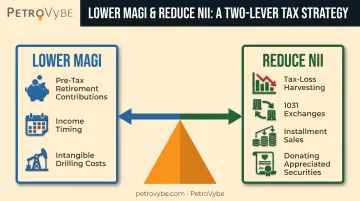
Think of NIIT planning as pulling one of two levers: lower your MAGI, or lower your net investment income. Which lever matters depends on your income mix.
If wages dominate your income: MAGI reduction does more work.
If investment income dominates: reducing NII directly through losses or deferral has the bigger effect.
Lowering MAGI
- Pre-tax retirement contributions. 401(k) and HSA contributions reduce taxable income and MAGI directly.
- Timing income recognition. Defer bonuses or stock vesting when you can keep MAGI under the threshold.
- Intangible drilling costs (IDCs). Working interests in oil and gas development can generate large first-year deductions against active income, including W-2 wages and capital gains. This treatment requires the investor to elect general partner status in the Subscription Agreement and may be limited in a given year by the excess business loss limitation under IRC §461(l).
Reducing Net Investment Income
- Tax-loss harvesting. Realized losses offset realized gains. Excess losses can reduce ordinary income by up to $3,000 per year; the balance carries forward.
- 1031 exchanges. Swapping investment real property for like-kind property generally defers the gain and its NIIT impact.
- Installment sales. Spreading gain recognition across multiple years also spreads the NIIT liability.
- Donating appreciated securities. Giving stock directly to charity avoids realizing the embedded gain, so that gain never enters NII.
These tactics reduce exposure year by year. If your income sits above the threshold every year, you need a recurring plan—not a one-time fix.
A Different Approach: Reducing Active Income Tax Burden Through Oil & Gas Development
Here's the distinction that changes the conversation: NIIT deductions only touch investment income. They can't reduce what you owe on W-2 wages or ordinary capital gains. Intangible Drilling Cost (IDC) deductions work differently. Under IRC 263(c), operators and working-interest holders can elect a current-year deduction for eligible intangible drilling costs—such as labor, fuel, and site preparation with no salvage value. Because a direct working interest is treated as nonpassive under tax law, the resulting deduction isn't confined to passive or investment income. That creates a different tax lever:. This treatment requires the investor to elect general partner status in the Subscription Agreement and may be limited in a given year by the excess business loss limitation under IRC §461(l).
- NIIT planning shaves 3.8% off investment income only
- IDC deductions can offset tax on active income, including W-2 wages and capital gains PetroVybe operates in that second category. The company offers accredited investors direct working-interest participation in Texas natural gas projects structured around this deduction. What partners have actually seen:
- 2025 partners received a 94% deduction against active income. Prior result; not a promise of any future deduction.
- Applies to W-2 earnings and capital gains—not just passive income Beyond the upfront tax benefit, the current program is backed by roughly 400 acquired wells and 57+ planned new wells across a 58,000-acre position in Lavaca County, Texas. It targets a 10-year MOIC of 2.2x to 5.8x and an IRR near 26%, with quarterly passive distributions projected to peak above $10,000 during production. This isn't for everyone. It's built for accredited investors with $100,000+ in liquidity who have already used conventional diversification through stocks, bonds, and real estate. For that group, the appeal is a tax lever that works on active income—not only the 3.8% surtax. This treatment requires the investor to elect general partner status in the Subscription Agreement and may be limited in a given year by the excess business loss limitation under IRC §461(l).

Frequently Asked Questions
What are the tax deductions I can claim for financial investments?
You can deduct investment interest expense, state and local taxes allocable to investment income, and rental or royalty expenses tied to that income. Most personal itemized deductions—like mortgage interest or charitable gifts—do not reduce NII.
How much tax is deducted from investment income?
NIIT applies a flat 3.8% rate to the lesser of your net investment income or your MAGI above the threshold. This comes on top of your regular capital gains tax, not instead of it.
What is Form 8960 and do I need to file it?
Form 8960 calculates your NIIT liability and attaches to Form 1040. You need it if your MAGI exceeds your filing status threshold and you have investment income that year.
Are IRA and 401(k) distributions subject to NIIT?
No, these distributions are excluded from net investment income. However, they still count toward MAGI, so a large distribution can indirectly push you over the threshold.
Can I avoid NIIT entirely through other investments?
You can't eliminate NIIT once income exceeds the thresholds, but assets with active-income deductions—such as oil and gas intangible drilling costs (IDCs)—can offset ordinary income and lower your overall tax bill. This treatment requires the investor to elect general partner status in the Subscription Agreement and may be limited in a given year by the excess business loss limitation under IRC §461(l).
Does rental income always count toward NIIT?
Generally yes, unless you qualify as a real estate professional who materially participates. That usually means more than 750 hours a year in real property trades or businesses, and more than half your working time in those activities.
Informational requests only. PetroVybe projects are offered solely to verified accredited investors. Submitting this form does not create an investment or advisory relationship.