

Royalty income gets taxed as ordinary income, the same brackets as your paycheck. But it comes bundled with deductions most W-2 earners never encounter, like depletion allowances, severance tax offsets, and administrative cost write-offs. This article breaks down how those deductions work, then contrasts them with the far larger deductions available to working interest and development investors, the ones who fund the drilling itself rather than just collecting a royalty check.
Key Takeaways
- Royalty income is reported on Form 1099-MISC and taxed as passive income on Schedule E, not self-employment income
- Percentage depletion lets owners deduct 15% of gross royalty income annually, even at zero basis
- Severance taxes, legal fees, and property taxes tied to the mineral interest are all deductible
- Working interest owners, unlike royalty owners, can deduct IDCs against active income like W-2 wages
What Is a Royalty Interest and How Is It Taxed?
A royalty interest gives you a share of production revenue without making you pay a dime toward drilling or operating the well. Working interest owners fund those costs directly and run the operation like a business. That distinction drives almost every tax difference between the two structures.
The IRS Oil and Gas Audit Technique Guide draws this line clearly: royalty owners hold a nonoperating interest, free of development and operating costs, while working interest owners bear those costs and get treated as running a trade or business.
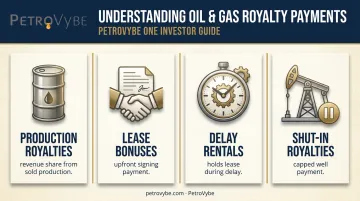
Royalty payments show up in a few different forms, all treated as ordinary income at the federal level:
- Production royalties – your cut of revenue from oil and gas actually sold
- Lease bonuses – upfront payments for signing a lease, before drilling starts
- Delay rentals – payments to hold a lease when drilling gets postponed
- Shut-in royalties – payments you receive when a producing well sits temporarily capped
How Royalty Income Gets Reported
Royalty income appears in Box 2 of Form 1099-MISC. From there, they land on Schedule E of Form 1040. Most royalty owners never touch a Schedule C, and they typically avoid self-employment tax entirely since they hold a passive, nonoperating interest.
Does Royalty Income Qualify for the QBI Deduction?
Generally, no. The Section 199A Qualified Business Income deduction requires income from an actual Section 162 trade or business, and passive royalty income from a mineral interest you don't actively manage usually doesn't clear that bar.
If you materially participate in an operation tied to that royalty, the analysis changes — though that's rare for pure royalty holders. Confirm your specific situation with a CPA before assuming either way.
One more wrinkle: passive royalty income can also trigger the 3.8% Net Investment Income Tax, reported on Form 8960, once your modified adjusted gross income clears $200,000 (single) or $250,000 (married filing jointly).
The Depletion Deduction: The Biggest Tax Break for Royalty Owners
Every barrel pulled from the ground permanently shrinks the reserve underneath your property. The IRS recognizes that lost value with a depletion deduction, the mineral-rights equivalent of depreciation. It's the single largest tax break available to royalty owners, and plenty of people leave money on the table by not calculating it correctly.
Percentage Depletion vs. Cost Depletion
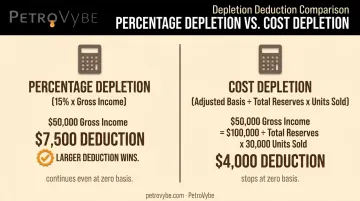
Two methods exist, and the rules require you to calculate both every year and claim whichever produces the bigger deduction.
Percentage depletion lets qualifying independent producers and royalty owners deduct a flat 15% of gross income from the property. Under IRC Section 613A, this deduction continues for the life of the well, even after you've fully recovered your original cost basis.
The deduction comes with limits:
- Can't exceed 100% of taxable income from that specific property
- Capped at roughly 65% of your overall taxable income
- Subject to production volume limits built into the statute
Cost depletion works differently. Take your adjusted basis in the property, divide it by total estimated recoverable reserves, then multiply by units sold that year. Once your basis hits zero, cost depletion stops. Percentage depletion does not.
A Simple Example
Say you own a royalty interest generating $50,000 in gross income this year. Percentage depletion gives you a $7,500 deduction (15% of $50,000), regardless of your remaining basis.
If your cost basis and reserve estimates instead produced a $4,000 cost depletion figure, you'd claim the larger number, percentage depletion in this case. That $7,500 comes straight off your taxable royalty income, before you even factor in severance taxes or admin costs.
Other Deductible Expenses Against Royalty Income
Depletion isn't the only deduction available. Several other costs reduce your taxable royalty income:
- Severance and production taxes – state levies withheld before your check arrives; Texas taxes oil at 4.6% of market value and natural gas at 7.5%. Claim this as its own deduction rather than netting it from gross income.
- Legal and accounting fees – costs tied to reviewing lease agreements, tracking payments, or resolving title disputes, provided they relate directly to managing the income-producing property.
- Administrative costs – management fees and bookkeeping expenses tied to your mineral interest.
- Property taxes – county ad valorem taxes billed annually against the assessed value of your mineral interest, separate from severance tax.
- Abandonment losses – formally and permanently abandoning a non-producing royalty interest generally produces a deductible ordinary loss.
One caveat: Costs tied to acquiring the interest itself, like title examination fees or acquisition commissions, typically get added to your basis rather than deducted immediately. That's a capitalization question, not a current-year deduction, so keep those categories separate on your books.
How Royalty Deductions Are Reported on Your Tax Return
Schedule E, Part I, is where all of this comes together. You'll list each royalty property separately, report gross income, then work through deductions line by line:
- Report gross royalty income on line 4
- Claim legal and professional fees on line 10
- Deduct management fees on line 11
- Enter taxes, including severance and property tax, on line 16
- Claim your depletion deduction on line 18
- Net everything out to calculate income or loss for that property
Because royalty payments rarely have federal tax withheld, most owners need to make quarterly estimated payments using Form 1040-ES.
The safe harbor rule helps you avoid penalties. Pay at least:
- 90% of your current year's tax liability
- 100% of last year's tax liability
- 110% of last year's liability if your prior-year AGI topped $150,000
Beyond the payment schedule, here's a detail that trips up plenty of royalty owners: your income gets sourced to the state where the producing property sits, not where you live. Own a royalty interest in North Dakota while living in Texas?
You may owe a nonresident North Dakota return in addition to your federal filing. Some states even withhold royalty payments upfront for exactly that reason.
Royalty Deductions vs. Working Interest Deductions: Why the Gap Matters
Here's where the math changes dramatically. Royalty owners get capped at roughly 15% percentage depletion. Working interest owners who fund actual drilling can deduct Intangible Drilling Costs, covering labor, fuel, hauling, and other non-salvageable development expenses. IDC deductions routinely reach 60-80% of invested capital in the year drilling occurs.
That gap also determines where the deduction can go:
- Royalty depletion offsets only the passive royalty income itself. Run out of royalty income to offset, and the deduction has nowhere to go that year.
- IDC deductions apply against active income, including W-2 wages and capital gains, under the direct working interest exception to the passive activity rules.
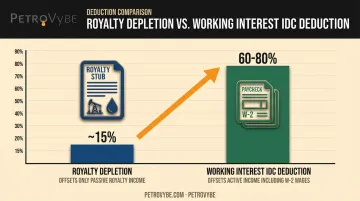
There's a structural reason for this difference. Royalty owners never fund drilling, so they never bear the cost that IDC deductions are designed to offset. Working interest partners write the check for development, and the tax code lets them deduct it as they go, while royalty owners have no say over drilling costs or timing in the first place.
PetroVybe's working interest development model illustrates this in practice. Structured for accredited investors under SEC Regulation D 506(c), PetroVybe ONE gives partners a direct working interest position across a 58,000-acre development in Lavaca County, Texas. The project is backed by roughly 400 producing wells and more than 57 planned new wells.
PetroVybe's 2024 partners saw first-year tax deductions ranging from 91% to 94% of invested capital against active income. That's a materially larger offset than any royalty owner could achieve through depletion alone, while partners still participate in natural gas production upside over a projected 10-year hold.
None of this means one structure beats the other for every investor. A passive royalty position suits someone who inherited mineral rights and wants simplicity. A working interest development stake suits someone actively managing a large tax bill who wants deductions against W-2 income or capital gains. Talk to a qualified CPA before deciding which fits your income profile and long-term goals.
Frequently Asked Questions
What is the royalty deduction for oil and gas?
The primary deduction is the depletion allowance, either 15% percentage depletion or cost depletion, whichever is larger. Severance taxes and administrative expenses tied to the mineral interest are also deductible.
How do royalties work in oil and gas?
Royalty owners receive a share of production revenue without paying drilling or operating costs. That income is reported as ordinary income on Schedule E, typically without triggering self-employment tax.
Does oil royalty income qualify for the QBI deduction?
Generally not. Passive royalty income doesn't qualify for the Section 199A deduction unless the owner materially participates in a related trade or business. Confirm your specific facts with a CPA.
Are oil and gas royalties considered passive income?
Yes, royalties are typically reported as passive income on Schedule E and aren't subject to self-employment tax. They can, however, trigger the 3.8% Net Investment Income Tax above certain thresholds.
Can royalty owners deduct severance taxes paid on production?
They are. Severance and production taxes are deductible against gross royalty income, often already reflected as withheld amounts on your 1099-MISC statement.
What's the difference between depletion and the IDC deduction available to working interest owners?
Depletion is capped around 15% and applies only to passive royalty income. IDC deductions for working interest owners, the structure used by companies like PetroVybe, can reach 60-80% of invested capital and offset active income, including W-2 wages.