Many investors and industry watchers struggle to tell the difference between short-term price noise and the structural shifts that actually matter for long-term returns. A rig count dip doesn't mean the same thing as a permanent change in gas demand from AI infrastructure.
This article breaks down where crude and natural gas prices stand today, the biggest trends reshaping the sector, and what all of it means if you're considering putting capital into oil and gas.
Key Takeaways
- Crude and natural gas prices remain volatile, driven by OPEC+ decisions and geopolitical risk
- Natural gas is becoming a core fuel source for AI data centers and grid growth
- Accredited investors can still capture up to 94% tax deductions in upstream development
- South Texas and the Gulf Coast Basin lead gas development and LNG exports
- Vet track record and reserve data before committing capital to any oil and gas deal
Current State of the Oil & Gas Market
Global oil and gas markets are recalibrating fast, shaped by geopolitics, technology, and shifting energy demand all at once.
Crude Oil Price Trends
WTI crude at Cushing settled at $79.20 per barrel on July 13, 2026, while Brent traded at $81.62 per barrel. That's a meaningful step down from June's monthly averages of $84.81/bbl (WTI) and $85.40/bbl (Brent) in 2026, both well above 2025 levels, when WTI averaged just $68.17/bbl.
S&P Global pointed to the effective closure of the Strait of Hormuz as the dominant price driver this year. The firm also cut its 2026 demand growth forecast to a contraction of 80,000 b/d, a sharp reversal from the pre-conflict estimate of 730,000 b/d growth.
OPEC+ has been actively managing supply in response. On July 5, 2026, Saudi Arabia, Russia, and five other producers approved a 188,000 b/d production adjustment for August, citing market stability and flexibility to reverse course if needed. Reuters noted crude settled near pre-Iran-war levels following the move, with the next OPEC+ review set for August 2.
Net effect: oil prices remain reactive to geopolitics, but OPEC+ has shown it's willing to use quota adjustments to keep the market from swinging too far in either direction.
Natural Gas Market Dynamics
Henry Hub spot gas priced at $2.83/MMBtu on July 13, 2026, below the July 2025 monthly average of $3.20/MMBtu but roughly in line with 2023 levels.
Demand-side fundamentals look stronger than the spot price suggests:
- US LNG export capacity hit 15.4 Bcf/d as of October 2025, with another 13.9 Bcf/d planned through 2029
- LNG exports averaged 15.1 Bcf/d in 2025, a 26% jump from 2024
- Actual exports reached 17.9 Bcf/d in April 2026, ahead of EIA's own forecast pace
- EIA projects average exports of 17.4 Bcf/d in 2026 and 18.6 Bcf/d in 2027
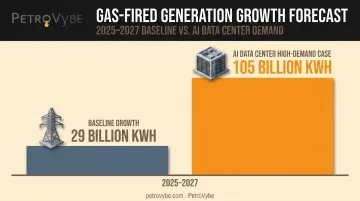
Power-generation demand is the other piece of this puzzle. Under EIA's high-demand case, AI data centers push regional electricity growth 50% above baseline. Gas-fired generation could rise by 105 billion kWh between 2025 and 2027 — more than triple the 29 BkWh baseline growth. That's the setup for the next trend worth watching.
Top Industry Trends to Watch
AI & Electricity Demand Boom
Data centers are pulling more power off the grid than almost anyone predicted two years ago. S&P Global projects US data-center grid demand reached 61.8 GW by year-end 2025, up 22% from 2024, with that figure climbing to 75.8 GW in 2026 and 134.4 GW by 2030.
Rystad Energy goes further, estimating US data centers could require 395-660 TWh annually by 2035, at least 10% of current national electricity demand. More than 100 GW of announced data-center projects are already in some stage of land acquisition or construction.
Renewables can't scale fast enough to absorb this alone, and grid interconnection queues are backed up for years. That leaves natural gas as the practical option for utilities and independent power producers trying to meet load growth on a realistic timeline. Natural gas is dispatchable, domestic, and supported by infrastructure that already moves it across much of the country.
Technology & Digitalization in Operations
AI and machine learning are reshaping how operators find and develop wells. Three applications stand out:
- Predictive maintenance models flag equipment failures before they happen
- Seismic interpretation tools process data in a fraction of the time older workflows required
- Drilling optimization algorithms adjust in real time to reduce nonproductive hours
Operators who adopt these tools well are pulling ahead on cost per barrel, turning a technical edge into a real competitive advantage.
Shift Toward NGLs and Premium Liquids
Natural gas liquids are commanding a real premium over dry gas right now. In April 2026, the US NGL composite price averaged $7.28/MMBtu, compared to just $2.77/MMBtu for Henry Hub dry gas, a gap wide enough to change how operators think about drilling economics.
This spread is pushing more independent developers toward liquids-rich acreage, where the same wellbore can produce oil, gas, and higher-value NGLs simultaneously.
M&A, Consolidation & Domestic Energy Security
Consolidation among independents hasn't slowed. Diversified Energy's $1.28 billion acquisition of Maverick Natural Resources in January 2025 (including roughly $700 million in assumed debt) added Permian assets to its Appalachia and Central Basin footprint. The deal created a pro forma production base of 59,000 boe/d split across gas, NGLs, and oil.
On the policy side, the administration's January 2025 national energy emergency declaration was designed to speed up permitting for domestic oil and gas projects. Together, private consolidation and federal policy support are accelerating the same goal: reducing US reliance on foreign energy sources.
Regulatory and Policy Landscape
Tax and environmental rules still shape where and how operators drill.
Tax treatment of Intangible Drilling Costs (IDCs) remains one of the sector's most consequential provisions. IRS Publication 5652 confirms that operators and investors can elect to expense qualifying IDCs in the year they're paid or incurred, rather than capitalizing them.
The 2025 Form 6251 instructions clarify that excess IDCs become an AMT preference item only when they exceed 65% of net income from the properties. That threshold matters for anyone modeling after-tax returns.
On the environmental side, the EPA's 2025 interim final rule pushed back specified compliance deadlines under the 2024 methane rule by 18 months, giving operators more runway on control devices, leak detection, and storage vessel requirements.
At the state level, Texas Railroad Commission rules matter directly for anyone operating in-state:
- Revised Chapter 4, Subchapter A waste-management rules took effect July 1, 2025
- New requirements cover authorized pits, waste manifests, and closure standards
- Operators in South Texas and the Gulf Coast Basin fall directly under these updated rules
Regional Spotlight: US Shale and the Gulf Coast Basin
Drilling activity has been ticking back up. Baker Hughes reported 588 active US rigs for the week of July 17, 2026, up 7 from the prior week — the fifth consecutive week of gains.
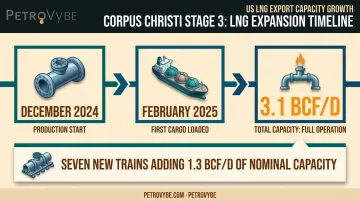
That national uptick is playing out most visibly in South Texas and the Gulf Coast Basin, which continue to stand out as growth corridors thanks to their proximity to LNG infrastructure. Corpus Christi's Stage 3 expansion illustrates why:
- Located in San Patricio County, the expansion began production in December 2024 and loaded its first cargo in February 2025
- Seven new trains add 1.3 Bcf/d of nominal capacity
- Total Corpus Christi capacity reaches 3.1 Bcf/d once fully operational
EIA data confirms the pattern: nearly all US LNG export capacity sits on the Gulf Coast, with every new project modeled through 2025 located in Texas and Louisiana.
PetroVybe is one of the companies actively developing natural gas assets in this corridor. Its flagship PetroVybe ONE project sits in Lavaca County, Texas, within the broader South Texas/Gulf Coast footprint benefiting from LNG-driven demand.
The company's combined operations span roughly 58,000 acres and 400 producing wells, generating about 1,300 boepd. That output puts PetroVybe among the operators actively driving growth in this corridor.
What These Trends Mean for Investors
Volatility and AI-driven demand growth are creating a genuinely unusual setup: short-term price swings sitting on top of what looks like a durable, multi-year increase in gas demand. That combination cuts both ways — it's risk and opportunity depending on how an investment is structured.
Tax efficiency is where oil and gas still stands apart from most other asset classes. IDC deductions can offset active W-2 income and capital gains, not just passive income. That's a distinction that doesn't exist in real estate or most public equity structures.
PetroVybe's own partner data shows deduction rates of 91% in 2025 and 94% in 2024 against active income, illustrating how substantial this benefit can be in practice.
Beyond the tax picture, direct working-interest investments offer a different return profile than public equities or REITs:
- Distributions are tied to production volume and cash flow, not daily stock price movement
- There's no market to panic-sell into during a price dip
- Returns compound over a multi-year hold rather than reacting to quarterly earnings calls
PetroVybe's own model targets a 10-year MOIC range of roughly 2.2x to 5.8x and an IRR near 26%, figures the company describes as illustrative and forecast-dependent rather than guaranteed.
None of this replaces due diligence. Before committing capital, look at:
- Operator track record: Has this team actually scaled assets before, or is this their first project?
- Third-party engineering validation: Is the reserves estimate independently verified, or just management's projection?
- Transparency: Will the operator show you well data, not just marketing slides?
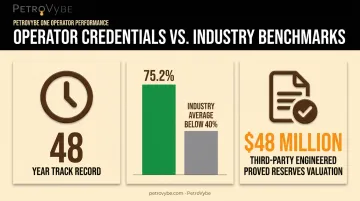
PetroVybe points to its own team credentials as part of this picture: a Chief Geophysicist with a 48-year track record and a 75.2% well success rate against an industry average below 40%, plus a $48 million third-party engineered proved reserves valuation.
Whether that specific track record fits your goals is a decision only you and your advisors can make. It's the kind of detail worth demanding from any operator before wiring capital.
Frequently Asked Questions
What's going on with oil and gas?
Prices remain volatile due to OPEC+ supply decisions and Middle East geopolitical risk, while natural gas is gaining structural importance as a power source for AI data centers and grid expansion.
Are oil prices expected to surge?
EIA's July 2026 outlook forecasts Brent averaging $74/bbl in Q3 2026, falling to $70/bbl by Q4 as supply recovers post-Hormuz reopening. Most analysts expect prices to soften, not surge.
Why is natural gas important for AI data centers?
Natural gas offers reliable, dispatchable power that scales with grid demand faster than renewables alone. EIA models a 105 BkWh increase in gas-fired generation between 2025 and 2027, driven by data center growth.
What tax benefits exist for oil and gas investments?
Intangible Drilling Cost deductions let investors offset active W-2 income and capital gains, not just passive income. PetroVybe partners saw deduction rates of 91-94% against active income in recent years.
Is now a good time to invest in oil and gas?
Timing depends on your risk tolerance, tax situation, and investment horizon. Evaluate the operator's track record and third-party validation before considering entry timing.
How do oil and gas price fluctuations affect long-term investors?
Direct development investments are typically structured around 10-year production cycles and cash flow, meaning a single volatile year has limited impact on overall project returns.