
This article is general education, not investment, tax, or legal advice. A $400,000 lump sum is a milestone most people reach after years of saving, an inheritance, or a business sale. The natural next question: how much monthly income can this actually generate?
The answer varies wildly. A high-yield savings account might hand you $1,350 a month. A dividend ETF could land closer to $980. Meanwhile, alternative assets promise different structures entirely. That range is exactly why a simple, honest calculator framework matters more than a single magic number.
This guide breaks down the real math behind monthly returns on $400K, compares common investment vehicles using current rates, and introduces a less familiar category: direct oil and gas development, which offers accredited investors tax-advantaged passive income outside the stock market.
Key Takeaways
- $400K can yield roughly $207–$1,431/month, from average savings up to 10-year Treasury benchmarks
- The core formula: (Principal × Annual Rate) ÷ 12 = Monthly Income
- Tax treatment—ordinary income, qualified dividends, or deductions—changes what you keep each month
- Accredited investors with $400K+ liquidity can access alternatives like direct natural gas development
How Does a Monthly Return on $400K Calculator Work?
The Basic Formula
Start simple: Monthly Income = (Principal × Annual Rate of Return) ÷ 12
At a 5% annual yield on $400,000:
- Annual return: $400,000 × 0.05 = $20,000
- Monthly income: $20,000 ÷ 12 = $1,667/month

Every income projection starts from this baseline.
Simple vs. Compound vs. Distribution-Based Income
These three produce very different quarterly figures:
- Simple interest pays a flat rate on the original principal only — common in basic savings products
- Compound interest grows the balance itself, since interest earns interest over time — the Schwab compound formula is A = P(1 + r/n)^(n×t)
- Distribution-based income (ETFs, funds, oil and gas projects) pays from cash flow or NAV and can vary month to month
Nominal vs. Real Returns
A 4.05% nominal savings rate sounds solid until you factor in inflation. With 2025 CPI running at roughly 2.6%, the real return calculation is:
Real return = (1 + nominal) ÷ (1 + inflation) − 1
That 4.05% nominal yield shrinks to roughly 1.4% in real purchasing power. Skip this step and a “solid” monthly figure overstates what the income still buys after inflation.
Key variables every calculator needs:
- Principal (your $400,000)
- Expected annual rate
- Time horizon
- Tax rate on the distributions
Change any one, and the quarterly output shifts significantly.
How you handle distributions matters just as much:
- Withdraw the cash and that capital stops earning
- Reinvest it and the balance keeps compounding
How Much Income Will $400K Generate Per Month?
Here's where the vehicle you choose makes or breaks your quarterly number.
| Vehicle | Typical Rate (2025) | Monthly Income on $400K | Liquidity/Tax Notes |
|---|---|---|---|
| Savings, national average | 0.62% | $207 | Fully liquid, ordinary income |
| Savings, top offer | 4.05% | $1,350 | Liquid, ordinary income |
| 12-month CD, top offer | 3.60% | $1,200 | Locked term, ordinary income |
| 10-year Treasury | 4.29% | $1,431 | Semi-liquid, favorable state tax treatment |
| Dividend ETF (VYM proxy) | 2.94% | $980 | Market-correlated, often qualified dividends |
| REIT index (Nareit All Equity) | 4.07% | $1,357 | Market-correlated, mostly ordinary income |

According to Bankrate's 2025 savings data, the gap between a top-tier savings offer and the national average is enormous, nearly $1,150/month on the same principal. That spread alone turns "shop around" from optional advice into hard math.
A word of caution on high-yield promises: Single-stock option-income ETFs advertising 12%+ yields often carry significant principal risk and volatility. Higher advertised income usually means the fund is selling upside potential or taking on leverage. Read the fine print before chasing yield.
Where Oil and Gas Development Fits In
Traditional income vehicles are all correlated to interest rates or stock market sentiment. Direct oil and gas development sits outside that correlation entirely, generating cash flow from producing wells rather than market pricing.
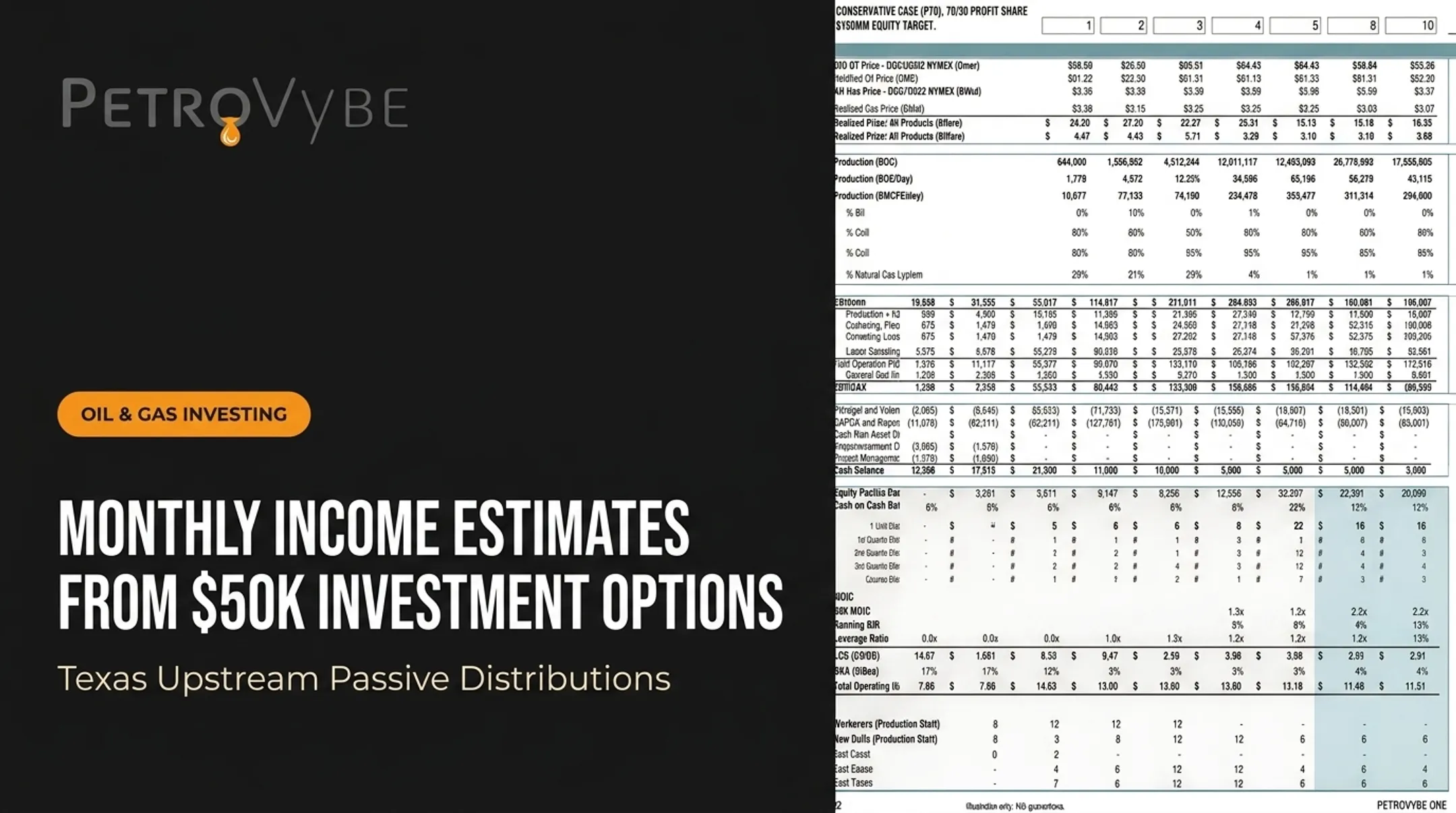
PetroVybe, a Texas-based natural gas developer, offers accredited investors direct participation in development projects across Lavaca County and the Gulf Coast Basin. The structure includes:
- A targeted 10-year MOIC of approximately 2.2x–5.8x
- A targeted 26% IRR
- Projected peak quarterly passive distributions exceeding $10,000/month during the production phase (project-level partner projection)
- First-year tax deductions against active income, including W-2 earnings, of up to 94% for recent partners. Prior result; not a promise of any future deduction.

This isn't a substitute for a savings account. It's a different asset class with an illiquidity trade-off: first distributions typically arrive 2-3 years after investment, not immediately.
Can I Live Off the Interest of $400K?
Using the 4% safe withdrawal rule, $400,000 generates about $16,000 a year, or roughly $1,333/month, before tax.
That's rarely enough on its own. Most households spend more than $1,333/month on housing alone, let alone healthcare, food, and transportation.
A few honest caveats:
- The 4% rule comes from Bengen's 1994 historical research on stock/bond portfolios since 1926. It is a withdrawal framework, not a guaranteed interest rate
- Morningstar's 2025 base case lowers this to 3.7% for a 30-year horizon with 90% success probability, or about $1,233/month
- Inflation erodes fixed monthly income, so a rate that works in year one may fall short by year ten
Living off interest alone usually works only when layered with Social Security, part-time income, or higher-yield alternative investments, not as a single-vehicle strategy.
How Much Will $400,000 Grow in 10 Years?
Compound growth over a decade looks different from monthly income alone.
Using Fidelity's reported 40-year average S&P 500 return of 11.5%, or a more conservative 7% blended estimate:
- At 7% annually: $400,000 grows to about $786,000 over 10 years, with no added contributions
- At 10% annually: $400,000 grows to roughly $1.037 million
- At 11.5% annually: $400,000 grows to roughly $1.19 million

The reinvestment trade-off matters. Withdrawing quarterly distributions for spending stops compounding on that cash immediately. Reinvesting those same distributions keeps the growth curve climbing—the real gap between decade-long wealth building and month-to-month income extraction.
Tax-advantaged structures change the math further. A large upfront IDC deduction that offsets active income in year one frees up more after-tax capital to reinvest elsewhere, something a standard brokerage account can't match. This treatment requires the investor to elect general partner status in the Subscription Agreement and may be limited in a given year by the excess business loss limitation under IRC §461(l).
Reducing Taxes While Maximizing Monthly Income
Not all monthly income is created equal after the IRS takes its share.
- Ordinary income (savings interest, CD interest, non-qualified dividends, bond interest) is taxed at your marginal rate, currently 10%-37%
- Qualified dividends and long-term capital gains receive preferential 0%, 15%, or 20% rates — but only when IRS holding-period rules are met
- IDC deductions from direct oil and gas working interests can offset active income, including W-2 earnings and capital gains, not just passive income. This treatment requires the investor to elect general partner status in the Subscription Agreement and may be limited in a given year by the excess business loss limitation under IRC §461(l).
That third category matters most for high-income earners. PetroVybe partners received a 94% deduction against active income in 2025, driven primarily by Intangible Drilling Costs. Prior result; not a promise of any future deduction. IDCs typically represent a first-year deduction target of approximately 70–80% of invested capital in a new drilling project, with depletion allowances adding further relief. This treatment requires the investor to elect general partner status in the Subscription Agreement and may be limited in a given year by the excess business loss limitation under IRC §461(l).
For someone in a high tax bracket, pairing a conservative income vehicle (like Treasuries or CDs) with a tax-advantaged alternative changes what actually lands in your pocket each month. A dollar of deducted income is worth more than a dollar taxed at 37%.
Frequently Asked Questions
How much income will $400K generate per month?
It depends heavily on the investment. Conservative options like savings accounts or Treasuries generate roughly $200-$1,430/month, while dividend ETFs and REITs land in the $980-$1,360 range using current 2025 rates.
Can I live off the interest of 400k?
Using the 4% rule, $400K generates about $1,333/month before tax, which is typically insufficient alone. Most retirees supplement this with Social Security, part-time work, or other income sources.
How much will $400,000 grow in 10 years?
At a conservative 7% average return, $400,000 grows to roughly $786,000 over 10 years without added contributions. Actual results vary based on asset class, fees, and whether distributions are reinvested.
What is a realistic monthly return rate to expect on $400K?
Realistic rates for diversified traditional portfolios range from 4-7% annually. Alternative assets like direct oil and gas development target higher returns, around a 26% target IRR, with different risk and tax profiles.
Are alternative investments like oil and gas development a good fit for generating monthly income from $400K?
These are generally reserved for SEC-defined accredited investors seeking diversification and tax efficiency, not immediate liquidity. Evaluate suitability with a financial advisor, since distributions typically begin only after a multi-year development period.
Informational requests only. PetroVybe projects are offered solely to verified accredited investors. Submitting this form does not create an investment or advisory relationship.