
This article is general education, not investment, tax, or legal advice. Hitting $100,000 in investable cash is a real milestone. It's enough to meaningfully accelerate retirement, cut your tax bill, and start building generational wealth, but only if you deploy it with a plan.
Many investors freeze at this stage. They try to time the market or hunt for a single "best" investment instead of building a diversified strategy that fits their actual risk tolerance and tax situation.
This guide covers where $100K can go in 2026, how to think about risk, tax-efficient moves worth knowing, and the mistakes that quietly erode returns.
Key Takeaways
- Build your $100K strategy around risk tolerance and time horizon, not a single "best" investment
- Spread capital across low-, moderate-, and high-risk assets to cushion volatility without giving up upside
- Oil and gas development can deliver large first-year deductions against active income for accredited investors
- Automated, consistent investing beats trying to time the market over multi-year horizons. This treatment requires the investor to elect general partner status in the Subscription Agreement and may be limited in a given year by the excess business loss limitation under IRC §461(l).
Before You Invest: Get Your Financial Foundation Right
Before any of the $100K goes toward long-term growth, handle two things first.
Pay off high-interest debt. Credit card APRs averaged roughly 25% for general-purpose cards and 31% for private-label cards in the CFPB's most recent report, based on 2024 data. No mainstream investment reliably beats that. Paying off a 25% APR balance is effectively a guaranteed 25% return.
Build an emergency fund first. Park 3–6 months of living expenses in a liquid, accessible account—separate from your $100K—so a job loss or repair bill does not force you to unwind long-term positions.
Once those boxes are checked, define your goals:
- Retirement acceleration on a defined timeline
- Tax-liability reduction against active income
- Passive monthly income from producing assets
- Long-term legacy wealth you can transfer or exit
That priority order decides how aggressively—and where—you put the $100K to work.
Know Your Risk Tolerance Before Choosing Where to Invest
A $100K allocation should match how much volatility—and illiquidity—you can live with, not only what looks attractive on paper.
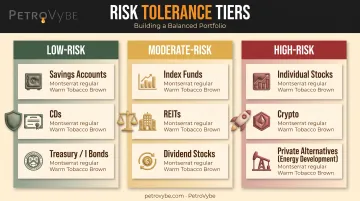
Low-Risk Investors
If capital preservation matters most, stick with vehicles that protect principal:
- High-yield savings accounts
- Certificates of deposit (CDs)
- Treasury securities and I Bonds
These won't make you rich, but they won't blindside you either.
Moderate-Risk Investors
A balanced mix accepts some volatility in exchange for growth that can outpace inflation:
- Broad index funds
- REITs
- Dividend-paying stocks
You trade day-to-day swings for longer-term purchasing-power protection.
High-Risk Investors
Comfort with volatility and longer hold periods opens higher-upside options:
- Individual stocks
- Cryptocurrency
- Private alternatives, including early-stage energy development
These carry real loss potential and often less liquidity, but also the largest upside for accredited investors who can commit capital for years, not months.
Best Ways to Invest $100K in 2026 by Risk Category
How you place $100K in 2026 depends on how much volatility you can tolerate and whether you need liquidity, income, or long-term growth. Here’s how common options compare by risk band.
Low-Risk Options
High-yield savings and CDs: As of August 2026, FDIC national averages sit at 0.38% for savings and 0.63% for money markets, with CD rates ranging from 1.14% to 1.71% across 3- to 12-month terms. Advertised "high-yield" accounts often beat these national averages, so shop around.
Treasury and I Bonds: New I Bonds issued through October 2026 carry a 4.26% composite rate, including a 0.90% fixed component. Redeeming before five years costs you the last three months of interest.
Moderate-Risk Options
Index funds and ETFs: The S&P 500 has returned roughly 10% annually since 1957, per Fidelity's research, though that's a historical average, not a promise.
REITs and dividend stocks: Nareit's July 2026 snapshot showed equity REIT yields around 3.56%, versus roughly 1% for the S&P 500. Income-focused, but principal still fluctuates.
High-Risk Options
Individual stocks and crypto: The SEC warns that crypto securities can be exceptionally volatile, with platforms sometimes lacking basic investor protections. Only risk money you can afford to lose entirely here.
High-Risk/Alternative: Direct Energy Development
Accredited investors can also put $100K into direct oil and natural gas development. This is where PetroVybe operates.
The project is built on producing assets in Lavaca County, Texas, in the Gulf Coast Basin:
- Roughly 400 acquired legacy wells
- 57+ planned new wells
- 58,000 acres under development
AI and data centers are pushing U.S. electricity demand higher, and natural gas already fuels a large share of the grid. Goldman Sachs estimates AI-driven data center growth could add roughly 3.3 Bcf/d of gas demand by 2030.
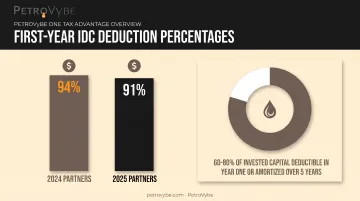
This path requires accredited investor status. Participation begins at one unit of $100,000, with add-on subscriptions from $25,000. It offers exposure that moves independently of stock and bond markets, and the partnership structure can support large first-year deductions against active income through intangible drilling costs (IDC) and depletion—94% for 2025 partners. Prior result; not a promise of any future deduction. This treatment requires the investor to elect general partner status in the Subscription Agreement and may be limited in a given year by the excess business loss limitation under IRC §461(l).

Diversification: Building a $100K Portfolio That Balances Growth and Protection
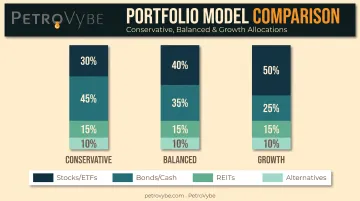
Spreading $100K across asset classes means no single market event can wipe you out. Match the mix to your risk tolerance, income needs, and time horizon—not to a generic rule of thumb. Three sample models:
| Model | Stocks/ETFs | Bonds/Cash | REITs | Alternatives |
|---|---|---|---|---|
| Conservative | 30% | 45% | 15% | 10% |
| Balanced | 45% | 25% | 15% | 15% |
| Growth | 55% | 10% | 10% | 25% |
On a $100K portfolio, that Alternatives sleeve is $10K–$25K depending on the model. Use it for assets that do not move in lockstep with public equities and bonds.
Who each model fits:
- Conservative — Prioritizes capital preservation and liquidity; heavier bonds/cash for nearer-term needs
- Balanced — Splits growth and ballast; common default for long-horizon wealth builders
- Growth — Accepts higher volatility for larger equity and alternatives exposure
Private natural gas development is one alternatives path accredited investors use inside that sleeve. Direct energy partnerships can add low correlation to stocks and bonds, plus tax-advantaged structure in some offerings—while tying capital up for a multi-year hold. Keep alternatives sized so a single project cannot dominate the portfolio.
Tax-Efficient Strategies to Maximize Your $100K in 2026
Before parking cash in a taxable brokerage account, use available tax-advantaged space. Retirement accounts: For 2026, the employee 401(k)-type limit is $24,500, and the IRA limit is $7,500, plus applicable catch-ups for those 50 and older. Tax-loss harvesting: Sell a losing position, replace it with something similar (not identical, to avoid the wash-sale rule), and use the loss to offset gains. Up to $3,000 of excess losses can offset ordinary income annually. Municipal bonds: Interest is generally exempt from federal tax, useful for high-income earners in taxable accounts. Oil and gas IDC deductions: Real estate depreciation is typically limited to passive income unless you qualify as a real estate professional. Intangible Drilling Costs (IDCs) work differently: they can offset active income, including W-2 earnings and capital gains. PetroVybe builds that advantage into its partnership structure. PetroVybe reports:
- 94% first-year deduction for 2025 partners. Prior result; not a promise of any future deduction.
- IDCs typically represent a first-year deduction target of approximately 70–80% of invested capital, deductible in year one or amortized over five years Always confirm accredited investor status with a CPA or tax attorney before pursuing deduction-heavy alternative strategies. Individual eligibility and tax treatment vary. This treatment requires the investor to elect general partner status in the Subscription Agreement and may be limited in a given year by the excess business loss limitation under IRC §461(l).
5 Mistakes to Avoid When Investing $100K
A $100K move can build real wealth—or stall—if a few avoidable errors creep in. Steer clear of these five:
- Trying to time the market. Morningstar's 2026 "Mind the Gap" study found investors earned 8.7% annually while their funds earned 9.9% over the same decade, a gap driven by poorly timed buying and selling.
- Concentrating the entire $100K into one asset or deal. Even a promising opportunity shouldn't be your whole portfolio; one bad outcome shouldn't sink the plan.
- Ignoring liquidity needs, fees, and tax drag. A high return on paper means little if lockups, fees, and taxes erase the edge.
- Skipping the emergency fund. Keep cash reserves separate so long-term positions never have to double as your safety net.
- Constantly switching strategies based on headlines. Vanguard's research found lump-sum investing beats staged entry more often than not, because it avoids second-guessing.
Frequently Asked Questions
How much interest will $100,000 make in a year?
It depends on where you place it. At current FDIC national averages, savings accounts yield around $380 annually, while a 1-year CD near 1.71% would generate roughly $1,710.
How much monthly income will $100,000 generate?
REIT yields around 3.56%-3.93% would generate roughly $297-$328 per month, while I Bonds at 4.26% annualize to about $355 monthly equivalent. Payout timing and structure still depend on the vehicle.
What is the best way to invest $100,000 for the best return?
Risk tolerance sets the ceiling. Diversified portfolios plus alternatives—such as accredited-investor energy development with upfront IDC tax benefits—can offer higher upside, with more risk and less liquidity.
Where is the safest place to invest $100,000?
FDIC-insured high-yield savings accounts, CDs, and Treasury securities are the lowest-risk options. FDIC insurance covers deposits up to $250,000 per depositor, per bank, per ownership category.
Where is the best place to put $100,000 right now?
2026 conditions favor a diversified mix: liquid low-risk holdings, a core of index funds, and for accredited investors, tax-advantaged alternatives like direct energy development that don't correlate with stock market swings.
Informational requests only. PetroVybe projects are offered solely to verified accredited investors. Submitting this form does not create an investment or advisory relationship.