

This article is general education, not investment, tax, or legal advice. Intangible drilling costs are often the single largest deduction on an oil and gas K-1 — sometimes a first-year deduction target of approximately 70–80% of invested capital, flowing straight into your first-year tax return. Yet many K-1 recipients open their form every spring and have no idea where that deduction is hiding or how to move it onto their 1040. This treatment requires the investor to elect general partner status in the Subscription Agreement and may be limited in a given year by the excess business loss limitation under IRC §461(l).
That confusion costs real money. Miss the deduction, misplace it on the wrong Schedule E line, or misunderstand your passive-versus-active classification, and you can leave thousands of dollars in tax savings unclaimed.
This guide walks through exactly where IDCs show up on a K-1, how to report them on Schedule E, the difference between active and passive treatment, and what you need to know about the Alternative Minimum Tax (AMT).
Key Takeaways
- IDCs usually show in Box 13 (Code J or ZZ) or inside Box 1 ordinary business loss
- Working interest owners without limited liability can deduct up to 100% of IDCs in year one under IRC §263(c)
- Limited partners often face passive loss limits unless an exception applies
- Report the deduction on Schedule E, Line 28; excess amounts may trigger AMT on Form 6251. This treatment requires the investor to elect general partner status in the Subscription Agreement and may be limited in a given year by the excess business loss limitation under IRC §461(l).
What Are Intangible Drilling Costs on a K-1
Under Treasury Reg. 1.612-4, intangible drilling costs (IDCs) are the non-salvageable expenses of drilling and preparing a well for production. Typical IDCs include:
- Labor and drilling contractor charges
- Fuel, chemicals, and hauling
- Site clearing and related prep work
None of these costs have resale value once the well is drilled.
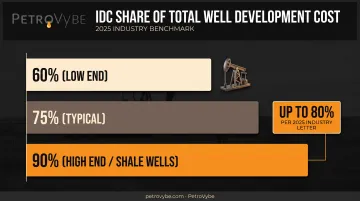
Per the Independent Petroleum Association of America, these costs can run 60% to 90% of a well's development cost, depending on well type, with shale wells often at the high end (IPAA testimony, 2021). A 2025 joint-industry letter puts the figure at up to 80% (IPAA, 2025).
Tangible vs. Intangible Distinction on the K-1
Not everything spent on a well qualifies as intangible. Tangible costs (casing, wellhead equipment, and tanks) have salvage value and are depreciated separately over seven years rather than expensed immediately.
Keep the two line items straight on your return. K-1 footnotes usually break out the AFE-based split between tangible and intangible costs—documentation worth keeping if the IRS asks.
Where to Find IDC Deductions on Your Schedule K-1
This is where most investors get stuck. IDCs aren't always in one obvious spot.
- Box 13, Code J: Reserved for Section 59(e)(2) expenditures — the attached statement lists the type, amount, and property
- Box 13, Code ZZ: Catch-all for items outside standard categories; not IDC by itself—confirm on the supplemental statement
- Box 1: Sometimes the ordinary business loss already includes IDC, bundled with other partnership expenses
- Box 17, Codes D and E: Report oil, gas, and geothermal gross income and deductions — needed to test your AMT exposure
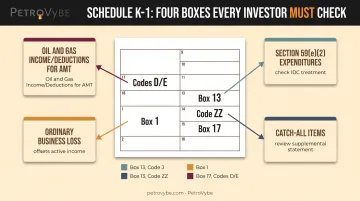
Always check the attached K-1 statement. The box code alone rarely tells the full story; the footnote does.
Cross-reference the reported IDC figure against the partnership's Authorization for Expenditure (AFE), which states the deal's projected intangible-versus-tangible split. If your K-1 shows a wildly different percentage than the AFE promised, that's a conversation for your CPA.
Timing matters too. Partnership K-1s are typically due by mid-March, with extensions pushing issuance to September 15. If you're expecting a large deduction, don't file your personal return until you've confirmed the K-1 is final.
Reporting IDC Deductions on Your Tax Return
Once you've located the IDC amount, it needs to land in the right place on your 1040.
The deduction flows to Schedule E, Line 28, where it factors into your overall taxable income. From there, you have two options:
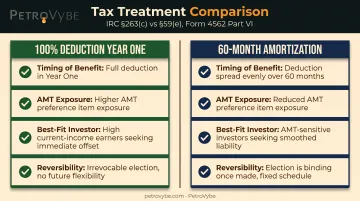
- Deduct 100% in year one under IRC §263(c), the standard approach for most working interest owners
- Amortize over 60 months under §59(e), calculated on Form 4562, Part VI, useful for investors trying to avoid AMT exposure or smooth income across multiple years
Once you elect a treatment for a given well, you generally can't switch later. Revoking a §59(e) election requires IRS consent, granted only in rare circumstances.
There's also a ceiling to watch: if IDCs exceed 65% of your net income from oil, gas, and geothermal properties, the excess must be treated separately for AMT purposes (IRS Form 6251 Instructions).
A simplified example: Say you invest $100,000 in a development project where IDCs represent 75% of invested capital. That's a $75,000 first-year deduction against ordinary income, before depletion or any AMT adjustment. This treatment requires the investor to elect general partner status in the Subscription Agreement and may be limited in a given year by the excess business loss limitation under IRC §461(l).
The exact percentage varies by project, so review your specific K-1 rather than relying on industry averages.
Active Income Classification and AMT Considerations
Whether your IDC deduction offsets active income—or sits unused against passive income only—depends on how you hold the interest. This treatment requires the investor to elect general partner status in the Subscription Agreement and may be limited in a given year by the excess business loss limitation under IRC §461(l).
Under IRC §469(c)(3), a working interest held without limited liability is exempt from passive loss rules. That usually means direct ownership or a general partnership structure. The deduction can then offset W-2 wages, active business income, and capital gains. This treatment requires the investor to elect general partner status in the Subscription Agreement and may be limited in a given year by the excess business loss limitation under IRC §461(l).
Contrast that with a standard limited partnership interest:
- IDC losses are generally classified as passive
- Passive losses can only offset passive income, unless you materially participate or hold a general-partner-type interest
- Some limited partners may qualify under IRS Publication 925 material-participation tests—the exception, not the rule
AMT exposure is the other piece. Excess IDC becomes a preference item under §57(a)(2), reported on Form 6251, Line 2t. It can shrink your net tax benefit, though it rarely eliminates it entirely.
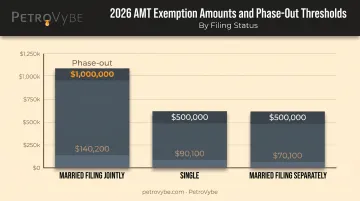
For 2026, the AMT exemption amounts are:
| Filing Status | Exemption | Phase-Out Begins |
|---|---|---|
| Married Filing Jointly | $140,200 | $1,000,000 |
| Single | $90,100 | $500,000 |
| Married Filing Separately | $70,100 | $500,000 |
(Source: IRS Rev. Proc. 2025-32)
Bring your K-1, the partnership's AFE breakdown, and last year's return to your CPA before year-end. Modeling the actual AMT impact ahead of time beats finding out in April.
Choosing a Structure That Maximizes Your K-1 Tax Benefit
Not every oil and gas K-1 is built the same way. The underlying partnership and operating structure determines whether your IDC deduction offsets active income or gets stuck in passive-loss purgatory. This is the detail investors skip past, and it's often the most expensive mistake in the deal. PetroVybe's development projects, structured around natural gas assets in South Texas's Lavaca County, are built with this distinction in mind. Accredited investors in PetroVybe ONE saw a 94% deduction against active income in 2025, figures tied to IDC and depletion allowances rather than passive-only categories. Prior result; not a promise of any future deduction. Individual results still depend on each investor's specific K-1 and personal tax situation, which is why reviewing the numbers with a CPA before committing capital matters. Before investing with any operator, ask for:
- Sample K-1s from prior years (redacted is fine)
- Historical deduction percentages actually achieved, not just projected
- Clarity on how the structure treats IDC relative to passive loss rules PetroVybe provides redacted 2025 K-1 samples through its investor materials for exactly this kind of due diligence, alongside offering documents and third-party engineering reports. This treatment requires the investor to elect general partner status in the Subscription Agreement and may be limited in a given year by the excess business loss limitation under IRC §461(l).
Frequently Asked Questions
Can I deduct intangible drilling costs on my K-1?
Yes, if the K-1 reflects a working interest. IDCs are generally deductible in full in year one, or you can elect to amortize them over 60 months. Passive activity rules determine whether that deduction offsets active income. This treatment requires the investor to elect general partner status in the Subscription Agreement and may be limited in a given year by the excess business loss limitation under IRC §461(l).
What does Box 13 code ZZ on Schedule K-1 mean?
Code ZZ is a catch-all for items that don't fit standard box codes. Check the attached supplemental statement for the specific deduction—in oil and gas partnerships, it is often IDC-related.
Where do I report IDC deductions on my 1040?
IDCs from a K-1 go on Schedule E, Line 28. Amortized amounts are calculated on Form 4562, and any AMT preference items land on Form 6251.
Can IDC deductions offset my W-2 income? This treatment requires the investor to elect general partner status in the Subscription Agreement and may be limited in a given year by the excess business loss limitation under IRC §461(l).
It depends on whether your working interest is exempt from passive loss rules under §469(c)(3). That generally requires unlimited liability exposure, not a standard limited partner position.
Do intangible drilling costs trigger the Alternative Minimum Tax?
Excess IDCs can become an AMT preference item, but most investors still see a net tax benefit. Have a CPA model the impact against your total income and other AMT triggers.
What's the difference between IDC and tangible drilling costs on my K-1?
IDCs cover non-salvageable costs like labor and fuel, deducted immediately. Tangible costs, such as equipment, get depreciated over seven years. Both may appear as separate K-1 line items or footnotes.
Informational requests only. PetroVybe projects are offered solely to verified accredited investors. Submitting this form does not create an investment or advisory relationship.