The 2023 environment made this worse. Higher interest rates changed where yield-seekers looked for returns, while persistent inflation pushed more households into brackets where every extra dollar of tax efficiency mattered. If you're earning $200,000+ individually or $400,000+ as a household, the standard playbook runs out fast.
This article breaks down the top investment vehicles available to high earners, the tax strategies that stretch every dollar further, and how to think about combining them into one coherent plan.
Key Takeaways
- High earners outgrow standard 401(k)/IRA limits and need supplemental strategies
- Backdoor Roth IRAs, HSAs, and taxable brokerages solve distinct tax problems
- Real estate and natural gas development add diversification and tax-deduction potential
- IDC deductions in oil and gas can offset active W-2 income, not just passive gains
- Match your mix to bracket, liquidity, and risk tolerance — no single "best" pick
Why High-Income Earners Need a Different Playbook
Once modified adjusted gross income (MAGI) crosses IRS phaseout thresholds, direct Roth IRA contributions disappear, and traditional IRA deductions shrink or vanish entirely.
For 2024, Roth IRA eligibility phases out at $230,000–$240,000 MAGI for married couples filing jointly. Traditional IRA deductions phase out even lower if you're covered by a workplace plan. Meanwhile, the top marginal rate of 37% hits taxable income above $609,350 (single) or $731,200 (MFJ) in 2024.
At those income levels, investment taxes stack on top of ordinary rates:
- Long-term capital gains rates (0%, 15%, 20%) depend on income thresholds that shift yearly
- The 3.8% Net Investment Income Tax applies once MAGI exceeds $200,000 (single) or $250,000 (MFJ)
- Short-term gains are taxed as ordinary income, so a high earner can lose nearly 40% on short-term trading gains

The options below prioritize tax efficiency, access for accredited or high-net-worth investors, and long-term wealth building.
Top Investment Options for High-Income Earners
Each option below is evaluated on tax treatment, contribution rules, risk/return profile, and how well it diversifies a portfolio already heavy in public equities.
PetroVybe: Natural Gas Development
PetroVybe is a private Texas-based natural gas development company focused on NGL production across South Texas and the Gulf Coast Basin, specifically Lavaca County. It gives accredited investors direct access to early-stage gas development assets — a category typically reserved for institutions.
What sets it apart:
- Chief Geophysicist with 48 years at ExxonMobil and a 75.2% well-location success rate (industry average: under 40%)
- Third-party engineering valued underlying reserves at $48 million PV-09
- IDC deductions apply against active W-2 income and capital gains, not only passive income
| Attribute | Detail |
|---|---|
| Tax Benefit | 91% deduction against active income (2024 partners); 94% (2025 partners) |
| Target Returns | 10-year target MOIC of ~2.2–5.8x; IRR of ~26% |
| Investor Fit | Accredited investors with $100,000+ liquidity seeking tax efficiency and passive income diversification |

Intangible Drilling Costs (IDCs) typically represent 60%–80% of invested capital in a new development project and are 100% deductible. Investors can claim them in year one or spread them over five years.
This is a statutory mechanism described in IRS Publication 535. PetroVybe structures offerings so accredited investors can use it against active income with minimal friction.
Backdoor Roth IRA
If your income locks you out of direct Roth contributions, the backdoor Roth is the workaround: contribute to a traditional IRA, then convert it.
| Attribute | Detail |
|---|---|
| Contribution Limit | $7,000 annually ($8,000 if 50+) for 2024 and 2025 combined across traditional and Roth IRAs |
| Tax Treatment | Taxes owed on conversion; tax-free growth thereafter |
| Best For | High earners over the Roth income limit |
One catch: the pro-rata rule. If you already hold pre-tax traditional, SEP, or SIMPLE IRA balances, part of your conversion may be taxable. The IRS looks at all IRA balances combined, not just the new contribution (IRS Form 8606 instructions).
Health Savings Account (HSA)
An HSA paired with a high-deductible health plan (HDHP) offers a triple tax advantage: deductible contributions, tax-free growth, and tax-free qualified withdrawals.
| Attribute | Detail |
|---|---|
| Contribution Limit | $4,300 individual / $8,550 family (2025) |
| RMDs | None required |
| Best For | Investors enrolled in HDHPs wanting a supplemental retirement vehicle |
Unlike a 401(k), there's no required minimum distribution age. Many high earners simply let the balance compound for decades and pay medical expenses out of pocket, saving receipts for later reimbursement.
Brokerage (Taxable Investment) Accounts
No contribution limits. No withdrawal penalties. Just standard capital gains and dividend taxation.
| Attribute | Detail |
|---|---|
| Tax Treatment | Capital gains and dividend taxes apply annually |
| Flexibility | Withdraw anytime, no penalty |
| Best For | Investors who've maxed tax-advantaged accounts and want liquidity |
The trade-off is tax drag. Interest income gets taxed at ordinary rates, while long-term gains and qualified dividends get preferential treatment — which is why asset location (what you hold where) matters as much as asset allocation.
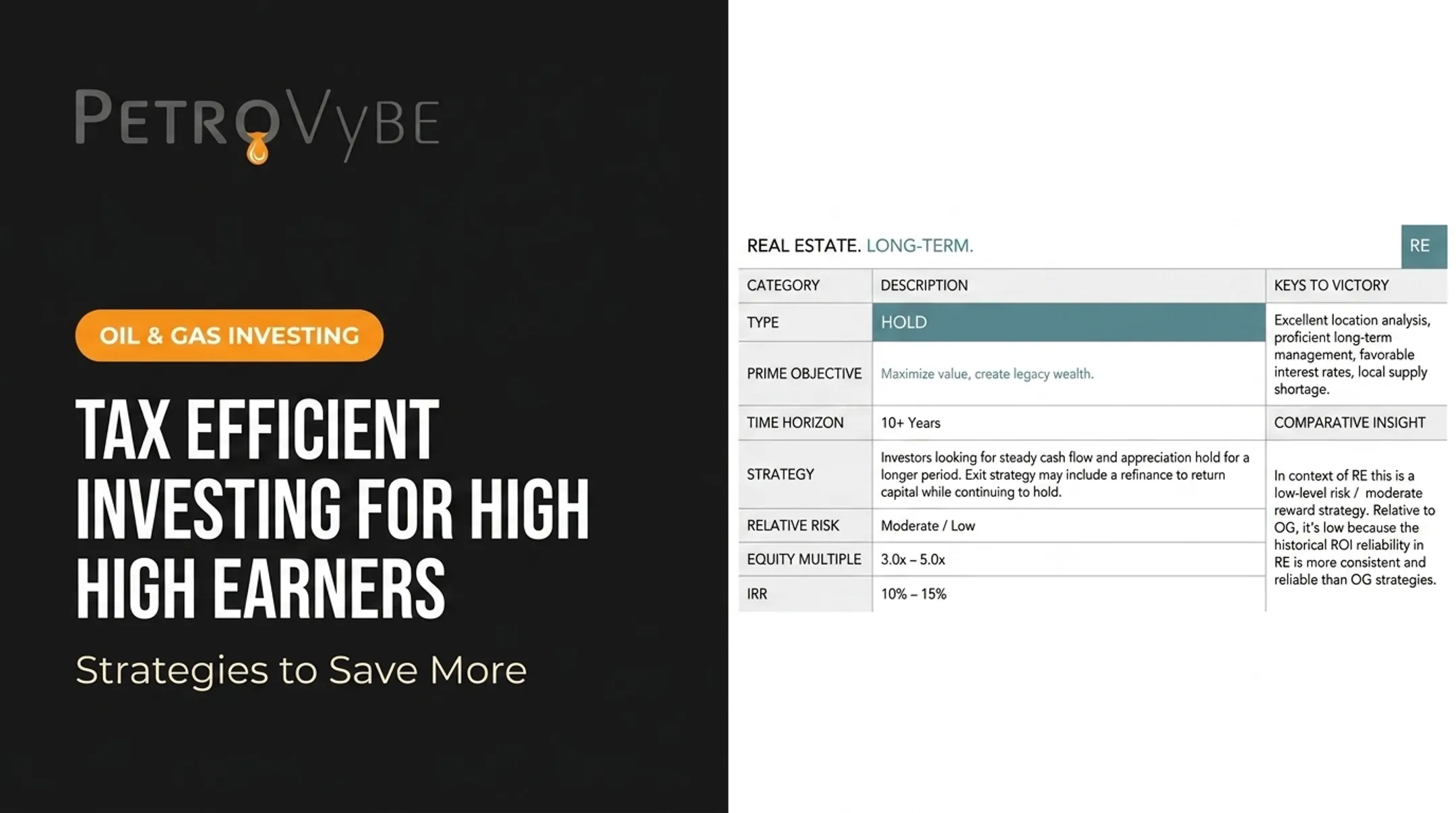
Real Estate (Direct or Syndicated)
Real estate offers appreciation, rental income, and depreciation-based deductions that shelter cash flow from taxes.
| Attribute | Detail |
|---|---|
| Tax Benefit | Depreciation deductions; potential 1031 exchange deferral |
| Time Commitment | High for direct ownership; low for syndications |
| Best For | Investors seeking tangible, income-producing diversification |
Residential rental property depreciates over 27.5 years under MACRS; commercial property over 39 years (IRS Publication 946). A 1031 exchange can defer gains indefinitely, but the rules are strict — you have 45 days to identify a replacement property and 180 days to close.

Advanced Tax-Efficient Strategies to Consider
Beyond picking the right accounts, high earners can stack a few tactics that keep more after-tax value in what they already hold.
Mega backdoor Roth. If your 401(k) allows after-tax contributions above the standard $23,500 deferral limit (2025), you can convert those amounts to Roth up to the $70,000 annual additions cap. Not every plan allows this, so read your plan document before you rely on it.
Tax-loss harvesting. Selling losers to offset gains is simple in concept. The wash-sale rule is the trap: buy a substantially identical security within 30 days before or after the sale, and the IRS disallows the loss.
Asset location. Keep tax-inefficient holdings such as bonds inside tax-deferred accounts. Leave tax-efficient equities in taxable brokerage accounts so qualified dividends and long-term gains can get preferential rates.
Municipal bonds. Interest is generally exempt from federal tax, which makes munis useful once you are in the top bracket. Watch private-activity bonds: some of that interest is an AMT preference item, so confirm the exemption before you buy.

Intangible drilling cost (IDC) deductions. Direct oil and gas development interests can generate large first-year deductions that, in working-interest structures, may offset active income such as W-2 wages and capital gains. For accredited investors already maxing standard accounts, this is one of the few remaining ways to pair real assets with upfront tax efficiency.
How We Chose the Best Investment Options
Chasing headline returns without factoring in tax impact is the most common mistake high earners make. A 12% return taxed at 37% often loses to an 8% return that's tax-advantaged.
We scored each option on four factors:
- Income eligibility: whether the strategy works at high-income levels, not just middle-income plans
- Tax treatment: deduction, deferral, or exemption, and which income type it offsets
- Third-party validation: return projections backed by independent data
- Long-term alignment: fit for a 10+ year wealth-building horizon, not a single tax-year fix
Conclusion
There's no single best investment for high-income earners. The strongest portfolios blend tax-advantaged accounts, taxable market exposure, and alternative assets that offer deductions standard vehicles can't touch. Before committing capital, weigh three factors:
- Your tax bracket and capacity for deductions
- Near-term liquidity needs
- Appetite for illiquid, long-hold assets If you're an accredited investor looking to offset active income and add natural gas exposure, that asset class is increasingly tied to AI and data center electricity demand. PetroVybe's development projects are built for that mix.
Frequently Asked Questions
What is the best investment for high-income earners?
There's no single "best" option. Diversify across tax-advantaged accounts, taxable brokerage investments, and alternatives such as real estate or energy development.
What is a backdoor Roth IRA and who should use it?
It's a strategy where you contribute to a traditional IRA, then convert to Roth, bypassing income limits. It's ideal for high earners who exceed direct Roth contribution thresholds.
How can high-income earners reduce their tax burden through investing?
Max out tax-advantaged accounts first, then use tax-loss harvesting, municipal bonds, and alternative investments with active-income deductions like oil and gas IDCs.
Are alternative investments like oil and gas developments worth it for high earners?
For accredited investors, yes. The upfront IDC deduction against active income can be substantial, and long-term passive income adds diversification beyond stocks and bonds.
What's the difference between a mega backdoor Roth and a regular backdoor Roth?
A regular backdoor Roth converts a traditional IRA (2024 cap: $7,000, or $8,000 age 50+). A mega backdoor Roth uses after-tax 401(k) contributions, allowing conversions up to the 2024 total plan limit of $70,000.
How much should a high-income earner invest each year?
Max out tax-advantaged accounts first, then allocate remaining income based on your goals, liquidity needs, and risk tolerance. There's no universal dollar figure.