
This article is general education, not investment, tax, or legal advice. Most high-growth investment opportunities never touch a public exchange. Startups, real estate funds, and energy development projects raise capital privately, often before most investors ever hear about them. The JOBS Act changed how these deals reach the public, opening a door that used to stay firmly shut.
Here's the problem: many accredited investors get pitched private placements without understanding the legal framework behind them. That confusion leads to missed opportunities, or worse, poorly vetted commitments.
This article breaks down what the JOBS Act actually changed, how private placements function today, and what you should verify before wiring a dollar.
Key Takeaways
- The JOBS Act (2012) let private companies publicly advertise capital raises under Rule 506(c)
- Only accredited investors can buy in—and issuers must verify that status, not take your word for it
- Private placements differ sharply from Rule 144A offerings in disclosure, eligibility, and liquidity
- Oil and gas developers use private placements to give accredited investors direct access to early-stage projects
What Is the JOBS Act and Why It Matters for Private Placements
President Obama signed the Jumpstart Our Business Startups Act on April 5, 2012, aiming to ease capital-raising rules for smaller and private companies. Before this law, private companies faced a hard rule: no public advertising of fundraising efforts, period.
That restriction meant deals stayed within closed networks. Wealthy, well-connected investors got first access. Everyone else got word-of-mouth referrals, if they got anything at all.
Core Provisions That Reshaped Private Fundraising
The JOBS Act introduced four major shifts:
- Rule 506(c): Allowed general solicitation for offerings sold only to accredited investors
- Emerging Growth Company IPO on-ramp: Reduced disclosure burdens for companies planning to go public
- Regulation A+ expansion: Widened smaller companies' access to public-style fundraising
- Crowdfunding exemptions: Created a new path for smaller-dollar capital raises
The SEC finalized Rule 506(c) on July 10, 2013. For private placements, that is the provision that matters most: issuers can advertise publicly, provided every purchaser is an accredited investor and the issuer takes reasonable steps to verify status.
Rule 506(b) still sits alongside it. It bars general solicitation but does not require the same verification rigor, so companies pick a path based on how they market and who they need to reach.
Understanding Private Placements Under Regulation D
A private placement is a securities offering exempt from full SEC registration under Regulation D. Private companies rely on this exemption to raise capital without the cost and disclosure burden of a full registered offering.
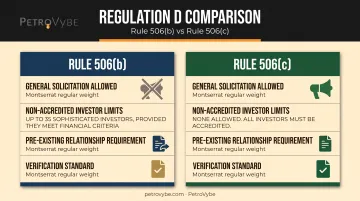
506(b) vs. 506(c): Not the Same Animal
| Feature | Rule 506(b) | Rule 506(c) |
|---|---|---|
| General solicitation | Not allowed | Allowed |
| Non-accredited investors | Up to 35 sophisticated investors | None permitted |
| Pre-existing relationship required | Yes | No |
| Verification standard | Self-certification often accepted | Reasonable steps required |
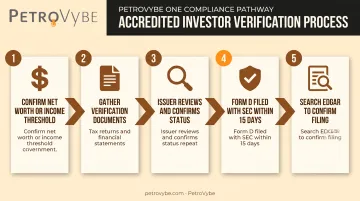
Verification under 506(c) means real documentation. Issuers can't just take a checkbox. They typically review:
- Tax returns, W-2s, or 1099s
- Bank and brokerage statements
- A written letter from a CPA, attorney, or registered broker-dealer confirming accredited status
The Private Placement Memorandum
Most offerings come with a Private Placement Memorandum (PPM), a document laying out investment terms, risks, and how proceeds will be used. It's not SEC-reviewed, so read it closely rather than assuming it's been vetted.
Beyond the document itself, liquidity is a structural constraint. There is no public exit market, so you are generally locking up capital for years—which is why modeled net exit MOIC and IRR timelines belong in your review before you commit.
Key Regulations Private Placement Investors Should Know
Accreditation isn't a vague concept. Under Rule 501(a), you qualify if you meet one of these thresholds:
- Net worth exceeding $1 million, excluding your primary residence
- Income above $200,000 individually (or $300,000 with a spouse or spousal equivalent) in each of the past two years, with a reasonable expectation of the same this year
A few other rules matter just as much:
- Reasonable verification is mandatory. Issuers using general solicitation under 506(c) can't rely on self-certification alone.
- Antifraud law never disappears. Exempt from registration doesn't mean exempt from federal or state antifraud provisions.
- Form D filing is required. Companies raising under Rule 506 must file a Form D with the SEC within 15 days of first sale.
You can search Form D filings yourself through SEC EDGAR. It won't tell you if the deal is good, but it confirms the offering was properly filed rather than fabricated.
Private Placement vs. Rule 144A: What's the Difference
These two get confused constantly, and the confusion causes real problems.
Rule 144A governs resales of restricted securities to Qualified Institutional Buyers (QIBs). A QIB generally needs at least $100 million in investable assets under discretionary management. This is an institutional resale market, not a way for individual investors to buy into a private company.
Rule 506 private placements, by contrast, are built for individual accredited investors. A company raising capital directly from you, structured through a PPM and subscription agreement, is operating under Regulation D, not Rule 144A.
The practical takeaway: if a sponsor mentions 144A while pitching you an individual investment opportunity, something's off. That rule wasn't built for individual accredited investors. Rule 506 is the framework smaller companies and development projects use to raise capital from people like you.
Real-World Example: How Private Placements Work in Energy Development
Here's how this plays out in practice. A company forms an LLC or limited partnership, files a Form D, drafts a PPM, and offers accredited investors direct participation in a specific development project. No public exchange. No ticker symbol. Just a direct stake in a defined asset.
PetroVybe operates on exactly this Regulation D framework. The company offers accredited investors direct access to early-stage natural gas development projects across South Texas and the Gulf Coast Basin, with its PetroVybe ONE program centered on roughly 58,000 acres in Lavaca County, Texas.

Why Energy Development Attracts Tax-Motivated Investors
Oil and gas private placements come with tax treatment that stocks and bonds simply don't offer. Intangible Drilling Cost (IDC) deductions let investors with a working interest deduct qualifying development expenses, sometimes representing a first-year deduction target of approximately 70–80% of invested capital, against active income including W-2 earnings and capital gains. This treatment requires the investor to elect general partner status in the Subscription Agreement and may be limited in a given year by the excess business loss limitation under IRC §461(l).
PetroVybe's partners reported 94% tax deduction against active income in 2025, driven by this IDC and depletion allowance combination. Prior result; not a promise of any future deduction. That's a meaningfully different tax profile than a typical brokerage account investment. This treatment requires the investor to elect general partner status in the Subscription Agreement and may be limited in a given year by the excess business loss limitation under IRC §461(l).
What to Verify Before Committing Capital
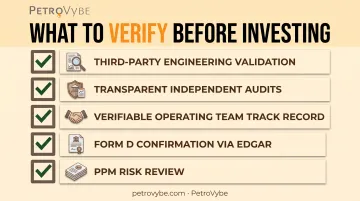
Before wiring money into any private placement, energy or otherwise, check these boxes:
- Third-party engineering validation: PetroVybe cites a $48 million proved-reserves valuation (PV-09, prepared by Lee Keeling & Associates, Tulsa, March 2026) from a licensed third-party engineering firm.
- Transparent reporting: Look for independent audits, such as PetroVybe's clean 2025 audit.
- Verifiable operating team track record: PetroVybe's leadership includes a CFO who previously raised $25 million for a South Texas drilling venture and a Chief Geophysicist with a 48-year exploration career.
- Form D confirmation: Search EDGAR to confirm the offering was actually filed.
- PPM review: Read the risk disclosures, not just the projected returns.
Projected figures, like PetroVybe's targeted 26% IRR or 2.2x to 5.8x MOIC over ten years, are forecasts, not guarantees. Commodity prices swing, drilling carries operational risk, and reserve estimates can shift. Treat every projection as a range of possible outcomes, not a promise.
Frequently Asked Questions
What are the regulations for private placements?
Private placements rely on Regulation D exemptions from SEC registration. Rule 506(c) offerings require verified accredited-investor status, while all private placements remain subject to federal and state antifraud law regardless of exemption status.
What is the difference between 144A and private placement?
Rule 144A covers institutional resales of restricted securities to Qualified Institutional Buyers with $100 million-plus in assets. Private placements under Rule 506 target individual accredited investors in initial capital raises, not institutional resale markets.
What is an example of a private placement?
A startup or development company raising capital directly from accredited investors through a Private Placement Memorandum is a classic example. Oil and gas development projects structured as Regulation D offerings, like PetroVybe's, follow this same model.
How do I know if I qualify as an accredited investor?
You qualify with a net worth over $1 million (excluding your primary residence) or income exceeding $200,000 individually ($300,000 jointly) for the past two years, and a reasonable expectation of the same this year.
Are private placement investments risky?
Yes. They're illiquid, lack a public exit market, and often require years-long hold periods. Always review the PPM's risk section and the issuer's track record before committing capital.
Informational requests only. PetroVybe projects are offered solely to verified accredited investors. Submitting this form does not create an investment or advisory relationship.