Yet upstream oil and gas, the exploration and drilling stage of the energy value chain, is where the biggest returns (and the biggest risks) in the industry originate. It's also where a growing number of accredited investors are looking as electricity demand from AI data centers reshapes the energy market. U.S. data centers consumed 176 TWh in 2023, or 4.4% of total U.S. electricity, and that figure could climb to 325-580 TWh by 2028, according to a Lawrence Berkeley National Laboratory report.
This article breaks down what upstream investment actually means, how it differs from midstream and downstream, the vehicles investors use to access it, and the benefits and risks accredited investors should weigh before committing capital.
Key Takeaways
- Upstream spans exploration, drilling, and production—distinct from midstream transport and downstream refining
- Working interests can unlock IDC deductions against active income, not just passive
- Vehicles include working interests, royalty interests, private placements, and E&P stocks
- Higher risk than midstream or downstream, but stronger return potential with an experienced operator
What Is Upstream Investment?
Upstream is the first link in the oil and gas chain. It covers exploration, drilling, and extraction, everything that happens before a single barrel or cubic foot of gas gets transported or refined. This is where value gets created, before it moves downstream for transport or processing.
Investing upstream means participating directly in exploration and production (E&P) economics. Rather than buying shares of a large integrated energy company and hoping the E&P division performs well, investors gain exposure through:
- Working interests in a specific well or lease
- Royalty interests tied to production revenue
- Private E&P partnerships structured for accredited investors
The Risk-Reward Trade-Off
Upstream carries geological risk (will the well produce?) and commodity price risk (what will that production be worth?). In exchange, it offers the highest profit potential in the value chain and unique tax treatment, including IDC deductions unavailable elsewhere.
Operator expertise matters here. Well success rates vary widely depending on the quality of geological analysis and the experience of the team making drilling decisions. PetroVybe's Chief Geophysicist, Michael Stamatedes, has posted a 75.2% career hit rate on profitable well locations over a 48-year career.
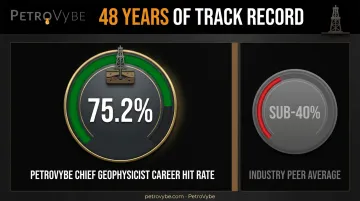
That's well above the sub-40% industry peer average he's benchmarked against, showing how much operator skill can shift the odds in an investor's favor.
Beyond operator selection, timing shapes upstream returns too. Why the renewed interest now? Natural gas is emerging as a primary fuel source for the electricity grid powering AI infrastructure. The International Energy Agency projects roughly 175 TWh of additional gas-fired generation tied to data centers globally by 2035, concentrated mostly in the United States. That's a structural demand tailwind upstream gas investors are watching closely.
Upstream vs. Midstream vs. Downstream Investment
Oil and gas breaks into three segments, and understanding each one matters because they carry fundamentally different risk and return profiles.
Midstream handles pipelines, storage, and transportation. It's the infrastructure layer, moving product from the wellhead to processing or market. Midstream cash flow is typically fee-based and contract-driven.
Interstate pipeline rates must be "just and reasonable" under FERC regulation, often set through cost-of-service ratemaking with reservation charges paid regardless of actual volume shipped. That structure makes midstream feel more like owning a toll road than betting on a resource.
Downstream covers refining, marketing, and retail, the stage closest to the consumer. Downstream economics hinge on refining margins, often measured by "crack spreads" (wholesale product prices minus crude cost). These margins swing with fuel demand and refinery utilization rather than with what's still in the ground.
Here's how the three compare side by side:
| Segment | Core Activity | Risk Level | Return Driver | Tax Treatment |
|---|---|---|---|---|
| Upstream | Exploration, drilling, production | Highest | Well output x commodity price | IDC deductions available (conditional) |
| Midstream | Pipelines, storage, transport | Lower | Tariffs and contracted fees | Standard depreciation, no IDC benefit |
| Downstream | Refining, marketing, retail | Moderate | Refining margins (crack spreads) | Standard corporate/business deductions |
Why Upstream Carries the Tax Advantage
Upstream's tax advantage comes down to the IDC deduction. Operators holding a working interest may elect to expense qualifying intangible drilling costs, meaning labor, fuel, and supplies used to drill and prepare a well.
This is a meaningful distinction from midstream or downstream investing, where no comparable deduction exists. That said, the IRS requires the working interest to carry unlimited liability for this treatment to apply as nonpassive, so structure matters (more on that below).
Types of Upstream Investment Vehicles
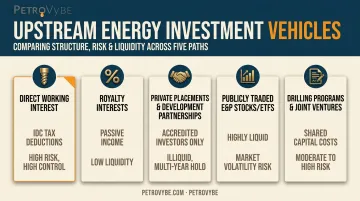
Not all upstream exposure looks the same. The vehicle you choose shapes your tax treatment, your liquidity, and how much risk you're actually taking on.
The main options break down like this:
- Direct working interest: You own a percentage stake in a well or lease, sharing in revenue and operating costs. IDC deductions are typically available against active income, but you also cover your share of costs if something goes wrong downhole.
- Royalty interests: You receive a percentage of production revenue with zero exposure to operating costs, though you give up most of the tax deduction benefits tied to a working interest.
- Private placements and development partnerships: Pooled-capital structures, available only to accredited investors, offering direct access to operator-led drilling and development projects.
- Publicly traded E&P stocks and energy ETFs: These offer liquidity and instant diversification, but only indirect exposure to well-level economics and limited tax benefits.
- Drilling programs and joint ventures: Structured partnerships where investors fund new well development in exchange for a share of future production.
PetroVybe ONE illustrates the private placement structure in practice: a Regulation D 506(c) offering offering direct equity in natural gas development across a 58,000-acre basin in Lavaca County, Texas, with roughly 400 producing wells and 57+ planned new wells.
Before committing capital to any vehicle, check the operator's track record and reserve reporting. A few questions worth asking:
- Who is doing the geological analysis, and what's their track record?
- Has an independent third-party engineering firm validated the reserves?
- What's the hold period, and when do distributions realistically begin?
- Is the working interest structured with unlimited liability (required for the IDC nonpassive treatment)?
Benefits and Risks of Upstream Investment
Key Benefits
Upstream investing offers a handful of advantages that don't show up in most other asset classes.
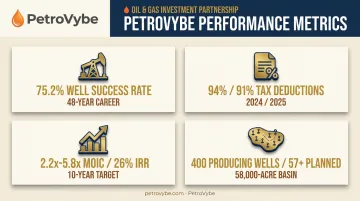
- Significant tax deductions against active income. Qualifying IDC deductions offset W-2 earnings and capital gains, not just passive income. PetroVybe partners saw 94% deductions in 2024 and 91% in 2025.
- A hedge tied to energy prices during inflationary periods. Energy commodities often move with inflation, though Federal Reserve research shows the pass-through to core inflation is smaller than to headline inflation. Treat this as inflation-sensitive exposure, not a guaranteed hedge.
- Direct exposure to rising natural gas demand, particularly from AI and data center electricity needs.
Key Risks
The upside comes with real risk, and any honest conversation about upstream investing has to include it.
- Geological and drilling risk. Success rates vary significantly by operator skill and the quality of geological analysis behind each well.
- Commodity price volatility. Henry Hub natural gas prices swung from $6.45/MMBtu in 2022 to $2.19 in 2024, directly hitting production revenue. EIA data showed producer cash from operations fell 12% year over year as gas prices dropped.
- Illiquidity and eligibility restrictions. Most private upstream deals are limited to accredited investors and require a multi-year hold, often 5-10 years, before capital is returned.
Why PetroVybe Offers a Direct Path Into Upstream Natural Gas Investment
PetroVybe is a private, Texas-based oil and natural gas development company giving accredited investors direct working interest access to upstream natural gas projects across South Texas and the Gulf Coast Basin.
A few things separate the team's approach from a generic private placement:
- Track record at the top. Chief Geophysicist Michael Stamatedes brings a 75.2% well-selection success rate over 48 years, nearly double the sub-40% industry peer average, directly reducing the geological guesswork that drives dry holes.
- Tax outcomes based on real results, not forecasts. Partners saw 94% deductions in 2024 and 91% in 2025 against active income, a real illustration of how IDC treatment plays out in practice.
- Long-term return targets. PetroVybe targets a 10-year MOIC of 2.2x-5.8x and 26% IRR, backed by a $48 million third-party reserve valuation (PV-09) across 264 development locations.
- Scale on the ground. Roughly 400 producing wells and 57+ planned new wells across a 58,000-acre basin.
If you're an accredited investor exploring ways to diversify beyond stocks and real estate while managing a high tax burden, connecting with PetroVybe's team is a reasonable next step to review current development opportunities.
Frequently Asked Questions
What is upstream investment?
Upstream investment means deploying capital into oil and gas exploration, drilling, and production activities, the first stage of the energy value chain, before any transport or refining occurs.
What is the difference between upstream and downstream investment?
Upstream involves exploration and production, carrying higher risk and higher reward potential tied to well output and commodity prices. Downstream involves refining and retail, where returns depend on margins closer to the end consumer.
What are examples of upstream investment opportunities?
Common examples include direct working interests, royalty interests, and private E&P partnerships like PetroVybe's development programs. Publicly traded E&P stocks and energy ETFs offer indirect exposure but carry different risk and tax profiles.
How much can I invest in upstream oil and gas as an accredited investor?
Minimums vary by operator and offering, but many private placements, including PetroVybe's, start around $100,000 in liquidity. Always confirm current minimums directly with the operator before committing capital.
What tax benefits are associated with upstream investment?
Qualifying working interests may allow Intangible Drilling Cost (IDC) deductions that offset active income, including W-2 earnings and capital gains, subject to IRS rules on liability and at-risk limits.
Is investing in upstream oil and gas risky?
Yes. Geological uncertainty and commodity price swings are real factors. Working with experienced operators and independently engineered reserve reports helps reduce, though never eliminate, that risk.