
This article is general education, not investment, tax, or legal advice. You've held a partnership interest for years. The exit finally comes, and you expect the sale to qualify for the 20% long-term capital gains rate. Then your accountant delivers unwelcome news: a chunk of that gain is taxed as ordinary income, at rates up to 37%.
This isn't an error. It's Section 751, the "hot assets" rule.
Congress built this provision to stop partners from converting ordinary income into cheaper capital gain simply by selling a partnership interest instead of the underlying assets. If the partnership holds unrealized receivables or inventory, part of your gain gets recharacterized. This guide walks through what counts as a hot asset, how the split gets calculated, and what it means for oil and gas investors specifically.
Key Takeaways
- Section 751 turns part of a partnership sale into ordinary income when "hot assets" are present
- Ordinary income can hit 37% federal rates versus 20% for long-term capital gains
- Sales (§751(a)) and distributions (§751(b)) trigger different ordinary-income results
- Oil and gas partnerships carry unique exposure through §1254 depletion and IDC recapture
- Pull partnership financials before you sell so you can estimate the ordinary-income hit
What Are Section 751 Hot Assets?
Hot assets are a partnership’s unrealized receivables and inventory items under IRC §751. When you sell or exchange a partnership interest, the portion of gain tied to these assets is taxed as ordinary income, not capital gain.
Section 751 exists to preserve that income character. Without it, a partner could sell an interest loaded with appreciated inventory or uncollected receivables and pay capital gains rates on amounts that would have been ordinary income if the partnership had collected or sold those items itself.
Unrealized receivables under §751(c) include:
- Rights to payment for goods or services not yet recognized as income
- Depreciation recapture under §1245 and §1250
- Oil, gas, and geothermal property recapture under §1254
Inventory items under §751(d) cover a broader category than the word suggests:
- Literal inventory (§1221(a)(1) property)
- Any partnership property that isn't a capital asset or §1231 property
- Property that would be inventory-type property in the hands of the selling partner
Not everything is a hot asset. Self-created goodwill and straight-line depreciated real property with no §1250(a) recapture generally escape this treatment.
The 1997 Taxpayer Relief Act eliminated the "substantially appreciated" threshold for sales. Before that change, only substantially appreciated inventory counted as a hot asset on a sale. Today, any inventory triggers §751(a) ordinary-income treatment on a sale—appreciated or not.
The 120% substantial-appreciation test still matters, but only for distributions under §751(b).
How Section 751 Applies: Sales vs. Distributions
Section 751(a): Sale of a Partnership Interest
Under §741, selling a partnership interest is generally a capital transaction. Section 751(a) carves out an exception: the portion of proceeds attributable to hot assets gets ordinary income treatment.
The mechanism, per Treas. Reg. §1.751-1(a)(2), works through a hypothetical sale. In plain terms:
- The partnership is treated as if it sold all property at fair market value right before the transfer
- The seller's ordinary income equals their share of gain on the hot assets in that snapshot
- No actual sale of the underlying assets has to occur
Rawat v. Commissioner shows how far that recharacterization goes. The D.C. Circuit held that §751(a) changes the character of gain from capital to ordinary, but it does not independently deem a sale of the underlying inventory or change where the income is sourced. Character and source stay separate legal questions, even when a hot asset is involved.

Section 751(b): Disproportionate Distributions
Distributions work differently. If a distribution shifts a partner's share of unrealized receivables or substantially appreciated inventory, the regulations treat it as a deemed sale between the partner and the partnership.
Liquidating payments to a retiring or deceased partner under §736 create a further limit. Those payments exclude certain recapture items that sit in §751(c)'s expanded definition—the statute says that expansion applies "but not for purposes of section 736."
So the two paths diverge cleanly:
- §751(a) (sale): ordinary income from a hypothetical hot-asset snapshot on transfer of the interest
- §751(b) (distribution): ordinary income from a deemed sale when the distribution changes the partner's share of hot assets
- §736 overlap: liquidating payments to retirees or successors do not pick up every expanded §751(c) recapture item
Calculating a Section 751(a) Gain
Total gain from a sale never changes under §751. Only its character shifts between ordinary and capital.
Simplified example:
| Item | Amount |
|---|---|
| Sale price for 50% interest | $200,000 |
| Total gain on sale | $100,000 |
| Hot asset FMV (partner's share) | $200,000 |
| Hot asset basis | $0 |
| Ordinary income portion | $200,000 |
| Capital loss on remainder | ($100,000) |
Notice that the ordinary income figure can actually exceed the total overall gain — the remaining, non-hot-asset portion may generate an offsetting capital loss. This is exactly the scenario the Tax Adviser's 2010 case study walks through, and it's why partners can't just assume a proportional split.
For a high-income seller, the stakes are real. The top ordinary bracket sits at 37% for 2024 and 2025, while long-term capital gains max out at 20%. Add the 3.8% net investment income tax for passive partners, and the rate gap between ordinary and capital treatment can approach 20 percentage points on the hot-asset slice.

Reporting requirements:
- Attach a statement under Treas. Reg. §1.751-1(a)(3) disclosing the ordinary/capital split.
- Report the ordinary income portion on Form 4797.
- Report the capital gain portion on Form 8949 and Schedule D.
- Ensure the partnership files Form 8308 to report the exchange to the IRS.
Hot Assets in Oil & Gas and Natural Gas Development Partnerships
Section 751(c) specifically pulls oil, gas, and geothermal property into the hot asset definition through §1254 recapture. This matters for anyone holding a working interest or LLC position in a drilling partnership.
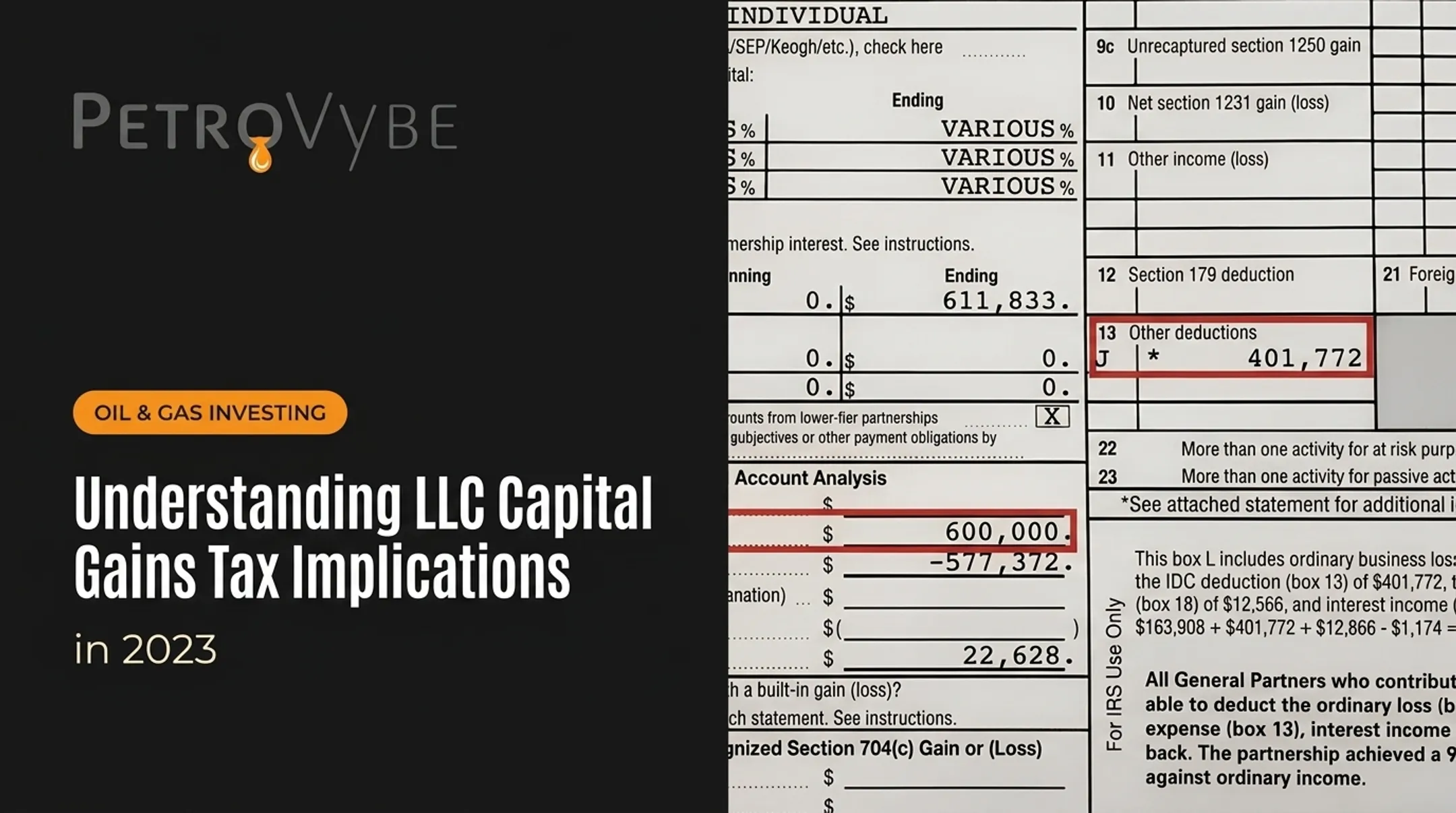
Here's the mechanism: intangible drilling cost (IDC) deductions and depletion allowances reduce your active income during the investment. Those same deductions build up recapture potential. When you exit, that recapture potential becomes an unrealized receivable under §751(c) — regardless of whether the deductions offset active income, capital gains, or anything else. This treatment requires the investor to elect general partner status in the Subscription Agreement and may be limited in a given year by the excess business loss limitation under IRC §461(l).
The trade-off in plain terms:
- Large upfront IDC and depletion deductions reduce your current tax bill significantly
- Those deductions create a §1254 recapture liability that follows the asset
- On sale or exit, your share of that recapture is taxed as ordinary income, not capital gain. This treatment requires the investor to elect general partner status in the Subscription Agreement and may be limited in a given year by the excess business loss limitation under IRC §461(l).
This is the same tax efficiency that makes oil and gas partnerships attractive to accredited investors seeking deductions against W-2 income or capital gains. The deduction is real. So is the eventual recapture exposure. This treatment requires the investor to elect general partner status in the Subscription Agreement and may be limited in a given year by the excess business loss limitation under IRC §461(l).
Clear reporting is what lets you see that exposure build before an exit. PetroVybe provides K-1 and investor reporting so partners can track IDC and depletion over time, with third-party engineering validation that includes an independently prepared PV-09 reserve valuation, prepared by Lee Keeling & Associates, Tulsa, March 2026.

Understanding hot asset exposure before an exit event—not at closing—starts with reviewing your K-1 history. Discuss IDC and depletion amounts with a tax advisor well ahead of any sale decision.
Planning Strategies to Manage Section 751 Exposure
You can't eliminate §751 exposure, but you can plan around it.
Before finalizing any sale:
- Request the partnership's balance sheet, depreciation schedules, and receivables aging
- Ask specifically for IDC and depletion amounts claimed against your interest, if oil and gas is involved
- Model the ordinary/capital split before agreeing on a purchase price
Consider transaction structure. A redemption under §736 and an outright sale under §741 are not interchangeable. Each path shifts who bears the tax and how payments are characterized:
- §736 redemption: Liquidating payments follow separate rules on which recapture items get included
- §741 sale: A straight interest transfer with a different ordinary/capital split profile

Work with a qualified tax advisor to model the hot-asset split before you sign. Build that split into price negotiations so it protects your after-tax proceeds instead of eroding them after the fact.
Frequently Asked Questions
What is a Section 751(a) gain?
A Section 751(a) gain is the portion of gain from selling a partnership interest attributable to your share of unrealized receivables and inventory items. That portion is taxed as ordinary income instead of capital gain.
How is a Section 751(a) gain calculated?
Using the hypothetical-sale method: assume the partnership sold all assets at fair market value immediately before your transfer. Your share of the resulting ordinary income is subtracted from total gain to find the capital portion.
Do I owe the 3.8% net investment income tax on Section 751 ordinary income?
Active partners who materially participate in the business are generally excluded under §1411(c)(4). Passive partners may owe the tax on this income.
Does depreciation on real estate create hot assets under Section 751?
Straight-line depreciated real property usually has no §1250(a) recapture, so it typically isn't a hot asset. Unrecaptured §1250 gain may still be taxed at 25%, and cost-segregated components can still trigger hot asset treatment.
Can I avoid Section 751 by having the partnership redeem my interest instead of selling it?
Redemptions run through §736 rather than §741, but they can still trigger §751(b) exposure if the distribution is disproportionate. It's a different path, not an exemption.
Does Section 751 apply if I sell only part of my partnership interest?
Yes. A partial sale still triggers a proportional share of ordinary income recognition under §751(a). There's no de minimis exception based on the size of the sale.
Informational requests only. PetroVybe projects are offered solely to verified accredited investors. Submitting this form does not create an investment or advisory relationship.