
But "buying an oil well" means wildly different things depending on the deal. A $5,000 royalty stake and a $500,000 working interest carry different risks, different cash flow timing, and completely different tax treatment. Many investors don't realize this until they're already reviewing paperwork.
This guide breaks down the ownership structures, the real cost ranges, and the tax code provisions, like Intangible Drilling Cost deductions, that make oil and gas one of the few asset classes capable of offsetting active income.
Key Takeaways
- Investment minimums range from $5,000 for drilling partnerships to $100,000+ for institutional programs
- Ownership paths include working interest (highest risk and tax benefit), passive royalty interest, and fund structures
- IDC deductions can offset a large portion of a working interest against active income in year one
- Operator track record and geological due diligence matter as much as deal structure for actual returns
- Most private oil and gas offerings require accredited investor status under SEC Regulation D
Understanding Oil Well Ownership Structures
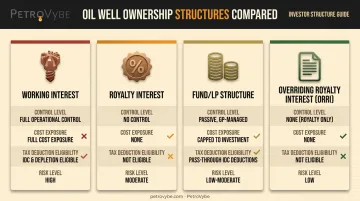
Before you look at a single deal, you need to know which flavor of "ownership" you're actually buying. Each structure allocates cost, control, and tax benefit differently.
Working Interest: Maximum Control, Maximum Deduction
A working interest gives you direct ownership in the well itself. You share proportionally in revenue, and you also share proportionally in every cost, drilling, completion, operating expenses, and eventual plugging.
This is the structure with the largest tax write-off potential, because it's the one the IRS treats as an active trade or business rather than a passive investment. It's also the one carrying the most operational risk.
Royalty Interest: Passive Income, No Cost Exposure
A royalty interest entitles you to a percentage of gross production revenue, with zero exposure to drilling or operating costs. According to a Texas A&M AgriLife land-use guide, a 3/16 royalty (18.75%) has become fairly common across Oklahoma and Texas leases, though rates vary by lease terms and negotiating leverage.
The tradeoff: no operating cost liability, but also no meaningful drilling cost deduction. You're a bystander to the capital expenditure, for better or worse.
Fund and Limited Partnership Structures
Pooled capital across multiple wells under a single managing operator. Benefits include:
- Diversifies risk across several wells instead of one single wellbore
- Limits liability generally to your invested amount
- Delegates day-to-day operations to professional management
- Reduces impact from any one well's underperformance
PetroVybe's partnership units follow this model, pooling investor capital across roughly 400 producing wells and 57 planned wells on a 58,000-acre South Texas basin, while still assigning each partner direct working interest for IDC deduction eligibility.
Overriding Royalty Interest (ORRI)
An ORRI is a royalty-like carve-out tied to the life of a specific lease rather than the underlying minerals. Per Bureau of Land Management definitions, it's severed from the lessee's working interest and carries no development or operating cost obligation, making it attractive for investors wanting royalty-style exposure without a long-term commitment.
The right choice depends on your goal. If tax offset against active income is your priority, working interest is the only structure that gets you there. If you want pure passive cash flow with no capital call risk, royalty or fund structures fit better.
How Much Does It Cost to Buy an Oil Well? Minimums Explained
There's no single answer here, and anyone who quotes you one flat number is oversimplifying. Costs vary by structure, formation, and how much of the well you're actually buying.
What the Filed Offerings Show
SEC-registered drilling partnerships give us real, documented reference points:
| Offering type | Minimum investment | Source |
|---|---|---|
| ICON Oil & Gas Fund-A LP (2012 prospectus) | $5,000 | SEC EDGAR filing |
| Reef Oil & Gas Drilling and Income Fund | $10,000 (unit price $100,000) | SEC EDGAR filing |
| Private accredited development programs | $100,000+ | Varies by sponsor |
These figures come from specific SEC filings, not universal industry norms, and actual costs vary considerably depending on the sponsor and offering structure.
Before comparing dollar amounts, one requirement applies across nearly every offering: investor eligibility.
The Accredited Investor Threshold
Most private oil and gas offerings are structured under SEC Regulation D, which restricts participation to accredited investors. Per the SEC's official accredited investor criteria, that means:
- Individual annual income above $200,000 (or $300,000 with a spouse or partner) in each of the last two years, with reasonable expectation of the same this year
- Net worth above $1,000,000, excluding your primary residence
- Entities with total assets exceeding $5,000,000, or where every equity owner independently qualifies as accredited
What Drives the Cost Variance
- Well count: A single-well deal versus a multi-well portfolio
- Basin and formation: Established producing basins carry different risk-adjusted pricing than exploratory plays
- Development stage: Proven producing assets versus greenfield exploration
- Operator overhead: Sponsor fees, management structure, and administrative costs
PetroVybe's development programs, for example, are structured for accredited investors with $100,000+ in liquidity seeking direct entry into early-stage natural gas development across the Gulf Coast Basin and South Texas, specifically Lavaca County's Wilcox formation.
One thing that surprises first-time buyers: your initial buy-in isn't necessarily the full cost. Working interest owners can face additional capital calls if drilling or completion expenses exceed the original Authorization for Expenditure (AFE). Always ask how a sponsor structures overrun risk before you sign.
Finally, don't confuse a fractional interest purchase with buying an entire producing lease or field outright. Full-well or full-lease acquisitions command a dramatically higher price point. The U.S. Energy Information Administration reported 2014 onshore well costs ranging from roughly $4.9 million to $8.3 million depending on the play. That figure reflects the whole-well capital cost, not a fractional investor minimum.
Tax Breaks: How Oil Well Investments Reduce Your Tax Bill
This is where oil and gas earns its reputation as one of the more tax-efficient alternative assets available to accredited investors.
Intangible Drilling Costs (IDCs)
Under IRC Section 263(c), taxpayers can elect to deduct qualifying intangible drilling and development costs (labor, drilling mud, fuel, chemicals, anything without salvage value) in the year they're paid or incurred. The IRS Oil and Gas Audit Technique Guide confirms this election is binding once made.
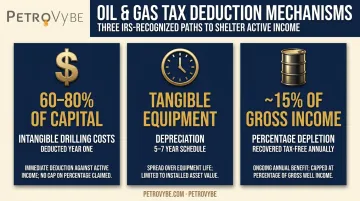
In practice, IDCs typically represent 60-80% of total capital deployed in a new drilling project. A $100,000 investment might generate $60,000-$80,000 in first-year deductible IDC expense, with the remaining balance going toward tangible, depreciable equipment.
PetroVybe partners realized this firsthand: 94% total tax deduction in 2024 and 91% in 2025, against ordinary, active income, including W-2 earnings and capital gains. These weren't projections. PetroVybe reported them as actual results on partner K-1s.
IDCs deliver another advantage rental real estate can't match. Rental losses are generally boxed into passive income offsets, unless you qualify for real estate professional status. A working interest held directly (or through an entity that doesn't limit your liability) is treated as nonpassive under IRS rules, meaning the loss can offset:
- W-2 wages
- Capital gains
- Other active business income
Beyond the upfront IDC write-off, two more mechanisms compound your tax efficiency over the life of the well.
Depreciation and Depletion
Tangible costs (casing, tanks, wellhead equipment) get capitalized and depreciated, typically over 5 or 7 years depending on asset classification under IRS Publication 946. Percentage depletion allows independent producers and royalty owners to deduct roughly 15% of gross well income annually as a tax-free capital recovery, subject to a 1,000 barrel-per-day cap and a 65% of taxable income limitation.
The Caution Every CPA Will Give You
Deduction eligibility isn't automatic. It depends on:
- Basis limits: you can't deduct more than your investment basis
- At-risk rules: losses are capped at amounts you're genuinely at risk for
- Excess business loss rules: noncorporate taxpayers face additional limits under Form 461
Confirm specifics with your CPA before committing capital. The structure matters enormously, and a limited-liability interest doesn't automatically qualify for the same nonpassive treatment as a direct working interest.
How to Buy an Oil Well: Step-by-Step Process
Once you understand structure and tax mechanics, the actual buying process follows a clear, linear path.
- Confirm accredited investor status: gather income documentation or net worth verification before you start shopping deals
- Define your primary objective: tax offset, monthly cash flow, or long-term growth, each pointing toward a different structure
- Research operators with verifiable production history and safety records, not just a polished pitch deck
- Review the Private Placement Memorandum (PPM), subscription agreement, and third-party geological or reserve reports
- Conduct independent due diligence on production history and operator financials rather than relying solely on sponsor-provided numbers
- Complete subscription documents and fund the investment through the required wire or transfer
- Monitor ongoing reporting: production updates, distributions, and annual K-1 tax documents, which often arrive close to or after the standard April filing deadline, making extensions common for oil and gas partnership investors
Key Risks to Weigh Before You Buy
No honest conversation about oil wells skips the downside. Here's what actually moves the needle on returns.
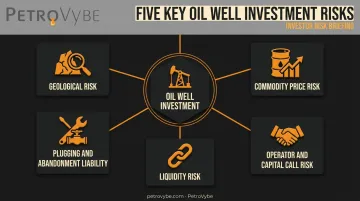
- Geological risk: Dry holes or underperforming wells happen even with strong data. Operator track record matters: a proven geologist with an above-average success rate cuts this risk versus an unproven team.
- Commodity price risk: A well that's economic at $75 oil can become marginal at $50. Prices swing, and drilling activity follows with a lag
- Operator and capital call risk: Vetting the operating team's technical history is non-negotiable. Ask for specifics, not adjectives
- Liquidity risk: There's no public exchange for fractional working interests. Once you're in, you're generally in for the life of the well or fund
- Plugging and abandonment (P&A) liability: Every well eventually requires funded decommissioning. Texas, for instance, requires financial assurance ranging from $25,000 for small operators up to $250,000 for those running 100+ wells
Frequently Asked Questions
What is the average cost of an oil well?
There's no single average. Cost depends heavily on structure and scope, ranging from a few thousand dollars for a fractional royalty stake to hundreds of thousands or millions for full working interests or complete lease packages.
How do I buy into an oil well?
Verify your accredited investor status, choose a structure (working interest, royalty, or fund), review the offering documents, complete independent due diligence, then fund through a subscription agreement.
Is owning oil wells a good investment?
Oil wells can offer strong tax advantages, passive income, and portfolio diversification. Returns depend heavily on operator quality, geology, and commodity prices, so suitability varies by individual investor.
What is the minimum investment required to buy an oil well?
There's no single industry-wide minimum. Registered drilling partnerships have offered participation for as little as $5,000-$10,000, while accredited-only development programs, like PetroVybe's, commonly start at $100,000 or higher.
Do I need to be an accredited investor to invest in an oil well?
Most private oil and gas offerings, including PetroVybe's, require accredited investor status under SEC Regulation D. A limited number of Reg A+ offerings allow non-accredited participation, though these are less common in the direct drilling space.
What tax documents will I receive from an oil well investment?
Partnership-structured oil and gas investments typically issue a Schedule K-1. These can arrive close to or after the standard tax filing deadline, which is why filing extensions are common among oil and gas investors.