
Here's the short answer: mineral rights ownership is public record in the US. But there's no single website you can search. Records live at the county level, scattered across more than 3,100 jurisdictions, and tracking down a clear chain of title often takes some legwork.
This article walks through where those records live, how to search them yourself, and what your options look like once you've confirmed ownership.
Key Takeaways
- Mineral rights records are public but decentralized, mostly filed at the county level, not in one national database
- Ownership can be "severed" from surface rights, so your property deed alone may not tell the full story
- County clerks, state oil and gas commissions, and title companies are your main research tools
- Complex, multi-generational chains of title often justify hiring a landman or title attorney
- Confirmed mineral owners can lease, sell, or join direct development for potential royalty income
Are Mineral Rights Public Record in the US?
Yes. Mineral rights ownership is documented in public land records. But "public" doesn't mean "centralized." Every county maintains its own recorder or clerk's office, and that's where deeds, leases, and transfers get filed.
Severed Estates: Why Surface Ownership Isn't Enough
Under property law, land ownership splits into two distinct estates: surface and mineral. An owner can sell the surface while retaining the minerals underneath, or vice versa.
This split is called a "severed estate," and according to the Railroad Commission of Texas, it's especially common in areas with a long history of oil and gas development.
Once severed, minerals can be sold, leased, or inherited entirely independent of what happens to the surface property.

No National Database Exists
There's no federal or state-run search engine covering private mineral ownership across the country. The U.S. Department of the Interior administers leasing for federal minerals, but that only covers government-owned land, a fraction of total US mineral acreage.
A "free mineral rights search by state" usually means:
- Searching individual county recorder databases one by one
- Cross-referencing multiple counties if the mineral estate spans county lines
- Checking state regulatory agency records for supplemental data
What Counts as Proof of Ownership
Recorded instruments are your evidence trail. Look for:
- Deeds (regular and mineral-specific)
- Oil and gas leases
- Probate orders and affidavits of heirship
- Reservation language such as "save and except minerals" or "excepting oil and gas"
One wrinkle: inherited minerals often transfer through probate or an affidavit of heirship rather than a new deed. A "gap" in the recorded chain isn't necessarily a red flag; it's often just how inheritance works.

Where to Find Mineral Rights Records
Mineral rights records live across county offices, state agencies, and professional or mapping tools. Start local, then widen the search when leases, wells, or older chains of title matter.
County Clerk's Office / County Recorder
This is ground zero for mineral rights research. County offices maintain the grantor-grantee index, a system that lets you trace ownership forward and backward by searching names instead of parcel numbers. Most deeds, leases, and mineral transfer documents live here, and many (though not all) counties now offer online access.
State Government and Oil & Gas Regulatory Agencies
State agencies fill in gaps that county records don't cover, particularly around active leasing and drilling. The USGS maintains a directory of state well data portals covering all 50 states. A few standouts:
- Texas Railroad Commission: roughly 132 million pages of well records dating to 1964
- Oklahoma Corporation Commission: pooling, spacing, and unitization records
- Colorado COGIS: well location, inspection, and production data
Title Companies and GIS Mapping Tools
For anything beyond a quick check, a professional title search is worth considering. Title companies and landmen can trace ownership back to the original land patent.
Free GIS mapping tools from state agencies, such as the Texas General Land Office's GIS viewers, let you visualize parcel boundaries and historical drilling activity without leaving your desk.
How to Find Out Who Owns the Mineral Rights on Your Property
Follow these steps in order:
- Read your deed carefully. Look for phrases like "mineral rights reserved," "severed," or "excepting oil and gas." This tells you immediately whether you own the minerals or someone else does.
- Pull the chain of title at the county recorder's office. Trace deeds, leases, and transfers backward through time, sometimes across decades.
- Check for existing oil and gas leases recorded against the property. These often name the current mineral rights holder directly, saving you research time.
- Cross-reference with state GIS tools or the oil and gas commission database to see if wells or permits are tied to your property.
- Bring in a landman or title attorney if the chain crosses multiple counties or gets tangled in inheritance disputes.

What Does a Professional Title Search Cost?
There's no standardized fee schedule. Costs are quote-based and depend on:
- How far back the chain of title must be traced
- Counties involved in the search
- Conveyances, leases, and probate records to review
- Quality of county recordkeeping (handwritten vs. digitized)
- Distinct interest types in play (royalty, working interest, overriding royalty)
Get a written estimate from a licensed landman or title attorney before committing. Pricing varies too much for general benchmarks to be useful.
Common Challenges When Researching Mineral Rights Ownership
Mineral title research rarely goes perfectly smoothly. Common snags include:
- Limited online access in rural counties, sometimes requiring an in-person visit or a written records request
- Fractionated ownership from multiple generations of inheritance, splitting one mineral interest among dozens of heirs
- Incomplete or misfiled records, often requiring you to cross-check county files against state agency data
Federal record-keeping isn't immune either — a 2020 GAO report found federal agencies needed 40 separate recommendations just to improve electronic records management. County-level systems, many still partly paper-based, face similar gaps.
What to Do Once You've Confirmed Mineral Rights Ownership
Once ownership is clear, you generally have three paths:
- Hold the rights and wait for potential future royalty income if development occurs
- Lease to a development company in exchange for bonus payments and ongoing royalties
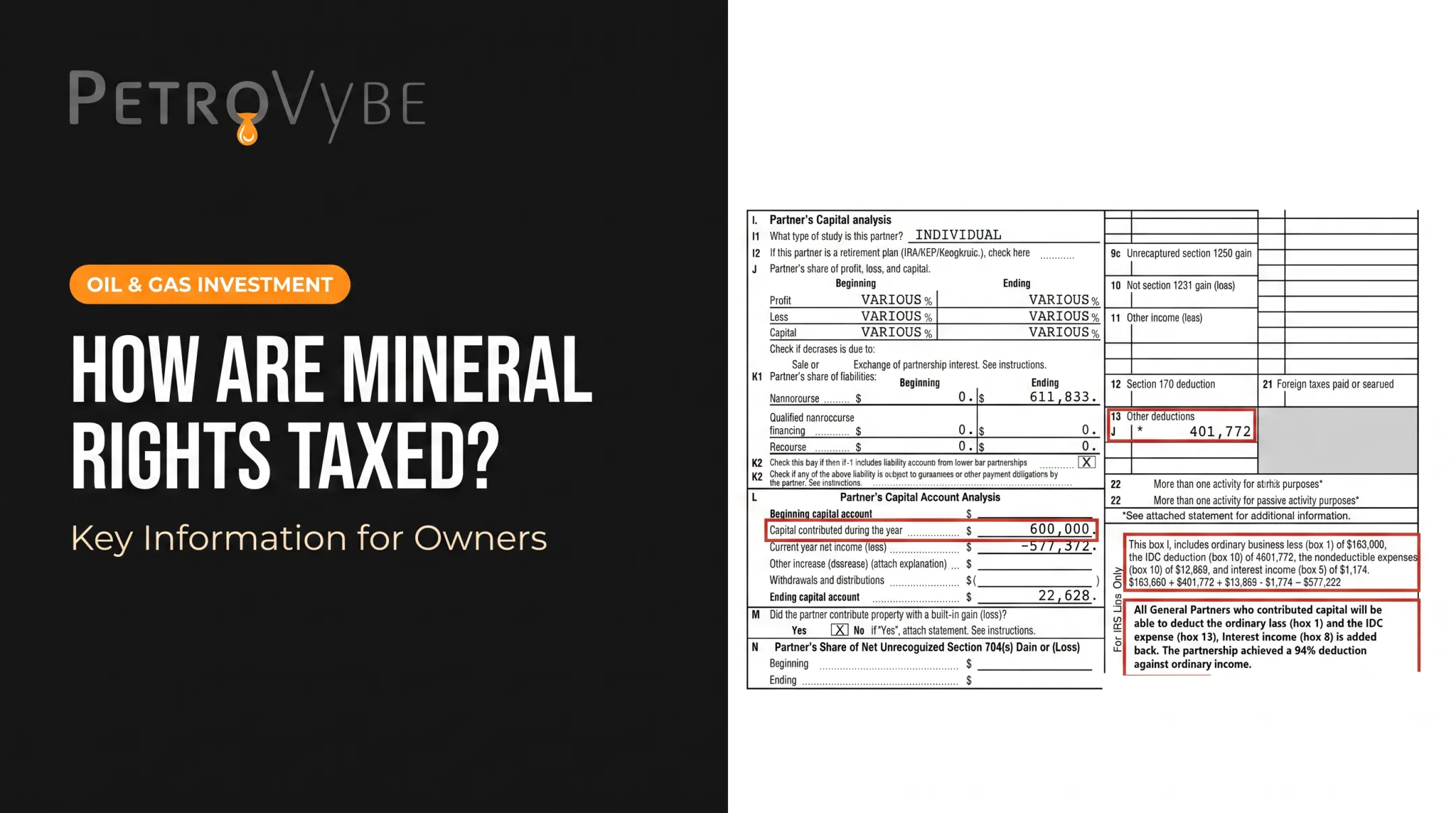
- Sell outright for a lump-sum payment There's a fourth option if you're an accredited investor. Rather than holding passive mineral rights and waiting on someone else to drill, you can take a direct equity position in an active development project. PetroVybe, for example, offers accredited investors direct participation in natural gas development across Lavaca County and the broader Gulf Coast Basin in South Texas: a 58,000-acre position with roughly 400 acquired legacy wells and 57+ planned new wells. The appeal isn't just potential returns. Direct working-interest participation can unlock intangible drilling cost (IDC) deductions and percentage depletion allowances that producers may apply against active income, including W-2 earnings and capital gains, not just passive income. Recent PetroVybe partners reported deductions in the 91–94% range against active income, though results vary by year and offering. This path differs from passive mineral ownership. It typically requires:
- Accredited investor status
- About $100,000 in liquidity
- A long-term outlook (PetroVybe's flagship project targets a 10-year hold) Whatever direction you're considering (leasing, selling, or investing directly), talk to a tax advisor first. Depletion allowances, IDC elections, and capital gains treatment each carry real consequences, and PetroVybe's own team is upfront that they're not financial advisors. Get independent counsel before signing anything.

Frequently Asked Questions
How can I find out who owns the mineral rights on my property?
Start with your property deed, then search county recorder records for the chain of title. Check for existing leases naming the current holder, and consult a title company or landman if history is unclear.
Can mineral rights be separated from surface rights?
Yes — this is called a "severed estate." Owning the land doesn't automatically mean you own what's beneath it.
Are mineral rights records available online?
Many counties offer online access to deeds and leases, but coverage varies significantly. Some rural counties still require in-person visits or written requests.
How much does a professional mineral rights title search cost?
Costs vary based on search depth, number of counties involved, and record complexity. Get a written quote from a landman or title attorney rather than relying on general estimates.
What documents prove who owns mineral rights?
Deeds, mineral deeds, oil and gas leases, probate orders, and affidavits of heirship are the key recorded instruments used to establish ownership.
Why is there no deed showing how I inherited mineral rights?
Inherited minerals often pass through probate or an affidavit of heirship rather than a new deed. This can make the record look incomplete, but it's a normal part of the inheritance process.