Introduction
Inherit a rental property with no plan for maintenance or taxes, and its value quietly erodes. Build a stock portfolio without rebalancing, and gains you earned in one decade can vanish in the next downturn. This is what happens without a system.
Asset management exists to solve exactly that problem, whether you're overseeing a $10,000 brokerage account or a multibillion-dollar infrastructure portfolio.
Global assets under management hit an all-time high of $135 trillion in 2024, with organic growth climbing from 2.1% to 3.7% year over year, according to McKinsey's 2025 asset management report.
This guide breaks down what asset management actually means, the five-stage process behind it, the three main types you'll encounter, and how alternative assets like natural gas development fit into a modern, tax-aware strategy.
Key Takeaways
- Balances growth against risk across financial, physical, and digital assets
- Uses a five-stage process, from planning to exit, to protect value consistently
- Spans three core categories: financial, physical, and digital, each with distinct oversight
- Diversifies into alternatives like natural gas development for tax efficiency and passive income
- Verifies a manager's track record and third-party validation over self-reported numbers
What Is Asset Management?
Asset management is the practice of overseeing, growing, and protecting the value of something you own, financial or physical, to meet specific goals without taking on more risk than you can tolerate.
That "something" could be a stock portfolio, a commercial building, a fleet of drilling rigs, or a company's software licenses. The mechanics differ, but the objective doesn't.
Asset management pursues two goals at once: maximizing the return or value an asset produces over time, and managing the risk of losing that value along the way.
Neither goal wins outright. Chasing maximum return while ignoring risk crosses into speculation, not asset management. Playing too safe carries its own cost: a portfolio with no growth slowly loses ground to inflation.
Assets vs. Liabilities: Why the Distinction Matters
An asset puts money in your pocket over time. A liability takes money out. A rental property generating positive cash flow is an asset. That same property with negative cash flow and rising maintenance costs behaves like a liability, even though you technically "own" it.
This distinction drives every decision in asset management. You're building a portfolio of assets that actively grow your net worth, not simply accumulating possessions.
Who Needs Asset Management?
Asset management isn't reserved for the ultra-wealthy. It applies across a wide range of situations:
- Individual investors managing retirement accounts and personal portfolios
- High-net-worth investors diversifying across multiple asset classes
- Corporations managing equipment, real estate, and operational infrastructure
- Government entities overseeing public infrastructure like roads and utilities
- Institutional investors such as pension funds and endowments
Strategy isn't one-size-fits-all. A 30-year-old with a 35-year time horizon can tolerate more volatility than a retiree drawing income. Risk tolerance, goals, and timeline shape everything else.
Financial vs. Physical Asset Management
Financial asset management covers investment portfolios, stocks, bonds, mutual funds, real estate, and alternative assets, managed on behalf of clients under a defined plan.
Physical or infrastructure asset management covers tangible assets: equipment, buildings, utilities, or energy infrastructure managed over their full lifecycle. Organizations increasingly follow ISO 55000, the global standard defining asset management vocabulary and principles. It sets expected outcomes such as improved financial performance, better risk management, and stronger organizational sustainability. While ISO 55000's original scope emphasized physical assets, its framework now applies broadly across asset types.
The Asset Management Process: 5 Key Stages
Whether you're managing a stock portfolio or an oil and gas development project, asset management generally follows the same lifecycle. Skipping a stage is usually where value gets lost.
- Planning & goal-setting: Define your objectives, risk tolerance, and target returns before a single dollar moves. This stage sets the rules everything else follows.
- Acquisition/investment: Research and select specific assets that align with your plan, such as stocks, real estate, energy projects, or equipment.
- Operation & monitoring: Actively manage, maintain, or track performance against benchmarks. This is where most of the ongoing work happens.
- Optimization & reinvestment: Adjust strategy, rebalance, or reinvest cash flow to compound returns over time.
- Reporting, exit, or disposal: Communicate performance to stakeholders, then eventually exit or divest to realize value.
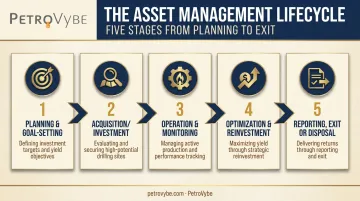
Stage 4 deserves extra attention because it's where discipline pays off most. Vanguard modeled 10,000 simulated 10-year scenarios for a global 60/40 portfolio and tested three rebalancing approaches, according to Vanguard's 2024 rebalancing research:
| Rebalancing Approach | Annualized Return |
|---|---|
| Monthly | 7.01% |
| Quarterly | 7.08% |
| Threshold-based | 7.19% |
That's roughly 15-25 basis points of annual benefit versus monthly rebalancing, purely from managing the process well rather than picking better investments. Small edge, big impact when compounded over a decade.
The Three Main Types of Asset Management
Most asset management activity falls into one of three categories, each governed by different rules and expertise.
| Type | Primary Focus | Example |
|---|---|---|
| Financial/Investment | Managing portfolios of stocks, bonds, mutual funds, and alternatives for clients | An RIA managing a retirement portfolio |
| Physical/Infrastructure | Managing tangible, long-life assets through their full lifecycle | Real estate, utilities, energy development projects |
| Digital/Enterprise | Managing IT systems, software licenses, and digital assets | Tracking software compliance and licensing costs |
Financial asset management splits into active management (professionals selecting investments to beat the market) and passive management (tracking an index). Within this category, several sub-roles carry very different obligations:
- Registered Investment Advisers (RIAs) owe clients a fiduciary duty under the Investment Advisers Act, meaning they must act in the client's best interest
- Broker-dealers operate under Regulation Best Interest, a recommendation-specific standard rather than a continuous fiduciary relationship
- Robo-advisors are registered investment advisers using algorithms, and they carry the same fiduciary obligations as human RIAs
- A title like "financial advisor" alone doesn't guarantee any specific legal duty, so confirm the professional's registration status before relying on their recommendations
Beyond financial markets, two other categories carry their own rules and expertise. Physical/infrastructure asset management governs real estate, equipment, and energy development projects across their full lifecycle, often through direct ownership structures like limited partnerships.
Digital/enterprise asset management handles software licensing, IT systems, and data assets. It's distinct from physical assets but follows similar lifecycle logic, from acquisition through retirement.
Best Practices for Effective Asset Management
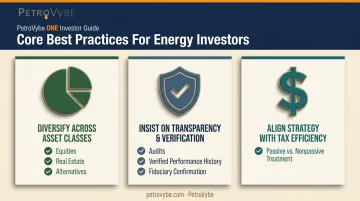
Good asset management isn't complicated, but it does require discipline. Three practices separate consistent performers from everyone else:
Diversify across asset classes and risk levels. Concentrating capital in a single investment type, even a good one, exposes you to sector-specific downturns. Spreading across equities, real estate, and alternative assets smooths volatility.
Insist on transparency and third-party verification. Before committing capital to any manager, look for:
- Independent audits or engineering reports
- Verified performance history, not just self-reported figures
- Confirmation of fiduciary standard or regulatory licensing
Align your strategy with tax efficiency. Not every asset class treats deductions the same way:
- IRS passive-activity rules typically limit real estate losses to passive income
- The IRS treats working interests in oil and gas development as nonpassive, regardless of material participation, provided liability isn't limited
- Qualifying deductions, like intangible drilling costs, can offset active income such as W-2 wages, not just passive income
- Basis, at-risk, and other limitation rules still apply, so consult a tax professional before committing capital
Alternative Asset Management: Why Natural Gas Development Is Gaining Attention
Stocks, bonds, and real estate no longer dominate portfolio construction the way they once did. Advisors are moving client money into alternatives at a notable clip: a CAIS-Mercer survey of 550 financial advisors found 92% already use alternatives in client portfolios, and 91% planned to increase those allocations over the next two years.
The scale of that shift is striking. Preqin forecasts global alternatives AUM will grow from $16.8 trillion in 2023 to $29.2 trillion by 2029, a projected 9.7% compound annual growth rate, according to Preqin's Future of Alternatives 2029 report.
Natural gas and natural gas liquids (NGL) development sit squarely inside that trend. Unlike a stock purchase, where value is already priced in, natural gas development creates value at the earliest stage, before a well is even drilled.
That timing is exactly what generates the tax advantage. Intangible drilling costs (IDCs) typically represent 60-80% of invested capital, and a working interest holder can deduct a large share of that in the first year against active income.
This is the space PetroVybe operates in. As a Texas-based natural gas development company, PetroVybe gives accredited investors direct equity participation in upstream projects across South Texas and the Gulf Coast Basin, rather than passive exposure through a fund. A few specifics from their track record:
- Partners received a 94% tax deduction against active income in 2024 and 91% in 2025
- Proved reserves independently valued at $48 million (PV-09) by a licensed third-party engineering firm
- Chief Geophysicist Michael Stamatedes carries a 75.2% career well-selection hit rate against an industry average below 40%
- President & COO Blaine Yeary previously scaled a $5 billion asset from zero to 35,000 BOEPD in eight years
- 10-year target range of 2.2x-5.8x MOIC and approximately 26% IRR (forward-looking projections, not guarantees)
None of this eliminates commodity, drilling, or liquidity risk. Direct working interests carry real exposure. But for accredited investors with $100,000 or more in liquidity and a high tax burden, it's a tangible way to diversify beyond traditional securities while offsetting W-2 or capital gains income.
How to Choose the Right Asset Management Partner
Whether you're hiring a financial advisor or evaluating a private development partnership, the vetting process looks similar.
- Verify the track record. Ask for documented performance history, not marketing claims. A documented decades-long track record with a specific, verifiable success rate tells you more than a slogan.
- Confirm the fiduciary standard. Is this manager legally required to act in your interest, or just recommending products that meet a lower "best interest" bar?
- Demand independent validation. Third-party engineering reports, audited financials, or verified reviews carry weight that self-reported numbers don't. PetroVybe, for example, publishes its 5.0 rating from 8 verified reviews on Invest Clearly, alongside completed KYB and KYC compliance checks.
- Check communication practices. You should always understand how your asset is performing and valued, not just receive an annual statement with no context.
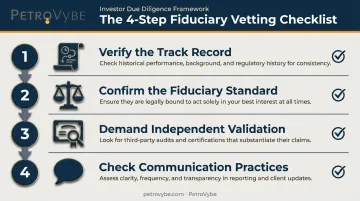
If a manager won't provide any of the above, treat that as a red flag and move on.
Frequently Asked Questions
What does asset management do?
Asset management identifies, acquires, monitors, and optimizes assets, financial or physical, to grow value while managing risk. Asset managers execute this work on behalf of an individual, corporation, or institution, following a defined plan.
What are the 5 stages of asset management?
Planning and goal-setting, acquisition or investment, operation and monitoring, optimization and reinvestment, and reporting, exit, or disposal. Each stage builds on the one before it.
What are the three main asset management types?
Financial/investment asset management (portfolios and securities), physical/infrastructure asset management (tangible, long-life assets), and digital/enterprise asset management (IT systems and software).
How much does asset management typically cost?
Fees are usually a percentage of assets under management, commonly in the 0.5%-1.5% range annually, though structures vary by manager and asset class. Some charge flat, hourly, or performance-based fees instead.
Is asset management the same as wealth management?
No. Asset management focuses on managing investment portfolios, while wealth management is broader, covering estate planning, tax strategy, and retirement planning alongside investments.
Can individual investors access alternative assets like natural gas development?
Accredited investors can access private natural gas development directly through specialized firms like PetroVybe, which offer tax-advantaged, passive investment structures starting at $100,000. Non-accredited investors currently don't qualify under SEC rules.