

You've probably heard the phrase "Great Wealth Transfer" tossed around in financial headlines, but here's the problem: most people don't know if it applies to them, whether it's overhyped, or what to actually do about it.
This article breaks down what the transfer really is, whether the hype matches reality, what trends are emerging as the money moves, and how both heirs and wealth holders can prepare — including where forward-thinking families are redirecting assets for better tax outcomes.
Key Takeaways
- The Great Wealth Transfer is already underway, moving roughly $124 trillion through 2048
- Most inheritances are far smaller than headlines suggest and concentrated among wealthy households
- Heirs and wealth holders both need a tax and diversification plan before assets change hands
- More heirs and high earners now seek tax-advantaged alternatives beyond stocks, bonds, and real estate
What Is the Great Wealth Transfer, Exactly?
The term describes the multidecade handoff of assets from Baby Boomers (born 1946–1964) and the Silent Generation (born 1928–1945) to their spouses, children, grandchildren, and favorite charities.
Cerulli's 2024 projection breaks the $124 trillion into two buckets: roughly $105 trillion to heirs and $18 trillion to charity through 2048. These are rounded estimates, not exact figures, but they set the scale for everything else in this article.
Who's Getting What, and When
The timing isn't uniform across generations:
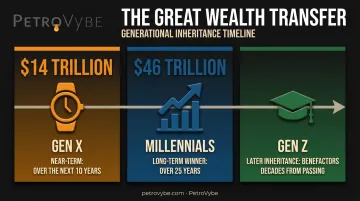
- Gen X leads near-term, projected to inherit $14 trillion over the next 10 years versus $8 trillion for Millennials
- Millennials win long-term, capturing the largest generational share disclosed: $46 trillion over the full 25-year window
- Gen Z inherits later, since most of their benefactors are still decades from passing
The Horizontal Transfer Nobody Talks About
Before money ever reaches the next generation, it often passes sideways, between spouses. Cerulli expects $54 trillion in interspousal transfers through 2048, with more than 95% going to women, including nearly $40 trillion to widowed Baby Boomer and older women.
That matters because it delays the "real" generational handoff by years, sometimes decades.
Why This Is Happening Now
Baby Boomers and the Silent Generation together hold 59.8% of all U.S. household wealth as of early 2026, per Federal Reserve data, a disproportionate share for generations that make up a much smaller slice of the population.
There's also a behavioral shift underway. An RBC Wealth Management survey found only 11% of Boomers had started gifting assets during their lifetime, while 96% of Millennial and Gen X recipients said receiving money now would matter more than waiting 20-30 years. Expect "giving while living" to accelerate as that gap closes.
Is the Great Wealth Transfer Actually Real? What the Data Shows
Yes — it's real and already happening. But the reality is smaller, messier, and far more uneven than the $124 trillion headline suggests.
That gross figure doesn't account for the things that actually shrink an estate: mortgage debt, retirement spending, healthcare costs, and taxes.
The Real Numbers vs. the Headlines
Two frequently cited averages tell very different stories:
| Source | Figure | What It Measures |
|---|---|---|
| Federal Reserve (2019 SCF) | $46,200 | Historical average across all families, inheritors or not |
| Visa (2026 projection) | ~$515,000 | Future average per household expected to inherit, excluding the top 1% |
Visa's model shows why the gap is so wide:
- Starts with roughly $93 trillion in Boomer assets
- Drops to $88 trillion after subtracting liabilities
- Falls to $60 trillion after excluding the top 1%
- Lands at $36 trillion after retirement spending, taxes, fees, and charitable bequests
Wealth Concentration: Where the Money Actually Sits
The transfer skews heavily toward the already-wealthy on both ends:
- High-net-worth and ultra-high-net-worth households, just 2% of all households, will account for $62 trillion, more than half of the entire projected transfer
- Transfers of $1 million or more represent only 2% of transfer events but 40% of transferred dollars
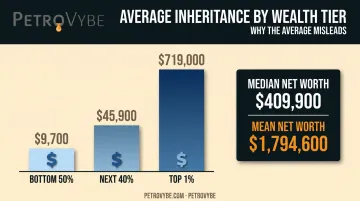
- Average inheritance size climbs sharply by wealth tier: $9,700 for the bottom 50%, $45,900 for the next 40%, and $719,000 for the top 1%
Where does a typical household actually stand? Families headed by someone age 65-74 had a median net worth of $409,900 in 2022, though the mean was $1,794,600, a gap that shows why averages mislead. Add in the fact that 41% of homeowners age 65-79 still carry mortgage debt, and the "inheritable" portion of that number gets smaller fast.
Bottom line: the transfer is real, but for most people it's not a windfall. Plan your finances as if it isn't coming, and treat anything you receive as a bonus.
What to Expect as the Wealth Moves: Emerging Trends
As assets shift hands, three patterns are showing up consistently in the data.
Younger heirs distrust traditional portfolios. A Bank of America survey of high-net-worth investors found 75% of respondents age 21-42 believe above-average returns are no longer achievable through stocks and bonds alone, compared to 32% of investors over 43. Younger respondents allocated 16% of their portfolios to alternatives, versus 5% for older investors. Direct, real-asset investments — think private energy partnerships or real estate — are increasingly filling that allocation gap.
Real estate priorities are shifting, not disappearing. Property remains a top choice across generations, but younger buyers weigh things their parents didn't prioritize as heavily:
- Energy efficiency and green home features
- Climate resilience: 71% of Gen Z buyers are hesitant to move somewhere with natural-disaster risk
- Long-term utility costs over short-term price
Tax efficiency is becoming table stakes. Whether someone just inherited a lump sum or is sitting on appreciated stock, both recipients and current holders are actively hunting for vehicles that reduce capital gains and income tax exposure. Diversifying risk is no longer the only goal.
How to Prepare: For Heirs and Wealth Holders Alike
Preparation looks different depending on which side of the transfer you're on, but both sides share one blind spot: taxes.
If You're Likely to Inherit
Don't build your financial plan around money that hasn't arrived yet.
- Keep investing consistently, independent of any expected inheritance
- Treat inherited assets as an accelerant, not a foundation
- Avoid major lifestyle decisions (a bigger mortgage, quitting a job) based on assumptions
If You're Planning to Transfer Wealth
Get the paperwork done now, before a health event forces rushed decisions:
- Update your will and any trusts to reflect current wishes
- Confirm beneficiary designations on retirement accounts and life insurance
- Talk to a tax and legal professional about your specific exposure
Taxes That Shrink the Sticker Price
Here's what most people picture: an estate worth $2 million transfers, tax-free, in one lump sum. Here's what's more accurate:
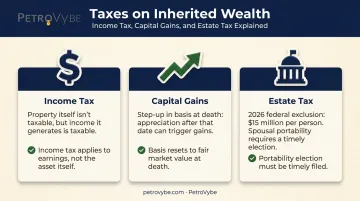
- Income tax: Inherited property itself generally isn't taxable income, but income the property later generates is
- Capital gains: Inherited assets typically get a step-up in basis to fair market value at death, but appreciation after that date can trigger gains when sold
- Estate tax: The federal exclusion rises to $15 million per person in 2026, up from $13.99 million in 2025, but portability between spouses requires a timely election — it's not automatic
Wealth holders carrying capital gains exposure often address it before assets transfer, using vehicles like PetroVybe's natural gas development partnerships, which offer deductions against up to 100% of taxable income, including capital gains.
Where Smart Wealth Is Being Redirected: Tax-Advantaged Alternatives
Whether you're receiving a lump sum or sitting on appreciated stock you've held for years, the tax bill often lands hardest in the exact year the windfall shows up. A sale, an inheritance, a bonus year: that's when income tax exposure peaks, and it's exactly when a tax-advantaged vehicle does the most good.
This is where direct participation in oil and natural gas development enters the conversation for accredited investors. Through the Intangible Drilling Cost (IDC) deduction, qualifying investors can offset a substantial percentage of active income (including W-2 earnings and capital gains) in the very first year.
PetroVybe operates directly in this space. As a Texas-based natural gas development company, we give accredited investors direct equity access to projects in South Texas and the Gulf Coast Basin, including active development in Lavaca County. A few specifics worth knowing:
- IDC deductions typically represent 60–80% of invested capital in new drilling projects, meaning a $100,000 investment can generate a $60,000–$80,000 first-year deduction
- Unlike most real estate depreciation, this deduction applies against active income, not just passive income
- Projects are structured around a 10-year hold with monthly passive distributions during production, backed by a $48 million third-party-engineered proved reserves valuation
This mirrors exactly what the data in this article points toward: younger heirs skeptical of traditional stock-and-bond mixes, and legacy-focused Boomers looking for tangible, inflation-resistant assets. Direct energy participation sits outside both categories: a real asset generating cash flow, with a tax benefit that matters most in the year a transfer actually happens.
Direct participation isn't for everyone. It requires accredited investor status, a minimum liquidity position, and a long time horizon; first distributions typically take two to three years to begin. It's a fit for wealth holders and heirs who can afford to be patient and want their capital working outside the traditional 60/40 portfolio.
Frequently Asked Questions
Is the Great Wealth Transfer real?
Yes. It's already in motion, with heirs inheriting trillions of dollars annually. The eventual scale for any individual household is typically much smaller than the $124 trillion headline suggests.
What is the average inheritance in the Great Wealth Transfer?
The Federal Reserve puts the historical average at $46,200 across all families. Visa projects future inheriting households will average roughly $515,000 — but that figure excludes the top 1% and only counts households expected to inherit at all.
What is the average net worth of a 70-year-old couple?
Households headed by someone age 65-74 had a median net worth of $409,900 in 2022, with a mean of $1,794,600. Much of that is home equity or retirement accounts, not immediately transferable cash.
How much money is expected to change hands overall?
Cerulli Associates projects $124 trillion transferring through 2048, split roughly between $105 trillion to heirs and $18 trillion to charity.
Who benefits most from the Great Wealth Transfer?
The wealthiest 2% of households will account for over half the total transfer, roughly $62 trillion, on both the giving and receiving ends. Concentration is the defining feature of this shift.
What should I do if I'm expecting an inheritance?
Avoid rushed financial decisions the moment funds arrive. Consult a tax professional first, then consider diversifying into tax-efficient vehicles, such as direct energy development partnerships offering upfront deductions, rather than parking everything in the same assets your benefactor held.