This article is general education, not investment, tax, or legal advice. Accredited investors exploring private placements — natural gas development deals included — inevitably run into two documents: the Private Placement Memorandum (PPM) and the Subscription Agreement. Confusing the two can lead to costly missteps.
One document discloses risk. The other locks you into a binding legal commitment. Mixing them up, or worse, skipping the PPM to jump straight to signing, is how investors end up surprised by terms they never fully understood.
This guide breaks down what each document does, how they work together, and what to look for before you sign either one.
Key Takeaways
- A PPM discloses investment risks, terms, and strategy; a subscription agreement executes the investment
- Read the PPM first, then sign the subscription agreement to formally commit capital
- Both documents operate under SEC Regulation D exemptions to protect issuers and investors
- Review both documents together before funding partnership units in offerings such as natural gas development deals
PPM vs Subscription Agreement: Quick Comparison
| Category | PPM | Subscription Agreement |
|---|---|---|
| Purpose | Discloses risks, terms, and strategy | Executes the capital commitment |
| Legal Status | Informational; not SEC-approved | Binding contract once accepted |
| Timing | Reviewed during due diligence | Signed at closing |
| Content Focus | Risk factors, use of proceeds, management | Representations, warranties, acceptance terms |
| Regulatory Basis | Regulation D disclosure practice | Regulation D exemption compliance (506b/506c) |
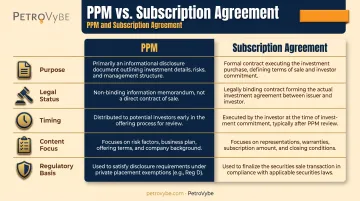
One document informs the decision; the other locks it in. You review the PPM first, then sign the subscription agreement when you commit capital.
The SEC does not require a PPM for accredited-only 506(b) or 506(c) offerings, but its absence should raise a red flag. As the SEC's own investor bulletin notes, a lack of issuer and offering information is a warning sign, not a shortcut.
What Is a Private Placement Memorandum (PPM)?
A PPM is the comprehensive disclosure document an issuer provides to prospective investors before they commit capital. It covers the investment strategy, management team, offering terms, and — critically — the risk factors.
A well-drafted PPM protects issuers from misrepresentation claims and gives investors the material information they need to decide.
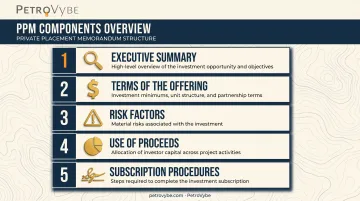
Typical PPM components include:
- Executive summary — the investment thesis in brief
- Terms of the offering — minimum investment, unit structure, fee schedule
- Risk factors — material risks spelled out in plain terms
- Use of proceeds — where the capital actually goes
- Subscription procedures — how investors formally participate
Note that exempt status doesn't exempt anyone from anti-fraud rules. A PPM is evidence of disclosure practice, not an SEC stamp of approval.
Use Cases of PPMs
PPMs are standard across private offerings to accredited investors: oil and gas development deals, private equity funds, real estate syndications, and venture funds.
In a natural gas development deal specifically, the PPM discloses drilling risk, commodity price volatility, and tax treatment details like intangible drilling cost (IDC) deductions. PetroVybe's disclosures, for example, flag drilling and operating risks, price volatility, and reserve-estimate uncertainty before investors commit.
Private placements are a major capital channel. In 2025 alone, the SEC recorded 34,553 initial Form D filings totaling $2,391.5 billion in capital raised under Regulation D, according to SEC Regulation D offering statistics. At that scale, clear disclosure is not optional—it is the baseline investors should expect in every deal.
What Is a Subscription Agreement?
A subscription agreement is the legally binding contract through which an investor formally commits capital and the issuer transfers securities or membership interests. It's where diligence turns into ownership.
Core benefit: It protects the issuer by having investors formally represent their accredited status, acknowledge risk, and confirm investment intent, reducing the issuer's legal exposure if things go sideways later.
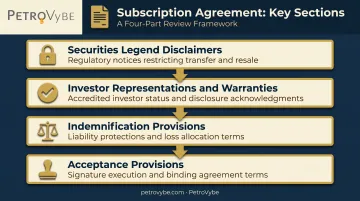
Key sections typically include:
- Securities legend disclaimers — restricted-security notices
- Investor representations and warranties — accreditation, intent, understanding of risk
- Indemnification provisions — allocating liability
- Acceptance provisions — the issuer's right to accept or reject the subscription
Use Cases of Subscription Agreements
You'll find subscription agreements anchoring LLC and LP interests, direct working interest programs, real estate funds, and private equity or venture deals.
In a natural gas development partnership, the subscription agreement confirms investor accreditation and finalizes the capital contribution and resulting ownership stake.
Under Rule 506(c) specifically, a checked box isn't enough. Issuers must take reasonable steps to verify accredited status, often through income documentation, net-worth evidence, or third-party confirmation from a broker-dealer, CPA, or attorney.
The same agreement also records the minimum capital commitment. Regulation D doesn't set one universal floor—Form D simply asks issuers to state their minimum, entering $0 if none exists. PetroVybe. Participation begins at one unit of $100,000, with add-on subscriptions from $25,000. This sits well above the "no minimum" end of the spectrum, reflecting the scale of the underlying development projects.
PPM vs Subscription Agreement: Which One Matters More?
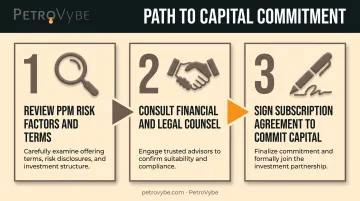
These documents work in sequence. Each plays a distinct role in the same investment process. Recommended order:
- Review the PPM's risk factors, terms, and financial projections
- Consult financial and legal counsel
- Sign the subscription agreement to formally commit capital The PPM matters most during due diligence: it's your homework. The subscription agreement matters most at closing, when capital actually changes hands. Treating them as interchangeable is where investors get into trouble.
A well-run issuer provides both documents with transparency and third-party validation. PetroVybe, for instance, backs its offering materials with independent engineering reports, including a $48 million PV-09 reserve valuation from a licensed third-party engineering firm, the kind of validation that should accompany any serious PPM. Prepared by Lee Keeling & Associates, Tulsa, March 2026.
Real-World Application: Natural Gas Development Deals
Investors evaluating private oil and gas opportunities face a common challenge: separating polished marketing materials from the binding legal commitments underneath them.
Here's how it plays out in practice. PetroVybe's PPM discloses drilling risk, geological assessments, and tax deduction potential, including how IDC deductions can offset active income like W-2 earnings and capital gains. This treatment requires the investor to elect general partner status in the Subscription Agreement and may be limited in a given year by the excess business loss limitation under IRC §461(l).
The subscription agreement then finalizes each accredited investor's capital commitment and ownership position, secured through third-party accreditation verification.
Beyond those core documents, investors also get:
- Three independent engineering reports covering 264 anticipated development locations across two basins
- A clean 2025 independent audit
- Investor access to a DataDrive containing the PPM, LPA, subscription agreement, and financial projections
Investors who understand both documents move from due diligence to closing with a clear picture of risk, commitment, and ownership. If you're evaluating a natural gas development partnership, read the PPM in full, run it past your own counsel, and contact a partner relations team with questions before you sign.
Conclusion
The PPM and subscription agreement serve distinct but connected roles. One informs; the other binds. Neither replaces the need for independent legal and financial review.
For accredited investors weighing opportunities like natural gas development partnerships, understanding both documents — and the order in which they're meant to be used — supports better-informed, more confident decisions.
Frequently Asked Questions
What is the difference between a private placement memorandum and a subscription agreement?
A PPM is a disclosure document outlining investment risks, terms, and strategy. The subscription agreement is the binding contract that actually executes the investment once you've reviewed the PPM.
Do I need a private placement memorandum or a subscription agreement?
Most private offerings require both, used sequentially. The PPM supports your due diligence; the subscription agreement finalizes the deal at closing.
What is the purpose of a private placement memorandum?
A PPM discloses risks, terms, and strategy to protect both the investor and the issuer. It gives investors the material facts needed to decide whether to invest at all.
Is a subscription agreement legally binding?
Yes. Once signed by the investor and accepted by the issuer, it creates binding legal obligations, including capital contribution and ownership terms.
Who prepares a PPM and subscription agreement?
These documents are typically drafted by securities attorneys working alongside the issuer's management team, tailored to the specific offering's terms and exemption structure.
Can I invest without reading the PPM first?
You shouldn't. The PPM contains critical risk disclosures you need before signing anything binding. Skipping it means committing capital without understanding what you're actually agreeing to.
Informational requests only. PetroVybe projects are offered solely to verified accredited investors. Submitting this form does not create an investment or advisory relationship.