](https://file-host.link/website/petrovybe-3y7l2j/assets/blog-images/6e191c1f-3248-4dfd-bbdd-24eca6acbc0d/1787672993029246_d8808aa3e23142678c97ba979ec0a5d5/2x_360.webp)
This article is general education, not investment, tax, or legal advice. Investors want cash flow they can count on, and that demand keeps rising as inflation eats into fixed budgets. Annual CPI inflation averaged 2.9% in 2024, according to the Federal Reserve Bank of Minneapolis, which means idle cash quietly loses purchasing power every year.
Traditional savings accounts simply can't keep up. That gap is pushing more investors toward diversified income-generating assets, from dividend stocks to real estate to private energy partnerships.
This guide breaks down the best investment plans for monthly income, how to choose between them, and where accredited investors can find higher-yield, tax-advantaged alternatives.
TL;DR
- Monthly income vehicles include dividend stocks, bonds, REITs, annuities, and energy alternatives such as natural gas development
- Filter choices by risk tolerance, liquidity needs, tax efficiency, and target cash flow
- Accredited investors can pursue tax-advantaged passive income through direct oil and gas development participation
Overview of Investment Plans for Monthly Income
A "monthly income investment plan" is any vehicle structured to deliver regular payouts, rather than one that simply grows in value and gets sold later for a lump sum.
In the US, income investing spans two broad categories:
- Traditional assets — bonds, dividend stocks, and dividend ETFs
- Alternative assets — real estate, private credit, and oil and gas development programs
High-income earners face steep tax burdens, and that's driving growing interest in tax-efficient income vehicles that pay cash and lower what investors owe the IRS.
The strongest options stand out on four measures: payout reliability, historical performance, liquidity, and tax treatment.
Top Investment Plans for Monthly Income
Each option below is judged on four factors: reliability of payouts, historical performance, liquidity, and tax treatment. No single asset wins on all four.
Dividend-Paying Stocks & ETFs
These are shares of established companies, or funds holding baskets of them, that distribute income on a quarterly or quarterly schedule. Investor.gov defines these as income stocks — purchased specifically for the payout, not just price appreciation.
Most dividend ETFs pay quarterly, not monthly, according to Morningstar's 2026 dividend ETF roundup. Popular funds like SCHD and SDY showed 12-month yields between roughly 1.2% and 3.1%. Covered-call income funds like JEPI and JEPQ have historically targeted higher distribution rates, sometimes in the 8-12% range, though that comes with different risk and tax considerations.
| Factor | Detail |
|---|---|
| Payout Frequency | Quarterly / quarterly |
| Risk Level | Moderate |
| Liquidity | High (exchange-traded) |

Why it stands out: broad accessibility, easy liquidity, and potential for capital growth alongside income.
Bonds & Bond Funds
Bonds pay periodic interest in exchange for lending money to a government or corporation. Investment-grade corporate bonds recently yielded around 4.84% as of December 2025, per FRED's ICE BofA Corporate Index data.
Municipal bonds carry a distinct advantage: interest is generally exempt from federal tax when issued by a state or local government, per IRS guidance.
| Factor | Detail |
|---|---|
| Payout Frequency | Semi-annual (bonds) / monthly (bond funds) |
| Risk Level | Low-moderate |
| Liquidity | Moderate-high |
Why it stands out: predictable income, lower volatility, and tax-exempt options through municipal issues.
Real Estate Investment Trusts (REITs)
REITs own income-producing property and must distribute at least 90% of taxable income annually, per SEC investor guidance. As of December 2025, the FTSE Nareit All Equity REITs index yielded 4.07%, compared to 1.10% for the S&P 500, according to Nareit.
| Factor | Detail |
|---|---|
| Payout Frequency | Quarterly / quarterly |
| Risk Level | Moderate |
| Liquidity | High (public) / low (private) |
Why it stands out: mandatory high distribution rates and yields that recently outpaced the broader equity market.

Non-traded REITs are a different animal entirely. Some lock up capital for more than 10 years with limited redemption options, so read the fine print before committing.
Income Annuities
An annuity converts a lump sum into guaranteed periodic payments through an insurance contract. Immediate annuities start paying within a year; deferred annuities begin later. The NAIC classifies contracts as fixed, variable, or indexed.
| Factor | Detail |
|---|---|
| Payout Frequency | Monthly |
| Risk Level | Low |
| Liquidity | Very low (locked-in) |
Why it stands out: it shifts longevity and market risk to the insurer, making it a favorite for retirees who want dependable cash flow above all else.
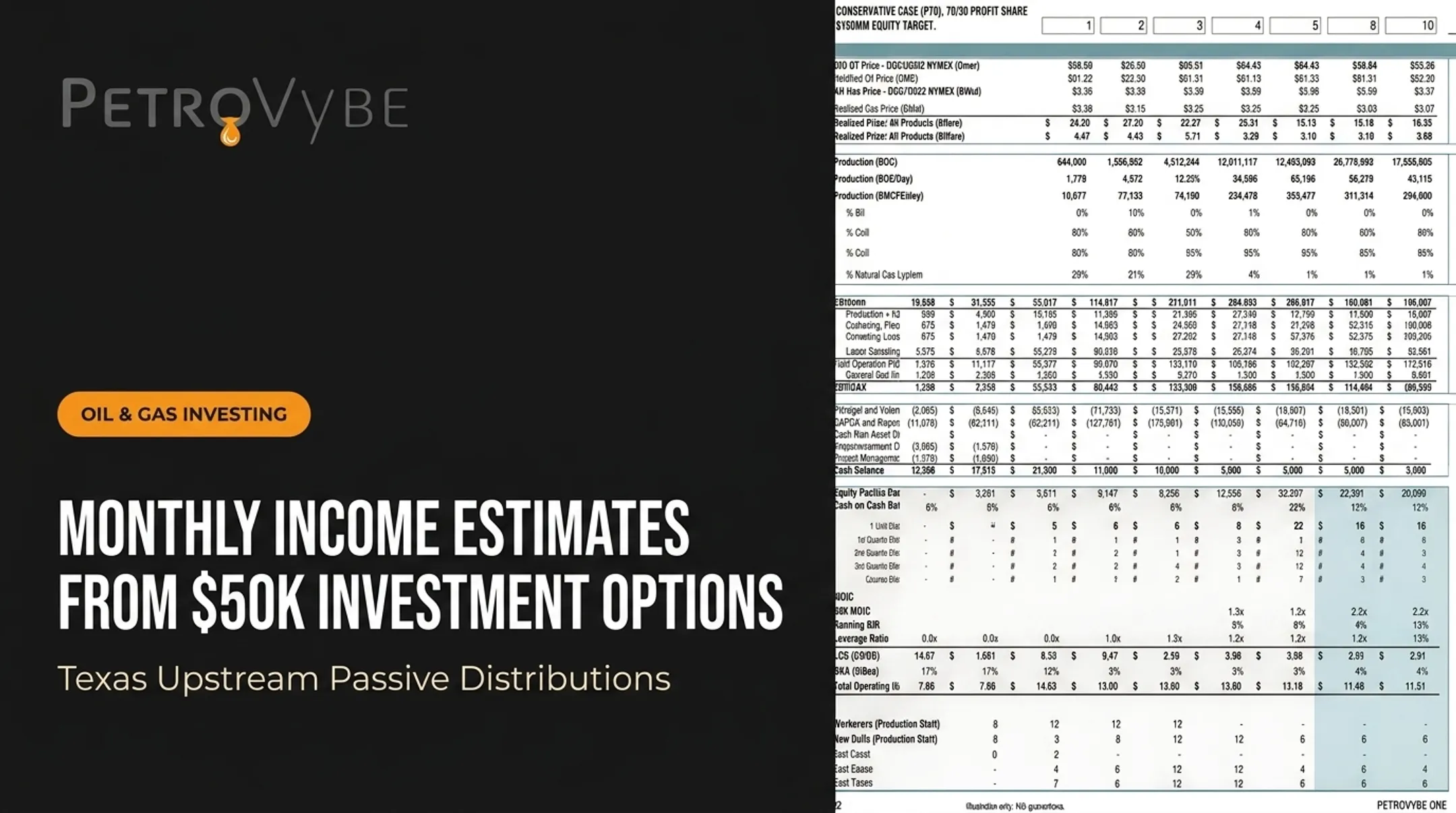
PetroVybe — Natural Gas Development Program (Accredited Investors)
PetroVybe is a private Texas-based natural gas development company. It gives accredited investors direct access to early-stage natural gas liquids development across roughly 400 producing wells on 58,000 acres in Lavaca County, part of the Gulf Coast Basin.
Based on internal financial projections, the project targets:
- 10-year IRR of approximately 26%
- MOIC range of 2.2x–5.8x
- First-year tax deduction of roughly 70% against active income, including W-2 wages
Partners saw 94% deductions in 2025. Prior result; not a promise of any future deduction.
Reserves are backed by a $48 million PV-09 valuation from a licensed third-party engineering firm, prepared by Lee Keeling & Associates, Tulsa, March 2026, and the company underwent a clean 2025 independent audit by Weaver.
| Factor | Detail |
|---|---|
| Payout Structure | Quarterly distributions typically begin in years 2–3; projected to peak above $10,000/month |
| Risk Level | Higher / illiquid; accredited investors only |
| Tax Treatment | IDC and depletion deductions against active income (including W-2) This treatment requires the investor to elect general partner status in the Subscription Agreement and may be limited in a given year by the excess business loss limitation under IRC §461(l). |

The team includes Chief Geophysicist Michael Stamatedes, whose career hit rate on profitable well selection sits at 75.2%, well above the sub-40% industry peer average across his 48-year career. Disclaimer: these results were achieved at prior companies.
Why it stands out: deductions against active W-2 income, third-party-backed reserves, and projected quarterly distributions few public income products can match. Open only to accredited investors who can hold through the development cycle.
How This Guide Selected These Investment Plans
Investors chasing monthly income often make the same mistakes:
- Chasing headline yield without checking whether it's sustainable
- Ignoring how long their money will be locked up
- Overlooking how taxes will eat into the actual cash received
To avoid those traps, each option was scored on:
- Historical payout consistency: Does the income stream have a real track record, or is it mostly speculative?
- Risk-adjusted returns: What do you earn relative to volatility and downside exposure?
- Liquidity and lock-up: How long is capital committed, and how predictable are quarterly distributions?
- Tax treatment: What share of the cash actually stays after ordinary income, capital gains, or pass-through rules?
- Regulatory oversight: Is the vehicle subject to SEC, FINRA, or state licensing requirements?
- Third-party validation: Independent engineering reports, audits, or verified investor reviews
FINRA's own risk guidance notes that even conservative options like CDs can fail to outpace inflation. Concentrating capital in one asset class compounds that risk. Diversifying across categories—not chasing the single highest yield—is what protects monthly income over time.
Conclusion
No single monthly income plan wins for everyone. The right mix depends on your liquidity needs, risk tolerance, and tax situation—not just the yield on a fact sheet.
Match the vehicle to the job:
- CD-like annuity — steady checks and minimal surprises in retirement
- REIT or dividend ETF — income with liquidity you can rebalance
- Deduction-heavy alternative asset — often more after-tax value for high earners than one extra point of yield
Most investors do best with a blend: traditional income sources for stability, alternative assets for growth and tax efficiency.
Accredited investors who want tax-advantaged quarterly distributions and diversification beyond stocks and bonds can explore PetroVybe's natural gas development opportunities to see whether they fit their portfolio and tax picture.
Frequently Asked Questions
How much do I need to invest to make $1,000 a month?
It depends heavily on yield. At a 4% annual dividend or bond yield, you'd need roughly $300,000 invested. At an 8% yield, that drops to around $150,000.
How much money will I earn if I invest $100 a month for 20 years?
At a 7% average annual return, contributing $100 monthly for 20 years grows to roughly $52,000, mostly from compound growth. Your final balance will track the return rate and how consistently you contribute.
What is the best investment for monthly income?
There's no single best option. It depends on your risk tolerance, liquidity needs, and tax bracket. Top contenders include dividend ETFs, bond funds, REITs, annuities, and for accredited investors, energy development programs like PetroVybe.
Which investment has the best returns?
Historically, stocks have outperformed bonds and cash over long periods. The S&P 500 returned 24.88% in 2024 and 17.78% in 2025, per NYU Stern data. Higher returns come with higher volatility, so the extra gain is a risk tradeoff.
What is a good monthly return on an investment?
A reasonable benchmark is 0.5% to 1% monthly (roughly 6-12% annualized) for moderate-risk assets. Higher targets usually mean higher risk or illiquidity, so weigh the number against what you're giving up to get it.
Informational requests only. PetroVybe projects are offered solely to verified accredited investors. Submitting this form does not create an investment or advisory relationship.