

Yet most high-income earners and accredited investors have never heard of it. That's not an accident. The rules live inside dense IRS guidance like Publication 535, written in language that assumes you already know what "adjusted basis" and "recoverable units" mean.
This guide breaks down what the depletion allowance actually is, who qualifies, how to calculate it using both IRS-approved methods, and why it matters if you're considering natural gas or oil development as part of a tax strategy.
Key Takeaways
- Qualifying investors deduct a percentage of gross income each year the well produces.
- IRS rules require calculating both depletion methods, then claiming the larger deduction.
- Percentage depletion continues even after full cost recovery, unlike most deductions.
- Since 1975, only independent producers and individual investors qualify for this benefit.
What Is the Oil Depletion Allowance?
Depletion is the tax code's way of recognizing that oil, gas, and mineral reserves are a "wasting asset." Every barrel extracted and sold permanently reduces what's left in the ground, so the IRS allows owners to recover their capital investment as production happens, similar to how depreciation works for equipment.
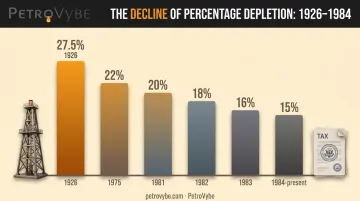
The allowance traces back to the Revenue Act of 1926, which introduced percentage depletion at a rate of 27.5% of gross income from a well. Federal depletion concepts existed even earlier, but 1926 marks the birth of the modern percentage method. That rate didn't stay fixed forever:
- 27.5% from 1926 through the mid-1970s
- 22% for qualifying independent production starting in 1975
- Phased down to 20% (1981), 18% (1982), 16% (1983)
- 15%, the current rate, locked in from 1984 onward
The provision has always been politically contentious. In a 1937 letter to Congress, Treasury Secretary Henry Morgenthau Jr. called percentage depletion "perhaps the most glaring loophole in our present revenue law." Congress kept it anyway.
Decades later, the Tax Reduction Act of 1975 stripped percentage depletion from major integrated oil companies while preserving it for independent producers and royalty owners — a distinction that still defines who benefits today.
Here's the part most people miss: the IRS doesn't let you pick your favorite method once and stick with it. You must calculate both cost depletion and percentage depletion every year, for every property, and claim whichever produces the larger deduction.
Cost Depletion vs. Percentage Depletion at a Glance
| Feature | Cost Depletion | Percentage Depletion |
|---|---|---|
| Based on | Adjusted basis in the property | 15% of gross income from the property |
| Stops when | Basis reaches zero | Never — can continue indefinitely |
| Ties to remaining investment? | Yes | No |
| Available to | Any owner with an economic interest | Independent producers & royalty owners only |
Who Qualifies for the Depletion Allowance?
The underlying rule, found in Treasury Regulation 1.611-1, is a two-part economic interest test. You must have:
- Acquired an investment interest in the mineral in place (through ownership, lease, or similar arrangement)
- Secured a legal right to income from the extraction, meaning you look to that production for your return on capital
Simply having a contract that gives you an economic advantage isn't enough. You need real ownership standing in the mineral property itself.
How you report that income depends on what kind of interest you hold:
| Interest Type | Where to Report | Self-Employment Tax |
|---|---|---|
| Royalty owners (no working interest) | Schedule E | Not typically subject |
| Working interest owners | Schedule C | Subject, due to operational responsibility |
Beyond these reporting rules, percentage depletion adds one more eligibility filter. It's reserved for independent producers, royalty owners, and individual working interest investors: large, integrated companies that refine or retail petroleum products above certain thresholds cannot claim it, regardless of how the ownership interest is structured.
How to Calculate the Oil Depletion Allowance
Because the two methods use completely different inputs, the results can vary widely from property to property and year to year. Smart investors — or their CPAs — run both calculations annually rather than assuming one will always win.
Cost Depletion: Step-by-Step Formula
The formula:
(Adjusted basis for depletion ÷ total recoverable units) × units sold during the tax year = cost depletion deduction
Here's a simplified, hypothetical walkthrough:
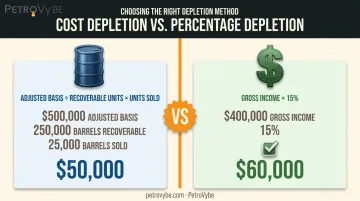
- Adjusted basis in the property: $500,000
- Estimated total recoverable units: 250,000 barrels
- Per-unit depletion rate: $500,000 ÷ 250,000 = $2.00 per barrel
- Barrels sold this tax year: 25,000
- Cost depletion deduction: 25,000 × $2.00 = $50,000
Once that $500,000 basis is fully recovered through this method, the deduction stops.
Percentage Depletion: Step-by-Step Formula
The formula:
Gross income from the property × 15% = percentage depletion deduction
Using a comparable hypothetical:
- Gross income from the property this year: $400,000
- Statutory rate: 15%
- Percentage depletion deduction: $400,000 × 0.15 = $60,000
In this example, percentage depletion ($60,000) beats cost depletion ($50,000), so the investor would claim the larger figure. This calculation applies regardless of remaining cost basis.
Unlike cost depletion, percentage depletion under IRC Section 613A has no basis floor. Investors can keep claiming it year after year even after their original investment has been fully recovered, sometimes producing cumulative deductions that exceed the initial capital outlay.
Key Limits and Rules to Know
Percentage depletion isn't unlimited. Three layers of restrictions apply, and missing any of them can trigger an audit adjustment.
- Property-level cap: The deduction cannot exceed 100% of taxable income from that specific property, calculated before the depletion deduction itself.
- Taxpayer-level cap: The deduction cannot exceed 65% of your total taxable income from all sources. Amounts disallowed by this 65% limit carry forward to future tax years.
- Small producer exemption: Percentage depletion is capped once production exceeds 1,000 barrels of oil per day (or 6,000 Mcf per day of gas), averaged across all properties you hold, not granted fresh per well.
Because auditors test these limits first, keep meticulous records. The IRS expects documentation of:
- Production volumes sold, by property and by year
- Reserve engineering reports supporting recoverable unit estimates
- Adjusted basis calculations showing how cost depletion was derived
Without this paper trail, you risk losing the deduction entirely during an examination. PetroVybe's Lavaca County project maintains this kind of documentation through third-party reserve engineering, including its $48 million PV-09 valuation.
Why the Depletion Allowance Matters for Oil & Gas Investors
Percentage depletion rarely operates alone. It typically stacks with Intangible Drilling Cost (IDC) deductions, creating a two-stage tax advantage: a large upfront write-off in year one, followed by an ongoing annual shelter on production income for as long as the well produces.
This combination matters because working interests are treated as nonpassive under Section 469, meaning the deductions can offset active income (including W-2 wages and capital gains) rather than being trapped against passive income only, as most real estate losses are.
Compare this to other asset classes:
- Real estate depreciation faces recapture on sale under Section 1250.
- Stocks and bonds offer no comparable resource-based deduction at all.
- Oil and gas has its own recapture regime under Section 1254, but percentage depletion claimed beyond zero basis (the amount that never reduced the investor's basis in the first place) generally isn't swept back in.
There's also an estate planning angle worth a closer look: mineral and working interests typically receive a stepped-up basis under Section 1014 when passed to heirs, which can be a meaningful piece of a broader generational wealth strategy.
This is precisely the structure PetroVybe is built around. As a private Texas-based natural gas development company, PetroVybe gives accredited investors direct working-interest access to NGL-focused projects across South Texas and the Gulf Coast Basin.
On a typical $100,000 investment, IDC deductions alone have represented 60–80% of invested capital in the first year. PetroVybe partners realized 94% and 91% tax deductions against active income in 2024 and 2025, respectively.
Layered on top of that first-year write-off, percentage depletion continues sheltering production income year after year. PetroVybe's current offering reflects that layered advantage:
- Targets a 10-year MOIC of roughly 2.2x to 5.8x and an IRR near 26%
- Backed by third-party engineering validation across ~400 producing wells on a 58,000-acre basin
- Led by a team that scaled a $5 billion asset to 35,000 BOEPD
- Guided by a Chief Geophysicist with a 75.2% well-success rate, versus an industry average below 40%

Frequently Asked Questions
What is the oil depletion allowance?
It's an IRS deduction that lets investors with an economic interest in an oil and gas property write off a portion of production income each year. This accounts for the resource being physically used up over time.
How do you calculate depletion?
You calculate both cost depletion (adjusted basis ÷ recoverable units × units sold) and percentage depletion (15% of gross income from the property), then claim whichever produces the larger deduction.
Who qualifies for percentage depletion on oil and gas?
Independent producers, working interest owners, and royalty owners qualify, subject to the small producer limit of 1,000 barrels of oil (or 6,000 Mcf of gas) per day across all their properties.
Is the depletion allowance available to big oil companies?
No. Large, integrated oil companies that refine or retail petroleum products lost access to percentage depletion under the Tax Reduction Act of 1975 and cannot claim it today.
Can I claim both cost and percentage depletion in the same year?
You must calculate both methods annually for each property, but you can only claim the larger deduction, not both simultaneously on the same property.
Does the depletion allowance reduce my cost basis in the property?
Cost depletion reduces your adjusted basis dollar-for-dollar until it hits zero. Percentage depletion, by contrast, can be claimed without regard to your remaining basis.