This article is general education, not investment, tax, or legal advice.
Introduction
US crude oil production hit a record 13.6 million barrels per day in 2025, according to the EIA. That number doesn't come from everywhere equally.
A handful of basins produce most of America's oil and gas: the Permian, Eagle Ford, Bakken, Haynesville, Appalachia, and the Gulf Coast Basin. Operators and investors who treat every acre the same misread geology, decline curves, and capital risk. Where a well gets drilled matters as much as who drills it.
This guide breaks down the major US basins by production volume, geology, and what those differences mean for operators and investors.
Key Takeaways
- Permian output hit 6.6 million bbl/day in 2025—about 48% of total US crude
- Geology, infrastructure, and tax structure set each basin’s breakevens and investor returns
- More than a dozen US basins produce, but capital clusters in only a few regions
- Haynesville and Appalachia now link to LNG exports and data-center power demand
What Is an Oil and Gas Basin?
A sedimentary basin is a geological depression where organic material was buried under layers of rock and, over millions of years, converted into oil and gas under heat and pressure. Basin shape and depositional history determine where source rock, reservoirs, and trapping structures end up.
There are two broad categories of production:
- Conventional reservoirs — oil or gas trapped in a discrete pool by a structural or stratigraphic barrier, typically accessed with vertical wells in higher-permeability rock
- Unconventional (shale) reservoirs — regionally extensive accumulations in tight, low-permeability rock that need horizontal drilling and hydraulic fracturing to produce economically (EIA on tight oil formations)
For investors, basin selection isn't a footnote. It's the single biggest variable in a project's outcome. A talented operator in a high-cost, maturing basin still faces different economics than one working stacked pay with low breakevens. The rock matters before the operator does.
Major Oil and Gas Basins in the United States
Permian Basin (West Texas & New Mexico)
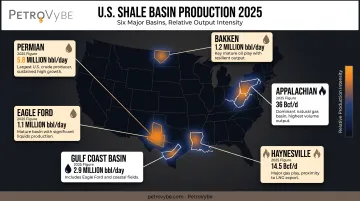
The Permian is the largest and most productive basin in the country, producing 6.6 million bbl/day in 2025, up 280,000 bbl/day year over year. It spans over 75,000 square miles across 43 counties, per the EIA, and holds more than 7,000 individual oil and gas fields.
What makes it unique is stacked pay. Multiple productive formations sit on top of each other—including the Wolfcamp, Bone Spring, and Spraberry—so operators can drill several horizons from a single surface location.
The USGS estimates the Delaware Basin's Wolfcamp and Bone Spring intervals alone hold a mean of 46.3 billion barrels of undiscovered technically recoverable oil, plus 281 trillion cubic feet of gas and 20 billion barrels of NGLs.
Eagle Ford Shale (South Texas)
Eagle Ford produced about 1.2 million bbl/day in 2025, up 18,000 bbl/day from the prior year. The play sits close to Gulf Coast refining and export infrastructure, which keeps transport costs manageable.
Moving from northwest to southeast, Eagle Ford transitions through three distinct windows:
- Oil window — shallower, liquid-rich rock
- Wet-gas/condensate window — mixed liquids and gas
- Dry-gas window — deeper, primarily gas
Bakken Formation (North Dakota & Montana)
Bakken kicked off the modern shale revolution, helping North Dakota cross 1 million bbl/day back in 2014. Production sat near 1.2 million bbl/day in 2025, though it declined by roughly 30,000 bbl/day from 2024, reflecting the basin's maturity.
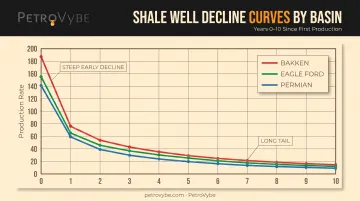
Bakken wells, like most shale wells, decline steeply and fast. A 2024 peer-reviewed study of more than 30,000 shale wells across Bakken, Eagle Ford, and Permian confirms this pattern: sharp early decline followed by a long, lower-rate tail. That's why operators in mature basins need constant new drilling just to hold production flat.
Haynesville & Appalachian Basins (Natural Gas)
Haynesville, straddling Louisiana and East Texas, produced 14.9 Bcf/d in 2025, up 4% year over year. Its biggest advantage is location: nearly all US LNG export capacity sits on the Gulf Coast, giving Haynesville gas a short, direct route to global buyers.
Appalachia, anchored by the Marcellus and Utica shales, is the country's single largest gas-producing region. It has supplied roughly 32% of Lower 48 natural gas production every year since 2016. Together, Appalachia, Haynesville, and the Permian are expected to supply about 69% of Lower 48 marketed gas production in 2026 and 2027.
Gulf Coast Basin & East Texas (Emerging Development Focus)
The Gulf Coast Basin has historically been known for NGL production and its proximity to refining and petrochemical infrastructure. Electricity demand is shifting that outlook. S&P Global reported in 2025 that US data-center growth could add 3-6 Bcf/d of natural gas demand by 2030, and gas already supplies close to half of US grid power.
That demand thesis sits behind PetroVybe's development strategy. The company holds a roughly 58,000-acre position in Lavaca County, Texas, within the Gulf Coast Basin:
- About 400 acquired legacy wells plus 57-plus planned new wells
- Proved reserves valued at $48 million (PV-09, prepared by Lee Keeling & Associates, Tulsa, March 2026) by third-party engineering firms
- Target formations including Haynesville, Middle Bossier, and Wilcox
As CEO Peter A. Snell puts it: "AI requires data centers, and data centers require one thing above all else: energy."
How Basin Geography Impacts Investment Returns
Not all barrels cost the same to produce. Basin geography drives breakeven price, and breakeven price drives investor risk.
Breakeven costs vary widely by basin and even sub-basin:
- Permian Midland Basin: $62/bbl average new-well breakeven
- Permian Delaware Basin: $64/bbl
- Permian basin-wide (2026 survey): $67/bbl, per the Dallas Fed Energy Survey
- Large E&P companies, company-wide average: $61/bbl
Lower breakevens mean more cushion when commodity prices dip. That cushion directly protects investor downside.
Beyond geology, three other factors shape returns:
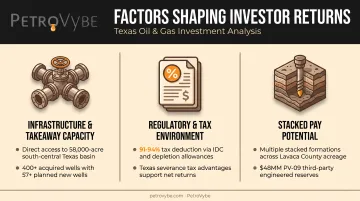
- Infrastructure and takeaway capacity. Pipelines and processing determine how fast product reaches market and what price it realizes. Basins near the Gulf Coast, like Eagle Ford, Haynesville, and the Gulf Coast Basin itself, benefit from proximity to LNG terminals and refineries.
- Regulatory and tax environment. Texas charges a 4.6% severance tax on crude oil market value and 7.5% on natural gas, alongside an operator-friendly regulatory framework through the Railroad Commission. States differ meaningfully here, and that difference flows straight to the bottom line.
- Stacked pay potential. Basins with multiple productive formations, like the Permian's Wolfcamp-Bone Spring-Spraberry combination, let operators recover more resource per acre without buying additional land.
There's also a timing dimension. Entering a maturing, high-cost basin looks very different from entering a developing one still early in its production curve.
PetroVybe's approach centers on that timing edge, targeting East Texas and Gulf Coast Basin natural gas assets before full-scale development drives up acquisition costs. The company's structure also leans heavily on Intangible Drilling Cost (IDC) deductions, which typically represent a first-year deduction target of approximately 70–80% of invested capital and can offset active income, including W-2 earnings and capital gains, not just passive income. This treatment requires the investor to elect general partner status in the Subscription Agreement and may be limited in a given year by the excess business loss limitation under IRC §461(l).
PetroVybe partners saw 94% deductions in 2025 against active income, though individual results depend on each investor's tax situation. Prior result; not a promise of any future deduction.
Which US State Has the Most Oil and Gas Production?
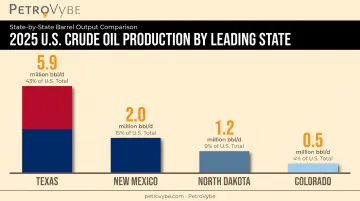
Texas leads the United States in both crude oil and natural gas production. On crude oil, 2025 EIA figures put the top producers here:
| State | 2025 Crude Oil Production | US Share |
|---|---|---|
| Texas | 5.75 million barrels/day | ~42.3% |
| New Mexico | 2.24 million barrels/day | ~16.5% |
| North Dakota | 1.17 million barrels/day | ~8.6% |
| Colorado | 0.46 million barrels/day | ~3.4% |
Texas also ranks first in natural gas output, so the oil-and-gas answer is the same state on both fuels.
That lead is not geology alone. Several structural factors stack in Texas’s favor:
- Multiple stacked plays — Permian, Eagle Ford, Haynesville, and Gulf Coast basins
- A relatively predictable state regulatory framework
- Dense pipeline and midstream takeaway capacity
- Deep service-sector and capital markets concentrated around the plays
Those same conditions are why upstream development—and much of the related investment activity—clusters in Texas rather than spreading evenly across producing states.
Who Owns the Permian Basin and How Much Oil Is Left?
Nobody owns the Permian outright. It's run by supermajors and large independents, including:
- ExxonMobil
- Chevron
- ConocoPhillips
- Diamondback Energy
- EOG Resources
- Occidental Petroleum
Consolidation remains active. Occidental's CrownRock acquisition alone was expected to add roughly 170,000 barrels of oil equivalent per day, according to Reuters.
USGS estimates put mean undiscovered technically recoverable resources in the Delaware Basin's Wolfcamp and Bone Spring formations at 46.3 billion barrels of oil, plus significant gas and NGLs. That figure is a geological estimate, not a guaranteed reserve. Actual recovery still depends on commodity prices and drilling technology.
Frequently Asked Questions
What is an oil basin?
An oil basin is a sedimentary basin, a geologic depression where buried organic material was converted into oil and gas over millions of years under heat and pressure. It's the fundamental geologic unit that determines where hydrocarbons accumulate.
What are the major oil and gas basins in the US?
The largest producing basins include the Permian, Eagle Ford, Bakken, Haynesville, Appalachian (Marcellus/Utica), and Gulf Coast Basin. Together, these regions account for the majority of national oil and gas output.
What is the largest oil basin in the United States?
The Permian Basin, spanning West Texas and southeastern New Mexico, is the largest by production volume. It produced 6.6 million bbl/day in 2025, roughly 48% of total US crude output.
What oil basins are in Texas?
Texas hosts the Permian, Eagle Ford, Haynesville, and Gulf Coast basins, making it home to more producing acreage than any other state. This concentration is a major reason Texas leads national output.
Who owns most of the Permian Basin?
No single company owns the Permian. It's operated by a mix of supermajors like ExxonMobil and Chevron alongside large independents such as Diamondback Energy and Occidental Petroleum.
How much oil is left in the Permian Basin?
USGS estimates put mean undiscovered technically recoverable resources in the Wolfcamp and Bone Spring formations at 46.3 billion barrels of oil. Actual recovery depends heavily on commodity prices and drilling technology.
Informational requests only. PetroVybe projects are offered solely to verified accredited investors. Submitting this form does not create an investment or advisory relationship.