This article is general education, not investment, tax, or legal advice. Hitting $500,000 is a real milestone. Turning that number into dependable monthly income is a different challenge entirely, and it takes a deliberate plan rather than guesswork.
Many high earners face a specific squeeze: a growing tax bill on one side and a shrinking list of safe, income-producing assets on the other. Traditional yields haven't kept pace with what investors need for real cash flow.
This guide breaks down the income options available for a $500K portfolio, what realistic monthly numbers look like, how taxes factor into your returns, and why alternatives like natural gas development are getting a second look from accredited investors.
Key Takeaways
- Spreading $500K across dividends, bonds, REITs, and alternatives reduces risk while producing steadier cash flow
- Tax efficiency can raise after-tax income as much as raw yield for W2 earners and high-net-worth investors
- A well-built $500K portfolio can realistically generate $1,500–$3,000+ monthly, depending on allocation and risk tolerance
- Alternative assets like natural gas development can add tax deductions and non-correlated income outside stocks and bonds
What to Consider Before Investing $500K for Income
Define Your Income Goals and Time Horizon
Before picking assets, get clear on timing. Do you need income starting next month, or are you building toward income five years out?
- Immediate income: Favor bonds, dividend stocks, annuities, and cash equivalents
- Future income: Favor growth-oriented assets and reinvest distributions while you build
Your risk tolerance shapes the mix:
- Conservative: Lean on bonds and cash for steadier income
- Balanced: Blend dividend stocks with REITs
- Aggressive: Add higher-yield and alternative assets, accepting more volatility for more income
Assess Liquidity Needs and Tax Situation
Don't commit the full $500,000 to income-producing assets. Keep a liquid reserve for emergencies before locking capital into longer-hold investments.
Your tax situation matters just as much as your asset choice:
- High-bracket W-2 income: Ordinary dividends and interest can lose a large share to taxes
- Recent liquidity events: Business sales or stock vesting can push gains into a higher bracket
- Tax-advantaged structures: Retirement accounts and direct energy investments can offset that drag
Best Income-Generating Investment Options for $500K
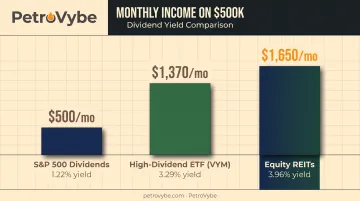
A $500K income portfolio can draw from several asset classes. Yields, liquidity, and tax treatment differ enough that the mix usually matters more than any single headline rate.
| Option | Approx. yield (end-2024) | ~Monthly on $500K |
|---|---|---|
| S&P 500 dividends | 1.22% | $500 |
| High-dividend ETF (VYM) | 3.29% | $1,370 |
| Equity REITs (FTSE Nareit) | 3.96% | $1,650 |
Common building blocks look like this:
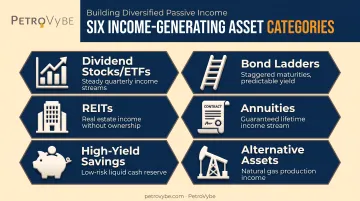
- Dividend stocks and ETFs — Income plus growth potential; payouts vary by company and cycle. The Vanguard High Dividend Yield ETF (VYM) reported a 3.29% income return for 2024, above the broad S&P 500 yield.
- Bond ladders and fixed income — Treasuries, munis, and corporates for predictable interest and lower equity-like volatility. Staggering maturities helps manage reinvestment risk as rates move.
- REITs — Real estate income without landlord duties; useful yield, but sensitive to rate shifts.
- Annuities — Contractual payouts in exchange for locking up capital. Amounts depend on age, gender, and terms—get a personalized quote before planning around a number.
- High-yield savings and money markets — Liquid, low-risk buffer. Fed-driven rates change, so shop around and treat this as safety cash, not the primary income engine.
- Alternative assets — Private natural gas development and similar partnerships sit outside public markets. They often bring different tax treatment (including deductions against active income) and distinct risk/return profiles, which is why some accredited investors use them to diversify a $500K income mix beyond stocks, bonds, and REITs. This treatment requires the investor to elect general partner status in the Subscription Agreement and may be limited in a given year by the excess business loss limitation under IRC §461(l).
How Much Monthly Income Could $500K Generate?
Actual income depends on your allocation, fees, and tax treatment. These single-asset figures use recent public-market yield benchmarks—not a blended portfolio forecast:
| Asset Class | Yield/Return Used | Monthly Income on Full $500K |
|---|---|---|
| Dividend ETF (VYM) | 3.29% | $1,371 |
| Equity REITs | 3.96% | $1,650 |
| S&P 500 dividends | 1.22% | $508 |
How you blend assets changes both the paycheck and the ride:
- Conservative — Heavier in bonds and cash; lower yield, more stability
- Aggressive — Heavier in REITs, dividend stocks, and alternatives; higher income potential with more variability
More income potential generally means more risk, less liquidity, or both. Tax treatment also changes what you keep each month—especially when taxable brokerage yields are compared with structures that can offset active income. This treatment requires the investor to elect general partner status in the Subscription Agreement and may be limited in a given year by the excess business loss limitation under IRC §461(l).
Why Tax-Advantaged Alternatives Like Natural Gas Development Deserve a Look
High-income earners and investors sitting on capital gains often skip direct energy investments simply because they're unfamiliar. That's a missed opportunity, given the tax mechanics involved.
How IDC Deductions Work Differently
Intangible Drilling Cost (IDC) deductions, authorized under IRC 263(c), let investors expense qualifying drilling and development costs in the year they're incurred.
Unlike many passive real estate deductions, a working interest in oil and gas held without limited liability is excluded from passive-activity treatment under IRC 469(c)(3). An allowable loss can therefore offset active income—including W2 earnings—subject to basis and at-risk limits, not only passive income. This treatment requires the investor to elect general partner status in the Subscription Agreement and may be limited in a given year by the excess business loss limitation under IRC §461(l).
PetroVybe as a Case Example
PetroVybe is a private natural gas development company offering accredited investors direct partnership units in early-stage projects across a 58,000-acre basin in Lavaca County, Texas. Documented partner outcomes and current project targets include:
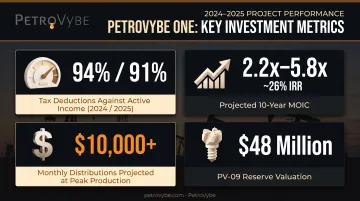
- Partners received 94% tax deductions against active income in 2025. Prior result; not a promise of any future deduction.
- The company targets a 10-year MOIC of roughly 2.2x-5.8x with a forecast IRR near 26%
- Quarterly passive distributions are projected to peak above $10,000 during peak production, though the first distribution typically arrives 2-3 years after investment
- Reserves are backed by a $48 million PV-09 valuation from a third-party engineering firm and a clean 2025 audit from Weaver. Prepared by Lee Keeling & Associates, Tulsa, March 2026.
This structure suits investors diversifying beyond stocks, bonds, and real estate. It requires accredited-investor status (generally $200K+ individual income or $1M+ net worth) and comfort with illiquidity for five years or more.
Important caveat: these are projections, not guarantees. Oil and gas investments carry real risk, including loss of capital, and require careful due diligence, review of the PPM, and consultation with a tax professional before committing funds.
Tips to Build a Safe, Diversified $500K Income Portfolio
- Spread across 3–4 asset classes so one market or sector can’t wipe out your income stream
- Rebalance annually to keep allocations aligned as markets and goals shift
- Model after-tax yield with a tax advisor before choosing an IRA, taxable brokerage, or mix
- Add real-asset alternatives if you’re accredited—private energy and similar plays can diversify beyond stocks, bonds, and real estate
Income portfolios aren’t set-and-forget. Adjust as your tax situation, markets, and goals change.
Frequently Asked Questions
How much interest will $500,000 earn in a year?
Returns vary by vehicle. At a 4–5% high-yield savings APY, $500,000 would generate roughly $20,000–$25,000 a year before tax. Bond and dividend yields move with the market, so check current rates before estimating.
How long will it take to turn $500K into $1 million?
At a hypothetical 10% average annual return (roughly the S&P 500's long-term historical average), the Rule of 72 suggests about 7.2 years to double your money. Actual results vary based on market performance and fees.
Can I live off interest of $500K?
Your spending needs and withdrawal strategy set the answer. The commonly cited 4% rule points to about $20,000 in year one, adjusted for inflation later—a historical guideline, not a guarantee.
What is the best investment for $500,000?
There is no single best option. Build the mix around your goals, risk tolerance, and tax situation—often dividend stocks, bonds, REITs, and alternatives such as direct energy partnerships.
Is investing in oil and gas development a good way to generate income and reduce taxes?
Direct oil and gas development can deliver tax deductions through IDC and depletion allowances, plus production income. It fits accredited investors who accept illiquidity, multi-year holds, and real risk of capital loss.
Informational requests only. PetroVybe projects are offered solely to verified accredited investors. Submitting this form does not create an investment or advisory relationship.