
This article is general education, not investment, tax, or legal advice. Oil and gas is one of the only asset classes where the tax code hands you a deduction against active income, not just passive gains. Percentage depletion is a core piece of that advantage. This treatment requires the investor to elect general partner status in the Subscription Agreement and may be limited in a given year by the excess business loss limitation under IRC §461(l).
Most passive investments don't work this way. Buy stock, and the IRS gives you nothing until you sell. Buy a rental property, and depreciation offsets rental income at best. Oil and gas wells are different: they generate an ongoing deduction tied directly to production income, and in many cases it can offset W-2 wages or capital gains. This treatment requires the investor to elect general partner status in the Subscription Agreement and may be limited in a given year by the excess business loss limitation under IRC §461(l).
This article breaks down what percentage depletion is, how it's calculated, who qualifies, and why it matters if you're looking to reduce your current-year tax bill while building a long-term passive income stream.
Key Takeaways
- Percentage depletion lets well owners deduct 15% of gross income per well, regardless of what they paid for the property
- Independent producers and royalty owners typically qualify; large integrated oil companies generally don't
- Unlike cost depletion, percentage depletion can continue even after basis hits zero
- Depletion is calculated by each partner individually, not by the partnership itself
What Is the Percentage Depletion Deduction?
Depletion is the tax code's way of recognizing that oil and gas wells lose value as resources come out of the ground. It's conceptually similar to depreciation on equipment, except it applies to the mineral asset itself rather than tangible property.
Percentage depletion assigns a flat statutory rate to a well's gross income each year. For independent producers and royalty owners, that rate is generally 15% under IRC Section 613A(c).
Gross income from the property isn't simply "revenue minus costs." Treasury regulations define it as the wellhead value: the price received when oil or gas is sold near the well, or a representative market price if the product is transported or processed before sale.
The deduction is also capped. Percentage depletion cannot exceed the property's net income before depletion, and it drops to zero if the well posts a loss for the year.
A Simple Example
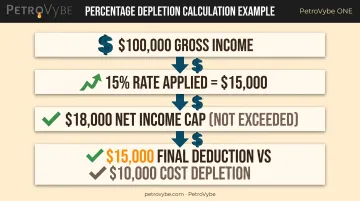
Say a well generates $100,000 in gross income and $18,000 in taxable income before depletion:
- 15% of gross income = $15,000
- That's below the $18,000 property income cap, so $15,000 is the tentative deduction
If cost depletion on the same property is only $10,000, you claim percentage depletion—the larger of the two allowable amounts.
The 1,000-Barrel-Per-Day Limit
IRC 613A(c)(3)(B) caps the production volume eligible for percentage depletion at 1,000 barrels per day, averaged over the tax year. Natural gas gets folded into this cap using a conversion ratio of 6,000 cubic feet of gas per barrel of oil. This is a taxpayer-level volume limit, not a rule that disqualifies an entire project once it crosses 1,000 barrels.
Percentage Depletion vs. Cost Depletion
The IRS requires taxpayers to calculate both methods every year and claim whichever produces the bigger deduction, per IRS Publication 535 and the mechanics laid out in IRC Sections 611–613A.
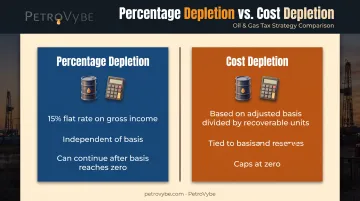
Percentage Depletion
- 15% rate applied to gross income from the well
- Independent of basis — not limited by what you paid for the property
- Can outlast your investment, continuing as long as the well produces income
Cost Depletion
- Formula: adjusted basis ÷ estimated recoverable units × units sold
- Tied to basis and reserves — what you paid and how much remains recoverable
- Caps at remaining basis, so the deduction eventually hits zero
Which method wins depends on the well:
- High income, low remaining basis → percentage depletion almost always wins
- Newer well, high basis, modest income → cost depletion may win
- Reserves and costs shift yearly, so recalculate both methods every year
How to Calculate the Percentage Depletion Deduction
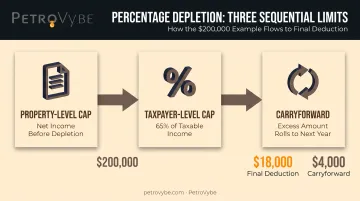
The core formula looks simple: gross income from the property × 15% = potential deduction. But three separate limits stand between that number and what you actually claim.
- Property-level cap. Percentage depletion can't exceed the property's net income before depletion. If costs eat up all the income, the deduction is zero for that year.
- Taxpayer-level cap. The deduction is further limited to 65% of the taxpayer's overall taxable income, calculated before certain deductions per IRC 613A(d).
- Carryforward. Amounts disallowed solely because of the 65% ceiling carry forward to the next year, where they're tested against that year's limit again.
Example: $200,000 gross income × 15% = $30,000 potential. A $22,000 property net-income cap cuts that to $22,000. If 65% of your taxable income is $18,000, you claim $18,000 and carry $4,000 forward.
That property-level cap hits new wells hard. Early-stage costs often outpace income, so net income from the property can sit near zero and leave little or no percentage depletion in year one.
A common misconception: the Schedule K-1 (box 20, code T) doesn't hand you a final number. It reports property-level gross income, production data, and basis information.
Each partner takes that data and computes their own allowable depletion, factoring in their individual 65% taxable income limit. Two partners in the same well can end up with different deduction amounts.
Who Qualifies for Percentage Depletion?
Qualification hinges on having an economic interest in the mineral property, meaning you've made a capital investment and have a legal right to income from what's extracted. A service contract or fee tied to production isn't enough on its own.
Who generally qualifies:
- Independent producers and royalty owners generally qualify for the 15% rate
- Working interest owners and royalty interest holders can both claim depletion
- Multi-party leases can split the deduction based on each party's share
Who is generally excluded:
- Large integrated oil companies under IRC Section 613A
- Retailers with combined gross receipts over $5 million from covered retail outlets
- Refiners averaging more than 75,000 barrels per day
If you hold a true economic interest through a working or royalty position, percentage depletion may be available. A pure service fee or production-tied contract payment is not enough.
Percentage Depletion vs. Depreciation
Both are non-cash deductions that reduce taxable income over time, which is why people sometimes conflate them. The mechanics differ:
- Depreciation applies to tangible equipment, like drilling rigs or pipeline infrastructure, over a defined useful life set by IRS tables.
- Depletion applies to the exhaustion of the natural resource itself; percentage depletion has no fixed schedule tied to remaining reserves.
In practice, oil and gas investors typically claim both in the same tax year. Depreciation covers the equipment; depletion covers the well's resource value.
Why Percentage Depletion Matters for Oil & Gas Investors
Percentage depletion is one piece of a broader tax strategy in direct oil and gas investing. Combined with Intangible Drilling Cost (IDC) deductions, which typically run a first-year deduction target of approximately 70–80% of invested capital in a new-drilling project, it's part of what makes this asset class stand apart from stocks, bonds, or real estate. For accredited investors carrying high W-2 income or capital gains, these deductions can meaningfully reduce a current-year tax bill while establishing a long-term passive income position. PetroVybe structures its natural gas development projects with this in mind. The company's PetroVybe ONE offering combines roughly 400 already-producing wells with 57+ planned new wells across a 58,000-acre position in Lavaca County, Texas, using a mix of IDC deductions and depletion allowances. Partners reported a 94% total deduction against active income in 2025 Results vary by investor, project year, and individual tax position, and these figures blend multiple deduction types rather than isolating depletion's specific contribution. Prior result; not a promise of any future deduction. Depletion calculations involve limits a K-1 alone won't resolve:. This treatment requires the investor to elect general partner status in the Subscription Agreement and may be limited in a given year by the excess business loss limitation under IRC §461(l).

- Per-well limitations
- Gross income adjustments
- Individual taxable income caps Working with an experienced operator and a tax advisor familiar with oil and gas structures isn't optional if you want an accurate picture of what you can actually deduct.
Frequently Asked Questions
What is depletion on tax returns?
Depletion is a deduction reported on your individual return, often via Schedule K-1, that accounts for the reduction in a mineral property's value as oil or gas gets extracted. It works similarly to depreciation but applies to the resource itself.
What is the depletion deduction and how does it work?
The depletion deduction lets owners of oil, gas, or mineral interests claim either percentage depletion on gross income or cost depletion based on remaining basis allocated to units sold. You calculate both each year and take the larger amount.
Can I deduct depletion on royalties?
Yes. Royalty owners with an economic interest in the mineral property can claim percentage depletion on their royalty income, subject to the same property and taxpayer-level limits as working interest owners.
What is the difference between cost depletion and percentage depletion?
Cost depletion is tied to your remaining basis divided across recoverable units. Percentage depletion is a flat 15% rate on gross income, unrelated to basis, and can continue even after basis is exhausted.
Does depletion reduce tax basis?
Yes. Both cost and percentage depletion reduce your property’s basis, but not below zero. Percentage depletion can still be claimed after basis reaches zero.
What is the difference between depletion and depreciation?
Depreciation applies to tangible equipment like pumps or pipelines over a defined useful life. Depletion applies to the exhaustion of the natural resource itself, with no fixed recovery schedule for the percentage method.
Informational requests only. PetroVybe projects are offered solely to verified accredited investors. Submitting this form does not create an investment or advisory relationship.