
This article is general education, not investment, tax, or legal advice. Private investment opportunities like oil and gas development deals aren't open to just anyone. Federal securities law restricts them to a specific class of investors, and most people don't know why or how that classification works.
Regulation D Rule 501 is the SEC standard that defines an "accredited investor." If you're considering any private placement, from a venture fund to a direct energy development partnership, this rule determines whether you're even allowed at the table.
This guide breaks down the exact criteria, how issuers verify your status, and why accreditation matters practically, not just legally, for investors eyeing opportunities like direct oil and gas development.
Key Takeaways
- Rule 501(a) sets income, net worth, and professional tests for accredited investor status
- Accreditation unlocks private placements, including oil and gas development partnerships
- The SEC's 2020 amendment added professional-license and "knowledgeable employee" pathways
- Self-certification is allowed under 506(b); 506(c) requires the issuer to verify status
What Is Regulation D Rule 501 and Why Does It Exist?
Regulation D is an SEC exemption that lets companies raise capital privately, without the cost and delay of full securities registration. Rule 501(a) is the piece that defines exactly who counts as an "accredited investor" for these offerings.
The concept traces back to the Securities Act of 1933, passed in the aftermath of the 1929 crash to protect investors from fraud. Regulation D itself was adopted later, in 1982, to simplify private-offering exemptions and align federal and state rules. A 2023 SEC staff report covers that history and the definition’s evolution.
The logic is straightforward: accredited investors are presumed to have the financial sophistication—or the capacity to absorb losses—that they don't need the same disclosure protections required in public markets.
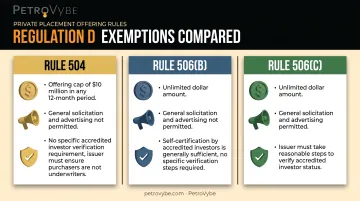
Rule 501 doesn't operate alone. It works alongside:
- Rule 504 — smaller offerings, capped at $10 million
- Rule 506(b) — private offerings, self-certification permitted
- Rule 506(c) — offerings with general solicitation, verification required
Who counts under Rule 501 has also expanded. In August 2020, the SEC adopted Release No. 33-10824, adding professional credentials, "knowledgeable employees," family offices, and the "spousal equivalent" concept. Access widened; the investor-protection goal stayed intact.
Who Qualifies as an Accredited Investor? (Core Breakdown)
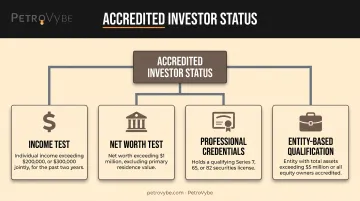
Rule 501(a) lists several distinct paths to accreditation. Most individual investors qualify through income or net worth.
Income and Net Worth Thresholds
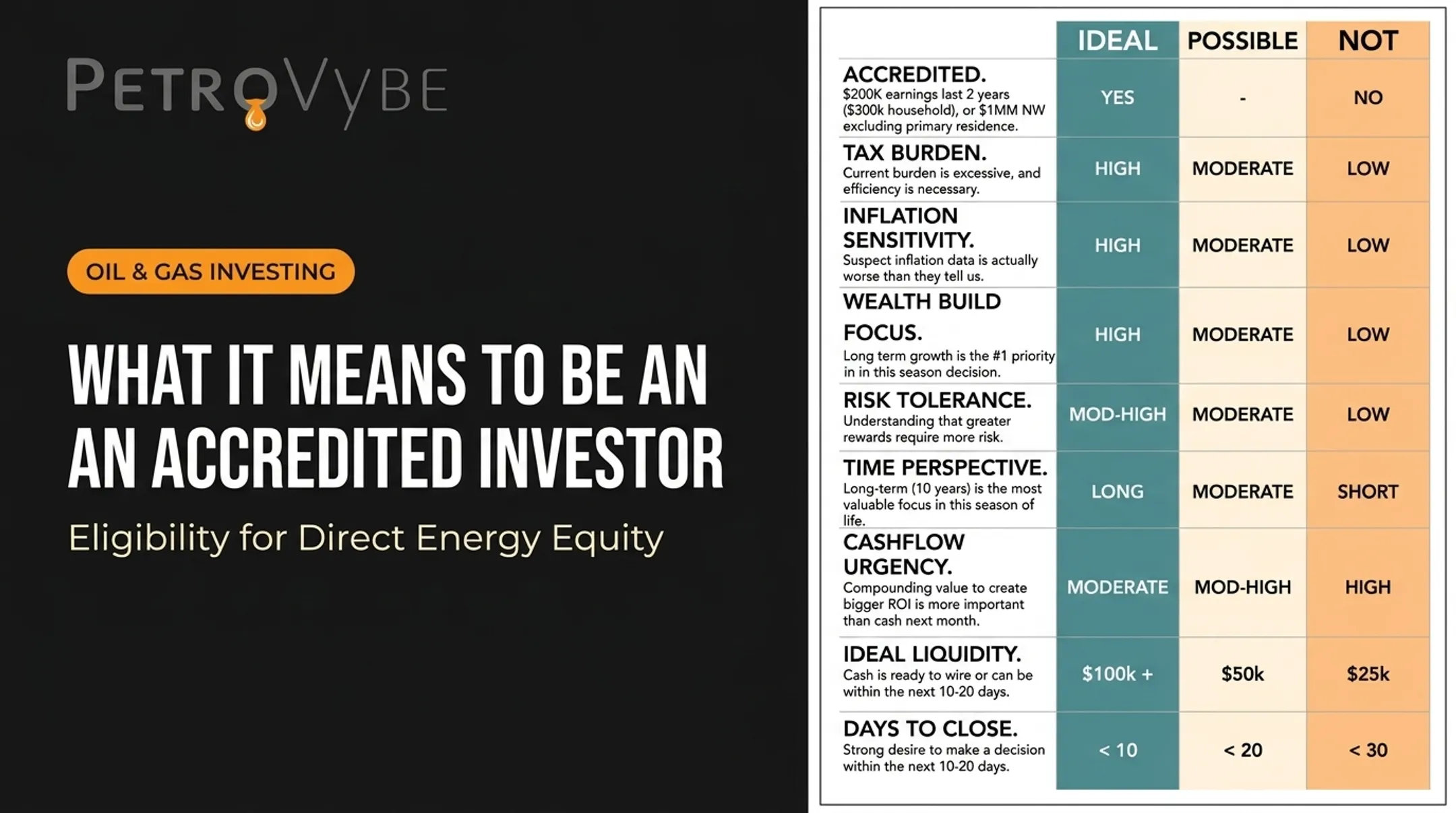
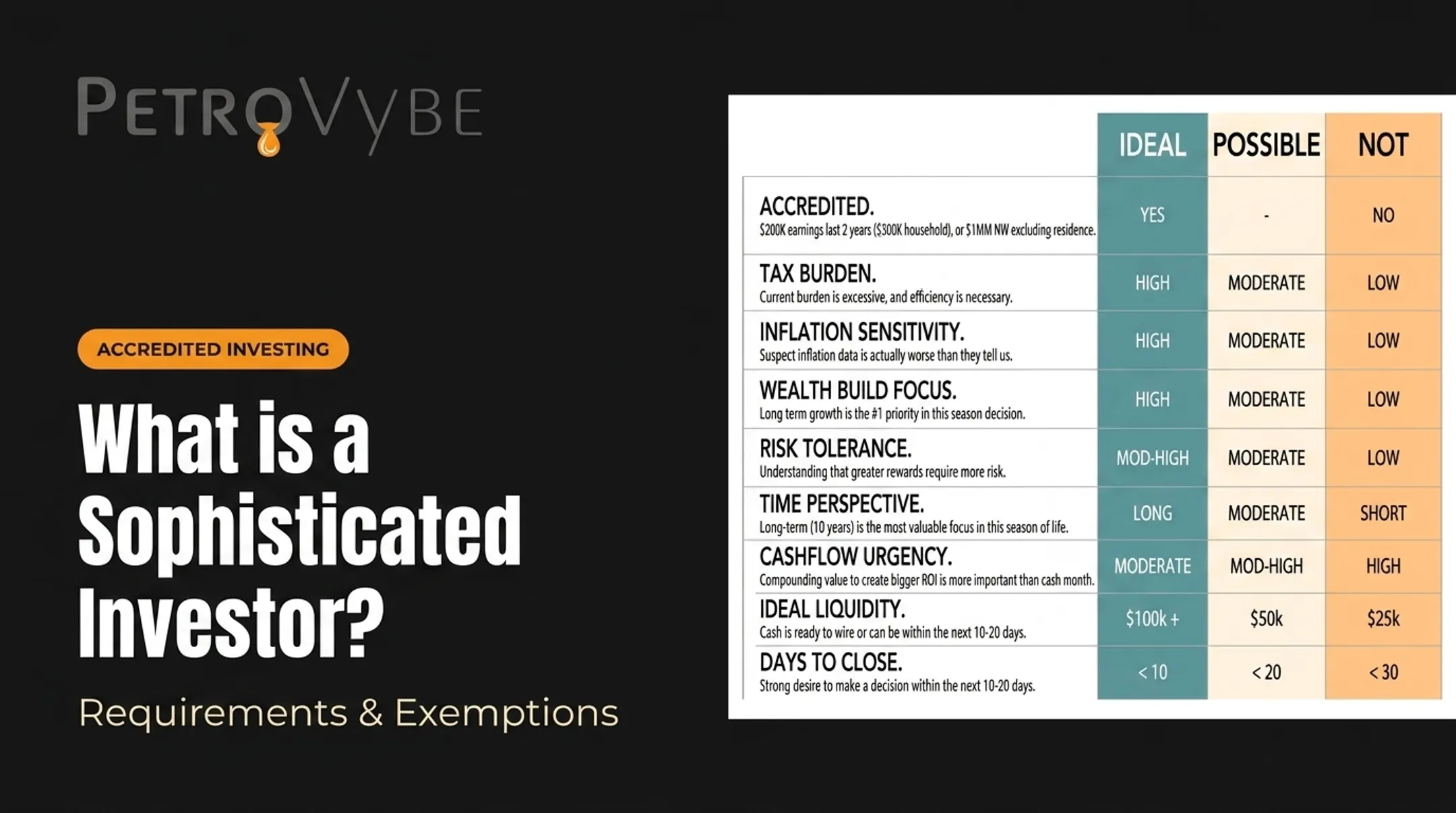
- Income test: Individual income over $200,000 (or $300,000 joint with a spouse or spousal equivalent) in each of the past two years, with a reasonable expectation of hitting that level again this year
- Net worth test: Net worth exceeding $1 million, excluding your primary residence, calculated individually or jointly
Spouses and spousal equivalents can pool income or net worth to meet the joint thresholds—useful when one partner earns most of the household income.
Professional Credentials and Entity-Based Paths
The 2020 amendments added qualification paths beyond wealth tests:
- Licensed professionals: Holders of Series 7, Series 65, or Series 82 licenses in good standing qualify automatically, regardless of income or net worth
- Knowledgeable employees: Employees of a private fund who meet the SEC's "knowledgeable employee" definition can invest in that fund
- Entities: Banks, insurers, registered investment advisers, family offices, and other entities with $5 million+ in assets or investments
- All-equity-owner entities: Any entity where every owner is already accredited
None of these criteria guarantee investment success. They're a regulatory filter, not a seal of approval. Every investor still has to evaluate whether a specific deal fits their goals.
How to Prove You Are an Accredited Investor
Verification depends entirely on which rule the issuer is using.
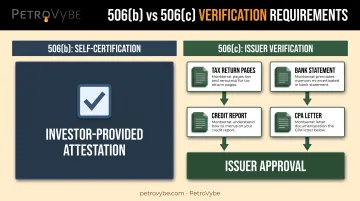
Rule 506(b) offerings allow self-certification. The issuer needs a "reasonable belief" you qualify. A bare checkbox with no supporting context is not enough on its own, per SEC guidance on assessing accredited investors.
Rule 506(c) offerings, which permit general solicitation (public advertising of the deal), require the issuer to take reasonable steps to verify status. Common documentation includes:
- Tax returns, W-2s, or 1099s covering the past two years
- Bank or brokerage statements dated within the last three months
- A credit report to confirm liabilities
- A written letter from a CPA, attorney, or licensed financial advisor confirming accreditation
Under 506(c), the compliance burden shifts to the issuer. The company must verify your status rather than rely on self-certification alone.
That is why firms offering direct oil and gas partnerships under 506(c), including PetroVybe, require third-party verification from a CPA, tax attorney, or licensed financial advisor before an investment is approved.
Why Regulation D Matters for Private Capital Raising
For issuers, Regulation D means raising capital without the cost and multi-month delay of SEC registration. That's a meaningful advantage for startups, funds, and energy development companies that need capital moving quickly.
For investors, the tradeoff runs the other direction. Private placements come with fewer disclosure requirements than public securities. That means higher risk, but also access to return potential that isn't available on any public exchange.
Rule 506 offerings have no cap on capital raised, unlike Rule 504's $10 million ceiling. That makes 506 the natural choice for larger private projects, including energy development and real estate deals that need substantial capital.
SEC data shows how large this channel has become:
- In 2025, Regulation D offerings reported $2,391.5 billion in total capital raised, per SEC Regulation D offering statistics
- Fund issuers accounted for $2,118.3 billion of that total across 17,593 offerings
Private placements are a major, active channel for capital formation—and accreditation is the gate.
Where Accredited Investors Can Put Their Capital to Work
Accredited status opens far more than stocks and bonds. Real estate syndications, private equity, venture capital funds, and natural resource development all sit behind this same regulatory gate.
Direct oil and natural gas development stands out for one reason: it combines tangible asset ownership with a tax structure most public investments can't touch. Intangible Drilling Costs (IDC) and depletion allowances can offset active income, including W-2 earnings and capital gains, not just passive investment income. This treatment requires the investor to elect general partner status in the Subscription Agreement and may be limited in a given year by the excess business loss limitation under IRC §461(l).
PetroVybe is one example of this model in practice. The Texas-based natural gas developer offers accredited investors direct participation in PetroVybe ONE, a project covering a 58,000-acre position in Lavaca County within the Gulf Coast Basin. It combines roughly 400 acquired legacy wells with 57+ planned new wells, backed by a third-party engineering firm's $48 million PV-09 proved-reserves valuation, prepared by Lee Keeling & Associates, Tulsa, March 2026.

Key details from the structure:
- 94% tax deduction against active income in 2025 via IDC and depletion. Prior result; not a promise of any future deduction.
- Offerings under Rule 506(c), so every investor must be verified by a CPA, tax attorney, or licensed adviser before approval
- Targeted 2.2x–5.8x MOIC and roughly 26% IRR over a 10-year hold. This treatment requires the investor to elect general partner status in the Subscription Agreement and may be limited in a given year by the excess business loss limitation under IRC §461(l).
Verification under Rule 501 isn't a formality. It's the mechanism that decides whether you can access a deal like this at all.
Frequently Asked Questions
Who qualifies as an accredited investor?
You qualify through income ($200,000 individual or $300,000 joint) or net worth over $1 million excluding your primary residence. You also qualify with a qualifying securities license, or by representing a trust or family office with $5 million+ in assets.
How do I prove I am an accredited investor?
Proof typically means tax returns, bank statements, or a written letter from a CPA or attorney. Requirements vary: Rule 506(b) allows self-certification, while 506(c) mandates issuer verification.
Can a married couple combine finances to qualify as accredited investors?
Yes. Spouses or spousal equivalents can pool income or net worth to meet the $300,000 joint income threshold or the $1 million net worth requirement.
Does accredited investor status expire or need renewal?
Verification is generally tied to a specific offering. Under Rule 506(c), a prior verification can be reused for up to five years, but most new placements require reverification.
What happens if someone falsely claims accredited investor status?
Misrepresentation can expose the investor to personal liability and create regulatory risk for the issuer. The SEC has penalized issuers even when investors were later confirmed accredited, because the verification process itself was inadequate.
Are accredited investor opportunities riskier than public market investments?
Generally yes. Private placements carry fewer disclosure protections and are typically illiquid. Vet the specific offering itself—accreditation alone is not a risk screen.
Informational requests only. PetroVybe projects are offered solely to verified accredited investors. Submitting this form does not create an investment or advisory relationship.