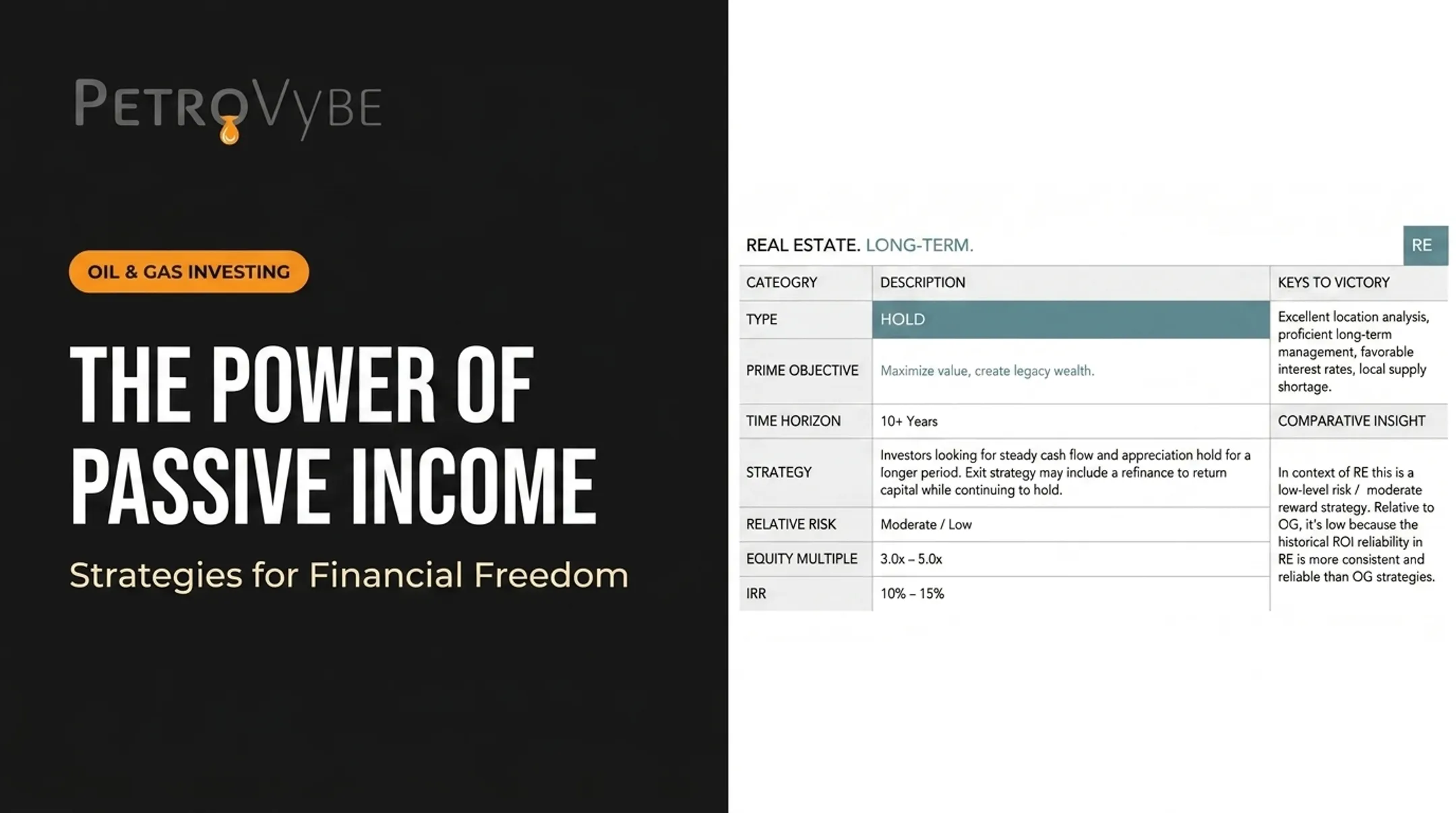

But here's the gap nobody talks about. Search "passive income ideas" and you'll find lists mixing $50-a-month dividend accounts with life-changing wealth targets, as if they belong in the same conversation. Reaching $100k a year passively isn't a side-hustle problem. It's a capital and tax-strategy problem.
This article breaks down the real math, the top strategies that actually scale, how taxes reshape your target, and how alternative assets like natural gas development can shrink the capital gap.
Key Takeaways
- Hitting $100k/year passively typically requires $1.5M–$2.5M+ invested, depending on yield and vehicle
- Tax treatment differs by vehicle, which can raise or lower the capital you need to net $100k
- Diversifying across real estate, dividends, fixed income, and alternatives like natural gas development reduces risk
- Tax-advantaged strategies, including IDC deductions in oil and gas, can lower the effective capital needed to net $100k
How Much Capital Do You Actually Need?
The formula is simple: Annual Income ÷ Yield = Capital Required.
- At a 4% yield: $100,000 ÷ 0.04 = $2.5 million
- At a 5% yield: $100,000 ÷ 0.05 = $2.0 million
- At a 6% yield: $100,000 ÷ 0.06 = $1.67 million
Here's how that plays out across common asset classes:
| Asset Class | Typical Yield | Capital Needed for $100k/year |
|---|---|---|
| S&P 500 dividend stocks | ~1.0% | $10M+ |
| FTSE Nareit All REITs | ~4.04% | ~$2.48M |
| Equity REITs | ~3.68% | ~$2.72M |
| 10-Year Treasury | ~4.77% | ~$2.1M |
| Rental real estate (gross yield) | ~7.45% | ~$1.34M |
These figures come from Nareit's REIT industry snapshot and ATTOM's 2025 single-family rental report. Note that ATTOM's rental figure is a gross yield, not net cash-on-cash return. Expect that number to shrink after taxes, vacancy, and maintenance.

Caveat: every figure above is pre-tax. After-tax income can run 15-40% lower, depending on your bracket and the type of income.
That gap is why tax-advantaged structures matter. Deductions can offset what you'd otherwise owe, which lowers how much capital you need to net $100k in your pocket.
Top Strategies to Build $100k in Passive Income
Real Estate and REITs
Rental property remains a go-to for passive income seekers, but "passive" is doing a lot of heavy lifting in that sentence.
- True rental cash flow hinges on leverage, vacancy, and whether a property manager is worth the fee
- REITs trade some yield for liquidity and diversification, with broad indexes recently yielding 3.68%–4.04%
- 2024 REIT sector performance varied wildly: specialty REITs returned 35.9%, while industrial REITs fell -17.7%, according to Nareit's 2024 performance report
Real estate rewards patience and stomach for volatility. It rarely rewards impatience.
Dividend Stocks and Fixed-Income Portfolios
Qualified dividends get preferential tax treatment — capped at 15% for most earners in 2026 — while bond and CD interest gets taxed as ordinary income, up to 37%.
The after-tax gap is larger than it looks:
- A $50,000 qualified dividend payout might net $42,500 after tax
- The same $50,000 in CD interest could net as little as $31,500 for a high earner
Reinvesting dividends compounds this advantage over time. The S&P 500's average annual return has hovered near 10% since 1957, according to Fidelity — but building $2M+ through market appreciation alone takes decades for most people without a large starting balance.

Alternative Assets: Oil & Gas Development
When tax drag and capital scale both matter, private energy structures change the math.
Accredited investors can take direct working-interest positions in natural gas development instead of relying only on stocks, bonds, and real estate. The standout feature is tax treatment: Intangible Drilling Cost (IDC) deductions can offset active income, including W-2 wages and capital gains, not just passive income.
That differs from most real estate losses, which the IRS generally limits to passive income unless you qualify as a real estate professional.
PetroVybe, a private Texas-based natural gas developer, offers a working example of this structure. Through its PetroVybe ONE offering:
- Partners received a 94% deduction in 2024 and a 91% deduction in 2025 against active income
- IDC deductions typically represent 60-80% of invested capital, reported through a K-1 in year one or spread across five years
- The project targets a 10-year IRR of approximately 26% and a MOIC of 2.2x-5.8x
- Monthly distributions are projected to peak above $10,000/month during peak production
The project is backed by roughly 400 producing wells and 57+ planned new wells across 58,000 acres in Lavaca County, Texas, with a third-party engineering valuation of $48 million (PV-09).

These figures are forecasts, not guarantees. Participation requires accredited investor status and roughly $100,000 in minimum liquidity.
Digital and Business-Based Passive Income
For those without seven figures to deploy, digital income offers a slower but accessible path:
- Online courses or digital products — scalable, but require significant upfront content creation
- Content platforms (ad revenue, affiliate income) — passive after launch, active before it
- Buying existing small businesses — semi-passive with management, higher upside, higher risk
These paths trade capital requirements for sweat equity. Neither is truly passive at the start.
Tax Considerations That Change Your $100k Target
Not all $100,000 is created equal after the IRS gets involved.
- Ordinary rates (10%–37%) apply to rental income, non-qualified dividends, and bond/CD interest
- Qualified dividends get capped rates up to 15% for most filers, per IRS Rev. Proc. 2025-32
- NIIT (3.8%) applies to investment income once MAGI exceeds $200,000 single or $250,000 joint, per the IRS
This is where upfront deductions change the equation. If a $100,000 investment in a PetroVybe partnership generates a 94% deduction against active income, that's roughly $94,000 shielded from your marginal rate in year one.
For someone in a high bracket, that deduction can be worth more than years of incremental dividend compounding. It also lowers the effective capital you need elsewhere to hit a net $100k goal.
Building a Diversified Passive Income Plan
Relying on a single income stream ties your $100k goal to one market's mood swings. A REIT downturn, a bond rate cut, or a rental vacancy shouldn't derail your whole plan.
A simple framework:
- Assess your timeline: 5 years out favors stability (bonds, dividend blue-chips); 15+ years allows more risk tolerance
- Check your liquidity needs: alternative assets like oil and gas typically lock up capital for years
- Match allocation to tax situation: high W-2 earners benefit especially from active-income deductions
- Combine 2-3 streams: dividends + real estate + one tax-advantaged alternative asset spreads risk without spreading effort too thin

Always consult a financial or tax advisor before committing significant capital to any single high-yield or tax-advantaged strategy. Build around these factors so the mix fits your timeline, liquidity, and tax situation.
Mistakes to Avoid When Chasing $100k in Passive Income
Three mistakes show up again and again on the path to $100k in passive income:
- Chasing yield blindly: A "high-yield" CD or dividend stock with an unsustainable payout ratio often signals risk, not opportunity
- Underestimating hidden work: Courses, rental properties, and content platforms all demand real hours before (and often after) they pay off
- Skipping due diligence on alternatives: Verify audits, engineering reports, and accredited-investor status under SEC Rule 506 before wiring capital into any private placement or fund
The SEC explicitly warns that Form D filings aren't approval or endorsement of an offering. Read the financials. Ask who audited them.
Frequently Asked Questions
How much money do I need to invest to make $100k a year in passive income?
It depends on yield. At 4-6% returns, expect to need $1.5M-$2.5M+ invested across most common asset classes like REITs, dividend stocks, or bonds.
What is the easiest way to start earning passive income with little money?
Dividend ETFs, REITs, and high-yield savings accounts offer low-capital entry points. Side hustles like content creation can scale over time but require upfront effort.
Is passive income taxed differently than regular income?
Yes. Qualified dividends and municipal bonds get preferential tax rates, while rental income, CD interest, and bond interest are taxed as ordinary income.
Can oil and gas investments really provide tax deductions against W2 income?
Yes—for accredited investors in qualifying working interests. Intangible drilling cost (IDC) deductions can offset active income, including W-2 wages and capital gains, unlike most passive real estate losses.
What's the difference between passive income and semi-passive or active income?
True passive income (dividends, royalties, IDC-backed distributions) requires no ongoing effort. Semi-passive income, like rental management or content creation, still demands regular time investment.
How long does it typically take to build $100k in passive income?
For average investors without large lump-sum capital, it often takes 15-40 years through consistent saving and compounding. Larger upfront capital or tax-advantaged structures can shorten that timeline considerably.