
A big chunk of this confusion comes down to timing and character of gain. Whether you're selling membership interests or LLC-owned real estate, the rules diverge fast. This guide breaks down pass-through taxation basics, what happens tax-wise when you sell, and legitimate strategies — including specialized deductions — that can reduce your bill.
This is educational content, not tax advice. Talk to a CPA or tax attorney before making decisions based on anything here.
Key Takeaways
- LLCs pay no entity-level capital gains tax; gains flow to members' personal returns on Schedule K-1
- Selling membership interests can trigger "hot asset" rules that convert part of your gain into ordinary income
- Holding period and asset type determine whether you pay 0%, 15%, or 20% federal capital gains rates
- Deductions from qualifying energy investments, like intangible drilling costs, can offset both active income and capital gains
- Basis tracking, entity elections, and sale timing directly shape your final tax bill
How LLCs Are Taxed: The Pass-Through Foundation
By default, the IRS taxes LLCs as pass-through entities, not as separate corporate taxpayers. Single-member LLCs are disregarded entities: income and gains flow onto the owner's Schedule C with their personal Form 1040, and there is no separate LLC return.
Multi-member LLCs default to partnership taxation. The entity files Form 1065 and issues each member a Schedule K-1 showing their share of income, losses, and capital gains.
Key pass-through rules that affect capital gains:
- LLCs may elect C-corp taxation on Form 8832 or S-corp taxation on Form 2553, which changes how gains and distributions are taxed
- Capital gains passed through keep their original character (short-term or long-term) based on the LLC's holding period, not when the member joined
- Under default pass-through treatment, the LLC pays no federal income tax; liability lands on the members
Self-Employment Tax vs. Capital Gains
This is where people get tripped up. Self-employment tax applies to ordinary business income earned through active participation — not to capital gains from selling an asset.
The self-employment tax rate is 15.3% (12.4% Social Security and 2.9% Medicare). It applies once net self-employment earnings hit $400 or more.
Capital gains never trigger self-employment tax, no matter how large the gain.
Capital Gains Tax and LLCs: What Happens When You Sell
Your holding period decides everything. Assets held over one year qualify for long-term capital gains rates. Assets held a year or less are taxed as ordinary income.
According to IRS Topic 409, the 2025 long-term brackets look like this:
| Filing Status | 0% Rate | 15% Rate | 20% Rate |
|---|---|---|---|
| Single | Up to $48,350 | $48,351–$533,400 | Above $533,400 |
| Married Filing Jointly | Up to $96,700 | $96,701–$600,050 | Above $600,050 |
| Head of Household | Up to $64,750 | $64,751–$566,700 | Above $566,700 |

Those rates apply only when the gain is true long-term capital gain. How you structure the sale often decides whether you keep that treatment.
Selling Membership Interests vs. Selling Assets
Selling LLC membership interests is not the same as selling corporate stock. Interest sales come with a blended basis and split holding periods, since your ownership stake may include contributions made at different times.
Under IRC § 751, a portion of your gain can convert to ordinary income if the LLC holds "hot assets":
- Unrealized receivables
- Substantially appreciated inventory
- Depreciation recapture items
This exists specifically to stop people from converting ordinary recapture income into preferential capital gains through an interest sale.

Asset sales work differently. If the LLC sells its own real estate or equipment directly, the gain's character is determined at the entity level and passes through accordingly. Selling membership interests instead often produces a different, and sometimes worse, tax outcome.
Basis Isn't Static
Your basis in an LLC constantly shifts based on income allocations, distributions received, and your share of entity debt. This directly affects your gain calculation at sale, and it's why so many owners miscalculate what they actually owe.
The "Transfer to My LLC" Myth
A common question: does moving a personally-owned home into an LLC avoid capital gains tax on a later sale? No. Single-member LLCs are disregarded entities. The IRS treats you and the LLC as the same taxpayer, so the transfer changes nothing about your eventual gain.
Strategies to Reduce Capital Gains Tax Liability for LLC Owners
Several legitimate levers exist to lower your tax bill in a gain year.
- 1031 exchanges: Defer gain on LLC-held real property by rolling proceeds into like-kind real estate. Post-TCJA, this applies only to real property—you get 45 days to identify a replacement and 180 days to close.
- Retirement contributions: Solo 401(k) or SEP-IRA contributions from LLC income lower taxable income in a gain year, though deferral limits often fall well short of larger gains.
- QBI deduction caveat: The Qualified Business Income deduction lets pass-through owners deduct up to 20% of business income, but it excludes capital gains entirely. Don't count on it to offset a sale.
- Direct participation in energy development: Accredited investors in oil and gas working interests can generate IDC deductions that offset capital gains and other active income.
Intangible Drilling Cost Deductions
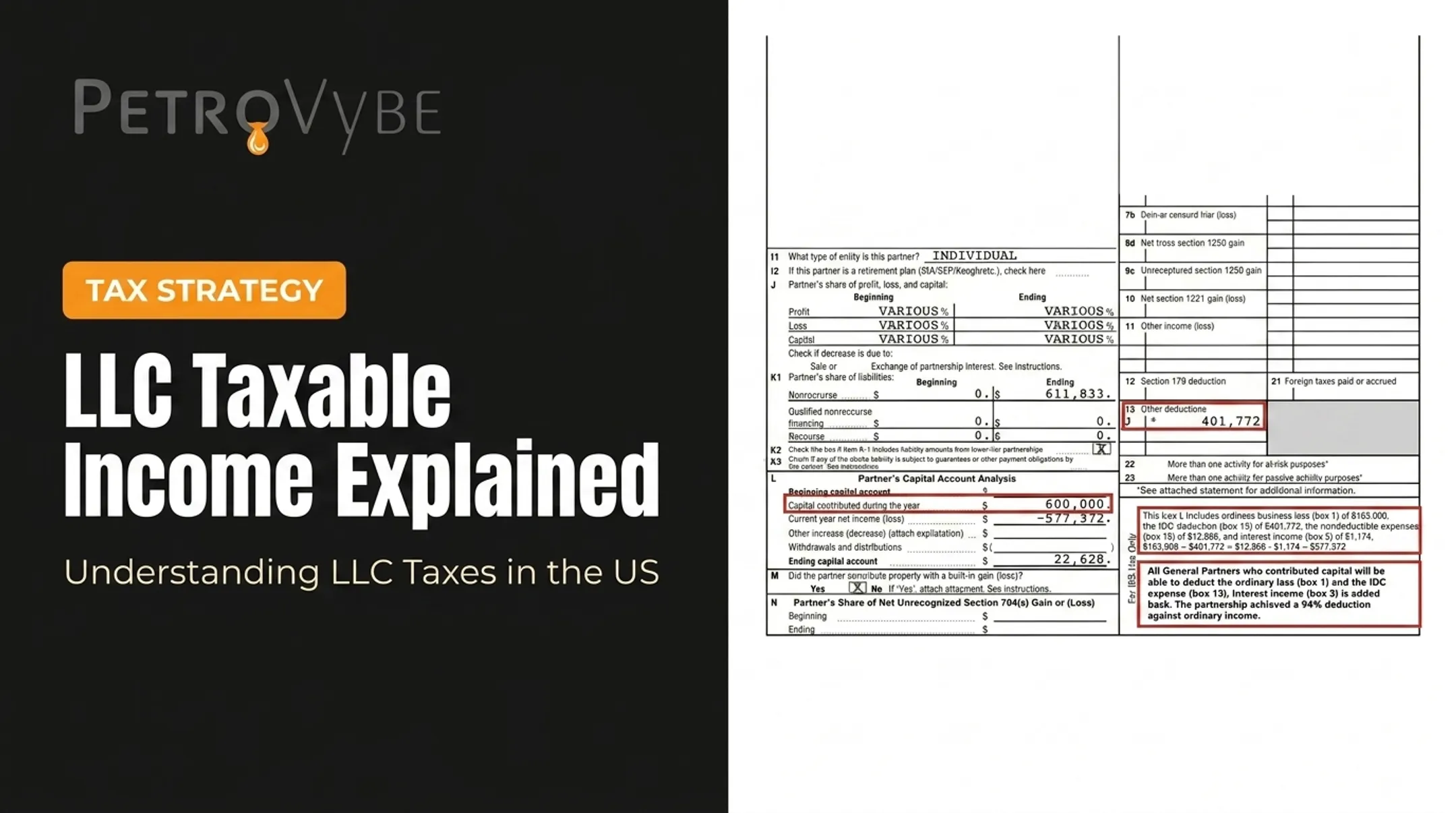
Investors who take a working interest in qualifying oil and gas development projects can deduct Intangible Drilling Costs. Under the working-interest exception in IRC § 469(c)(3), those deductions are not limited to passive income. IDC deductions can offset active income, including capital gains and W-2 wages.
PetroVybe structures its energy development partnerships around this mechanism. IDC deductions represent roughly 60–80% of invested capital, taken through the K-1 in the first year or spread across five years.
Documented results: recent partner cohorts received 91–94% deductions against active income, applied to W-2 earnings and capital gains alike.
This isn't a universal fit — participation requires accredited investor status, and outcomes vary by project and tax situation. But for someone sitting on a large capital gain from a business sale, it's a real, code-supported strategy worth modeling with a CPA before year-end.

Timing matters alongside the strategies above. Two calendar moves can further trim what you owe:
- Spreading sales across tax years can keep you in a lower capital gains bracket
- Gain/loss harvesting with LLC distributions should be modeled before December 31, not after
Common LLC Capital Gains Scenarios
Scenario 1: Partial interest sale. A member selling 30% of their LLC interest might recognize a mix of short-term and long-term gain if their basis includes contributions from different years. That mix is the blended basis problem in action.
Scenario 2: New buyer, old basis problem. Without a Section 754 election, a new partner buying into an LLC can inherit built-in gain from the prior owner's low asset basis. The election, made under IRC §§ 734(b) and 743(b), adjusts inside basis to match the new partner's purchase price, avoiding a double tax hit down the line.
Scenario 3: Selling to your own LLC. Selling assets to an LLC you wholly own is generally disregarded for federal income tax purposes, so related-party and disregarded-entity rules block any attempt to sidestep capital gains tax. The structure can also create extra complications around liability protection.

Mistakes LLC Owners Make With Capital Gains Tax
Most capital gains surprises for LLC owners come from a few avoidable errors:
- Treating LLC units like corporate shares. Corporate stock has clean, per-share basis tracking. LLC membership interests do not. Basis shifts with every allocation and distribution.
- Ignoring phantom income. Gains can be allocated and taxed even when no cash changes hands, which catches owners off guard every tax season.
- Skipping the operating agreement review. Before buying or selling interests, confirm whether a Section 754 election is in place or should be. Missing it can mean inheriting someone else's built-in gain.
Frequently Asked Questions
How much capital gains tax will I pay on $100,000?
It depends on your filing status, total taxable income, and how long you held the asset. Long-term gains typically face 0%, 15%, or 20% rates once that gain stacks on your other income.
Can I sell my house to my own LLC to avoid capital gains tax?
No. A single-member LLC is a disregarded entity for federal tax purposes, so you and the LLC are treated as the same taxpayer. The transfer creates no capital gains benefit and can raise gift-tax or basis complications.
How can an LLC avoid paying high taxes?
Legitimate options include retirement contributions, entity election changes, and timing sales across tax years. Accredited investors with active income or capital gains sometimes use IDC deductions from qualifying energy partnerships, though results depend on individual eligibility.
Are LLC capital gains taxed differently than regular business income?
Yes. Long-term capital gains get preferential rates of 0%, 15%, or 20%, while ordinary business income is taxed at personal rates plus self-employment tax where applicable.
What is the difference between selling LLC assets and selling LLC membership interests?
Asset sales determine gain character at the entity level before passing through to members. Interest sales use blended basis calculations and can trigger hot asset rules (inventory and depreciation recapture) that recharacterize part of the gain as ordinary income.