At the same time, a second demand story is unfolding. AI data centers and electrified grids are pulling natural gas consumption higher, creating a two-track thesis for energy investors: geopolitical premium on one side, structural gas demand on the other.
This guide covers the 7 best publicly traded oil and gas stocks for 2026, how they were screened, and a private alternative accredited investors are using to get closer to the ground floor of natural gas development.
TL;DR
- BP (BP) – Integrated major pivoting back to hydrocarbons
- Exxon Mobil (XOM) – 43-year dividend growth streak, supermajor scale
- Williams Cos. (WMB) – Midstream pipeline giant riding AI power demand
- EQT Corp. (EQT) – Pure-play Appalachian natural gas producer
- Cheniere Energy (LNG) – Largest US LNG export platform, contracted revenue
- Baker Hughes (BKR) – Diversified oilfield services with lower-carbon bets
- SLB (SLB) – World's largest oilfield services company
Selection leaned on dividend track record, balance sheet strength, and exposure to natural gas or AI-driven demand. Beyond these public-market picks, accredited investors have a private route into natural gas development with distinct tax advantages, covered later in this guide. Commodity price swings and geopolitical shocks remain the core risk across the sector.
Overview of the Oil and Gas Stock Market in 2026
"Oil and gas stock" covers a wider net than most people assume. It spans exploration and production (E&P) companies, midstream pipeline operators, refiners, integrated supermajors, and oilfield services firms. Investors use the group for two main reasons:
Inflation hedging — energy prices tend to rise alongside broader inflation
Portfolio diversification — energy often moves independently of tech or consumer stocks
Income generation — many established producers pay steady quarterly dividends
The sector's performance backs this up. The Morningstar US Energy Index gained 24.12% year-to-date through mid-June 2026, more than double the 11.22% return of the broader Morningstar US Market Index.
Natural Gas as the New Bridge Fuel
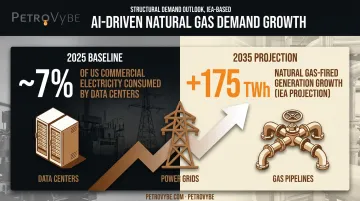
Something structural is happening underneath the headline volatility. Data centers consumed roughly 7% of US commercial-sector electricity in 2025. The International Energy Agency projects natural gas-fired generation will expand by 175 TWh through 2035, largely to serve that load, especially in the United States.
That's reshaping where capital flows industry-wide. Companies with direct pipeline, LNG, or Appalachian gas exposure are positioned differently than pure oil-price plays. The seven stocks below were chosen with that shift in mind.
Top 7 Oil and Gas Stocks to Buy in 2026
Each pick below was filtered through four lenses: dividend reliability, balance sheet strength, geographic or business diversification, and exposure to natural gas or AI-driven demand growth.
BP PLC (BP)
BP spent years diversifying into renewables, then reversed course under investor pressure. Reuters reported activist firm Elliott Management had built roughly a 5% stake by early 2025, pushing for strategic change. BP responded with a reset: $10 billion in annual upstream oil and gas investment through 2027 and total capital spending of $13-15 billion annually.
That's a return to what BP knows best. The tradeoff is growth speed. A vertically integrated major with BP's scale offers stability, but smaller E&P pure-plays can outrun it during a genuine upcycle.
| Metric | Details |
|---|---|
| Key Advantage | Renewed hydrocarbon focus and integrated global scale |
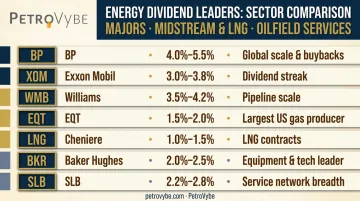
| Forward Dividend Yield | Approximately 5-6%, following a $0.4992 per ADS payment in June 2026 |
| Investor Fit | Income-focused investors wanting Big Oil stability |
Exxon Mobil Corp. (XOM)
Exxon has increased its annual dividend for 43 consecutive years — the longest streak among oil majors. It backed that record with $20 billion in share repurchases in 2025 and plans to hold that pace through 2026.
The company isn't chasing every trend either. Exxon's 2030 plan targets $25 billion of earnings growth and $35 billion of cash flow growth versus 2024, built on core fossil fuel operations plus selective lower-carbon investments rather than a full pivot.
| Metric | Details |
|---|---|
| Key Advantage | Longest dividend growth streak among oil majors |
| Forward Dividend Yield | Roughly 3-3.5%, after a Q4 2025 increase to $1.03 per share |
| Investor Fit | Long-term dividend growth investors |
Williams Cos. Inc. (WMB)
Williams operates purely in the midstream, transporting natural gas rather than producing it. The company operates interests in more than 32,000 miles of pipeline, including the roughly 10,000-mile Transco system that transports about 15% of all US natural gas.
What makes Williams timely in 2026 is Project NEO: a 682 MW behind-the-meter data center power project carrying an estimated $2.3 billion price tag, targeting service by late 2028. A separate agreement, Project Atlas, locks in up to 164 MMcf/d of pipeline capacity for a Northeast data center customer by year-end 2026. Williams captures AI-driven gas demand without taking on commodity price risk directly.
| Metric | Details |
|---|---|
| Key Advantage | Largest natural gas pipeline network exposure to AI-driven demand |
| Forward Dividend Yield | Around 3-3.5%, supported by a 2026 annualized dividend of $2.00 per share |
| Investor Fit | Investors seeking steady, contracted midstream cash flows |
EQT Corp. (EQT)
EQT calls itself the leading US natural gas producer, developing acreage across the Marcellus and Utica shales, including roughly 150,000 net acres in eastern Ohio's Belmont County. 2026 guidance calls for production between 2,275 and 2,375 Bcfe.
Unlike Williams, EQT carries direct commodity exposure — but that's the point for growth-focused investors. The company points to data center development and expanding LNG export markets as key drivers of future demand for its gas.
| Metric | Details |
|---|---|
| Key Advantage | Pure-play natural gas exposure in premier Appalachian shale |
| Forward Dividend Yield | Roughly 1.2-1.5%, following a $0.165 quarterly dividend declared in February 2026 |
| Investor Fit | Growth-oriented natural gas investors |
Cheniere Energy Inc. (LNG)
Cheniere runs one of the largest LNG liquefaction platforms on Earth. As of May 2026, it operates more than 53 million tonnes per annum across its Sabine Pass (about 30 mtpa) and Corpus Christi (about 23 mtpa) facilities, with another 8 mtpa under construction.
Contract structure, not just size, sets Cheniere apart. At the end of 2025, sale and purchase agreements covered roughly 90% of anticipated production with a 15-year weighted-average remaining life. That's a level of revenue predictability few oil and gas companies can match.
| Metric | Details |
|---|---|
| Key Advantage | Largest global LNG export platform with contracted revenue |
| Forward Dividend Yield | Approximately 1.5-2%, after a $0.555 quarterly dividend declared in April 2026 |
| Investor Fit | Investors seeking global export/demand exposure with lower volatility |
Baker Hughes Co. (BKR)
Baker Hughes operates in more than 120 countries with roughly 56,000 employees, giving it a geographic footprint most oilfield services rivals can't match. It's also hedging toward the energy transition without abandoning core drilling services.
Recent moves include a collaboration on a 150 MW New Mexico geothermal project announced in March 2026 and a contract supplying three CO2 compressor trains to the Liverpool Bay carbon capture project. That combination of traditional services and lower-carbon technology is the differentiator.
| Metric | Details |
|---|---|
| Key Advantage | Geographic and technology diversification across the energy value chain |
| Forward Dividend Yield | Roughly 2-2.5%, following a $0.23 quarterly dividend declared in April 2026 |
| Investor Fit | Investors wanting diversified oilfield services exposure |
SLB NV (SLB)
Reuters describes SLB, formerly Schlumberger, as the world's largest oilfield services operator. Its edge is technology. SLB brings decades of reservoir and drilling expertise, more than three decades of carbon capture activity through its SLB Capturi platform, and a New Energy division working on low-carbon hydrogen and solid-oxide electrolyzer technology.
For investors, SLB offers leveraged upside to any broad oil services upcycle, backed by international and offshore project strength that's harder for smaller competitors to replicate.
| Metric | Details |
|---|---|
| Key Advantage | Global technology leadership in reservoir and drilling services |
| Forward Dividend Yield | Approximately 2.5-3%, after a $0.295 quarterly dividend approved in April 2026 |
| Investor Fit | Investors seeking services-led exposure to any oil upcycle |
How These Stocks Were Chosen
The screening process focused on four criteria in combination, not isolation:
- Dividend consistency: companies with multi-decade payout histories, not just high current yields
- Balance sheet strength: the ability to fund buybacks and capex without excessive leverage
- Geographic and business diversification: reducing reliance on any single basin or commodity
- Natural gas demand exposure: direct or indirect ties to AI data center and grid electrification growth
A common mistake investors make is chasing whatever stock benefits most from this month's oil price spike. That approach tends to work until it doesn't.
Companies built to survive down-cycles, with strong free cash flow and disciplined capital allocation, are the ones that keep paying dividends when oil drops back below $70, as it briefly did in July 2026.
Beyond Public Stocks: A Private Alternative for Accredited Investors
Public stocks and ETFs offer something valuable: liquidity. You can sell on any trading day.
That liquidity comes bundled with daily market volatility and geopolitical headline risk: the same Hormuz tensions that spike oil prices one week can crush energy stocks the next. Public ownership also puts you several steps removed from where value is actually created, at the drilling and development stage.
Direct private oil and gas development investment is a different path entirely, one used by accredited investors to enter natural gas projects before public markets price in the upside.
PetroVybe is a Texas-based example of this model. The company develops natural gas liquids projects in South Texas and the Gulf Coast Basin, built around a leadership team with a specific track record:
- Chief Geophysicist with a 48-year career and a 75.2% well-success rate, nearly double the industry peer average of below 40%
- President & COO who scaled a $5 billion asset from zero to 35,000 BOEPD over eight years
- A $48 million proved reserves valuation (PV-10), verified by a licensed third-party engineering firm
The Tax Angle Public Stocks Can't Match
Here's where private development investment diverges structurally from stock ownership. Intangible Drilling Cost (IDC) deductions let investors write off 60-80% of invested capital in the first year.
Unlike most passive investment deductions, this one applies against active income, including W-2 earnings and capital gains. Public stock dividends and capital gains offer no equivalent upfront deduction.
PetroVybe's partners saw this play out directly:
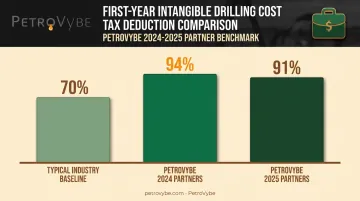
- 94% first-year tax deduction for 2024 partners
- 91% first-year tax deduction for 2025 partners
That's well above the roughly 70% baseline typically projected for these structures.
The tradeoff to weigh: Direct development investment complements public market exposure rather than replacing it. It's illiquid and restricted to accredited investors, with a minimum entry of $100,000 per unit and a multi-year hold before distributions begin.
In exchange, PetroVybe targets a 10-year MOIC of roughly 2.2x-5.8x and an IRR near 26%, figures dependent on commodity pricing and production performance rather than guaranteed outcomes.
Conclusion
These seven stocks capture different angles on the same 2026 story:
- Integrated majors like BP and Exxon offer scale and dividend history
- Midstream and LNG plays like Williams and Cheniere capture contracted cash flow
- EQT delivers pure-play natural gas growth
- Baker Hughes and SLB provide services-led exposure across the value chain
Before buying any single name, weigh dividend history, balance sheet strength, and natural gas demand exposure against your own risk tolerance and position size accordingly.
Accredited investors wanting deeper, tax-advantaged exposure beyond public markets can explore PetroVybe's direct natural gas development opportunities in South Texas and the Gulf Coast Basin.
Frequently Asked Questions
What is the best oil and gas company to invest in?
It depends on your goal. Dividend-focused investors often favor Exxon Mobil for its 43-year dividend growth streak, while growth-oriented investors may prefer EQT or Cheniere for natural gas and LNG demand exposure.
What is the best oil fund to invest in?
Diversified energy ETFs like the Energy Select Sector SPDR Fund (XLE) or Vanguard Energy ETF (VDE) offer broad sector exposure. Investors wanting a targeted play can look at oil services-specific ETFs instead.
Are oil and gas stocks a good investment in 2026?
Yes, for most diversified portfolios: global energy demand and AI-driven natural gas growth support the sector's relevance. That said, geopolitical shocks and commodity price swings remain real risks to size around.
What is the safest oil and gas stock to buy?
Integrated supermajors with long dividend histories and diversified operations, such as ExxonMobil or Chevron, are typically considered lower-risk than smaller E&P pure-plays.
How do I start investing in oil and gas stocks?
Getting started takes four steps:
- Open a brokerage account
- Research specific tickers or ETFs
- Decide between individual stocks and diversified funds
- Place a market or limit order through your broker's platform
Are there tax advantages to investing in oil and gas beyond stocks?
Yes. Direct private development investments can offer Intangible Drilling Cost deductions against active income, including W-2 earnings and capital gains. This benefit isn't available through public stock ownership, which is why accredited investors often explore platforms like PetroVybe.