
Introduction
Tax brackets shift. QBI thresholds move. Self-employment tax rules stay just complicated enough to trip up busy owners. If you run an LLC and don't actively plan around these 2026 changes, you risk overpaying thousands in taxes you didn't have to pay.
Most guides explain LLC tax benefits in theory. Few show how they actually play out when you're staring at your own return, actual numbers, and a deadline that's already here.
This guide breaks down how LLCs are taxed in 2026, the deductions and structures every owner should know, and the advanced strategies high-income earners use to push their tax bill even lower.
Key Takeaways
- LLCs are pass-through entities by default, so profits are taxed once, not twice like C-corps
- Business expense deductions, the QBI deduction, and retirement contributions lower taxable income
- Electing S-corp status can cut self-employment tax for profitable LLCs, though it isn't for everyone
- High-income owners can pair deductions with retirement plans and alternative investments to offset active income
What Is an LLC and How Is It Taxed
An LLC is a state-registered business structure that blends personal liability protection with flexible federal tax treatment. That flexibility is the whole point.
Here's what surprises a lot of new owners: the IRS doesn't have a dedicated "LLC tax return." Instead, an LLC is taxed as a sole proprietorship, partnership, S-corp, or C-corp, depending on elections you make. Single-member LLCs are treated as disregarded entities by default, while entities with more than one owner default to partnership status.
Single-Member vs. Multi-Member LLC Taxation
| LLC Type | Tax Treatment | Federal Filing |
|---|---|---|
| Single-member | Disregarded entity | Schedule C on Form 1040 |
| Multi-member | Partnership | Form 1065, with Schedule K-1 issued to each member |
| Corporate election | C-corp or S-corp | Form 8832 (C-corp) or Form 2553 (S-corp) |
A single-member LLC still files as a separate entity for federal employment and certain excise taxes, even though it's disregarded for income tax purposes.
This classification decision carries real weight beyond initial paperwork. It determines your tax bill every year and stands as one of the most direct levers you have for optimizing after-tax income.
Top LLC Tax Advantages
The advantages below are measurable reductions in tax liability you can act on this filing year, not abstract legal theory.
Pass-Through Taxation and Avoiding Double Taxation
LLC profits flow directly to members' personal returns. There's no federal income tax at the entity level, only self-employment and personal income tax at the member level. Compare that to a C-corp, which pays tax twice: once on corporate profits, again when those profits reach shareholders as dividends.
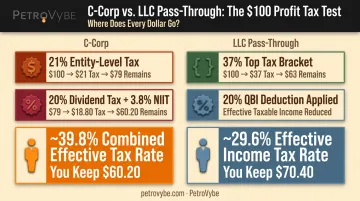
The numbers make the difference concrete:
- A C-corp pays 21% at the entity level, leaving $79 of every $100 in profit
- A top-rate dividend tax of 20% (plus the 3.8% net investment income tax) pushes combined tax on that $100 to roughly 39.8%
- An LLC member at the top 37% bracket, after the full 20% QBI deduction, pays an income-tax-only rate of about 29.6% on the same $100, before self-employment or state tax
This advantage matters most for growing multi-member businesses reinvesting profits rather than paying out large dividends year after year.
Business Expense Deductions and the QBI Deduction
Ordinary and necessary business expenses reduce taxable income directly. Think:
- Equipment and software subscriptions
- Home office costs
- Business travel
- Insurance premiums
- Professional services
On top of that, Section 199A allows eligible LLC members to deduct up to 20% of qualified business income before tax, and this deduction is now permanent under recent legislation.
2026 QBI thresholds (measured on taxable income before the QBI deduction):
| Filing Status | Phase-In Begins | Phase-In Ends |
|---|---|---|
| Single / other nonjoint | $201,750 | $276,750 |
| Married filing jointly | $403,500 | $553,500 |
Below the lower threshold, specified-service businesses and W-2 wage limits don't restrict the deduction at all. LLCs under that threshold, along with non-specified-service businesses that stay eligible even above it, see the biggest impact from this deduction.
Electing S-Corp Status to Reduce Self-Employment Tax
An LLC can elect S-corp tax treatment by filing Form 2553. Once elected, owner income splits into two buckets: salary and distributions. The 15.3% self-employment tax only applies to the salary portion; distributions escape it entirely.
Say your LLC nets $150,000 in profit. Pay yourself a reasonable $70,000 salary, and the remaining $80,000 in distributions avoids the 15.3% self-employment tax that would otherwise apply. That's roughly $12,240 in potential savings, minus added payroll administration costs.
But there's a catch: the IRS has no official 60/40 salary-to-distribution safe harbor. Compensation must be "reasonable" based on duties, time, and comparable pay. One Journal of Accountancy example showed a reclassified $50,000 distribution generating $8,084 in payroll tax, offset by only $1,193 in income tax savings, a net loss for the owner who cut corners on salary.
The election pays off most once an LLC consistently nets profits well above what a reasonable owner salary would be.
Advanced Tax Strategies for LLC Owners and High-Income Earners in 2026
Once you've maxed out standard deductions, expenses, QBI, and a solid retirement contribution, what's left? Quite a bit, actually, especially if you're also drawing W-2 income or sitting on capital gains.
Retirement contributions defer real money, and both options below shrink taxable income while building long-term wealth:
- Solo 401(k): Employee deferral up to $24,500 in 2026, with combined employee-employer contributions capped at $72,000 (before catch-up amounts)
- SEP-IRA: Employer contributions capped at the lesser of 25% of compensation or $72,000
The self-employed health insurance deduction gets overlooked constantly. It's an above-the-line deduction (Form 7206) covering medical, dental, and vision premiums for you, your spouse, and dependents, often worth thousands and easy to miss if your tax prep isn't thorough.
Beyond that, accredited investors have access to strategies most LLC owners never hear about. Direct working-interest investments in oil and gas drilling can qualify for Intangible Drilling Cost deductions under 26 CFR 1.612-4, a regulation dating back to provisions designed to offset the financial risk of drilling ventures. Unlike most passive deductions, IDCs on a properly structured working interest can offset active income, meaning W-2 wages and capital gains, not just passive income from other investments.
Companies like PetroVybe structure these opportunities specifically for accredited investors seeking that kind of upfront deduction alongside long-term passive income. PetroVybe partners received a 91% deduction against active income in 2024 and 94% in 2025, based on the company's own reported performance figures. Some partners have reported dramatic reductions in their tax liability through this structure, though results vary by individual circumstances. Minimum liquidity to participate typically runs $100,000, and investors must verify accredited status through a CPA, tax attorney, or licensed advisor before investing.

A quick word of caution: not every LLC owner qualifies for this kind of strategy, and passive-loss rules under Section 469 can limit deductions depending on how the investment is held. Talk to a tax professional before assuming any specific offset applies to your situation.
Also worth tracking for 2026: bonus depreciation is now permanently set at 100% for qualifying property acquired after January 19, 2025, reversing the previously scheduled phase-down. Combined with QBI's permanence under recent tax law, the deduction landscape looks more stable than it has in years — but "stable" doesn't mean "set it and forget it."
Common LLC Tax Mistakes That Cost Owners Money
Small missteps compound fast. Three show up more than any others:
- Commingling personal and business finances. This undermines liability protection and makes clean expense tracking nearly impossible, risking disallowed deductions at audit time.
- Missing quarterly estimated payments. LLC income isn't subject to withholding, so the IRS expects payments each April, June, September, and January. Skip them, and penalties apply even if your year-end return shows a refund.
- Sticking with the default tax classification too long. As profits grow, failing to reassess an S-corp election often means paying far more self-employment tax than necessary.
How to Maximize Your LLC Tax Benefits in 2026
A few habits separate owners who capture every available benefit from those who leave money on the table:
- Work with a CPA annually, not just at tax time, to reassess entity classification and available deductions as income changes.
- Use expense-tracking software year-round rather than reconstructing receipts every April.
- **Explore strategies beyond standard deductions** if you're a high-income earner, such as retirement accounts or direct investments in tax-advantaged sectors like oil and gas development, where structures such as PetroVybe's intangible drilling cost (IDC) deductions can offset a significant share of active income.
LLC tax advantages compound most through annual review and adjustment rather than a one-time setup.
Frequently Asked Questions
Is an LLC taxed as a partnership?
Multi-member LLCs default to partnership taxation, filing Form 1065 with Schedule K-1s issued to each member. They can elect corporate taxation instead if that fits better.
What is a limited liability company?
An LLC is a state-registered business structure providing liability protection while allowing flexible federal tax treatment as a sole proprietorship, partnership, S-corp, or C-corp.
How much can an LLC deduct in taxes?
Deductions vary by business but typically include ordinary operating expenses plus up to a 20% QBI deduction. There's no single fixed dollar cap.
Can I use my LLC's losses to offset W-2 income?
Active LLC losses can generally offset other income, subject to passive activity and basis rules. Passive losses usually can't offset wages without material participation — check with a tax professional.
What is the QBI deduction limit for 2026?
Phase-ins begin at $201,750 for single filers and $403,500 for joint filers, ending at $276,750 and $553,500 respectively. These thresholds adjust annually for inflation.
Should my LLC elect S-corp status?
It depends on consistent profitability well above a reasonable owner salary. Consult a tax professional before filing Form 2553 to confirm the math works in your favor.