
Most W2 earners and investors treat taxes as a once-a-year math problem instead of a decision that compounds. That compounding cuts both ways: unmanaged tax drag reduces the capital you have available to reinvest, which shrinks the wealth you'd otherwise build over a decade. A $50,000 annual overpayment invested at even modest returns becomes real money by year ten.
Here's the good news: your tax burden isn't fixed. It's a function of structure, timing, and how proactively you plan. This article breaks down how tax burden accumulates, what drives it, and the advanced strategies that address it at the decision, management, and structural level.
TL;DR
- High earners overpay by defaulting to reactive, year-end tax planning
- Tax burden builds through income concentration, missed deductions, and passive-only portfolios
- Strategies fall into three buckets: better decisions, better management, better structure
- IDC deductions can offset taxes on W2 wages and capital gains
- Documentation and qualified advisors keep every strategy audit-ready
How Tax Burden Typically Builds Up
Tax burden doesn't spike overnight. It compounds quietly as income grows without a matching adjustment in strategy or structure.
Each year you skip proactive planning, you leave a little more on the table:
- Bracket creep pushes more income into higher marginal rates
- Deferral opportunities — retirement contributions, timing elections — expire unused
- Structural mismatches persist, such as remaining a sole proprietor after income outgrows that setup and an S-Corp election would help
Many high earners don't feel the true cost until a trigger event hits: a bonus year, a liquidity event, or an asset sale. Supplemental wages like bonuses get withheld at a flat 22% up to $1 million, then 37% above that, according to IRS Publication 15.
A sudden asset sale can also trigger the 3.8% Net Investment Income Tax on top of standard capital gains rates, per the IRS. By then, it's usually too late to plan around it.

Key Cost Drivers Behind a High Tax Burden
Not all income is taxed equally, and that's the first lever most people miss.
Income type matters more than income amount:
- W2 wages face ordinary rates plus FICA
- Capital gains get preferential rates but can trigger NIIT above $200,000 single or $250,000 joint
- Passive income is boxed in by passive activity loss rules unless it qualifies for an exception
Entity structure shapes self-employment tax exposure. A sole proprietor pays the full 15.3% self-employment tax; an S-Corp election can shift some of that income to distributions not subject to SE tax.
Diversification into tax-advantaged assets (real estate, energy, qualified retirement plans) expands what you can actually control. Without it, you're stuck optimizing around the edges of W2 income alone.
Even strong positions fail without proof. Documentation and timing decide whether deductions survive scrutiny. Material participation status, for instance, isn't proven by intent alone; it requires records showing hours and activity, per Treasury Regulation 1.469-5T.
These drivers interact differently for a business owner, executive, or investor, so a one-size-fits-all strategy rarely works.

Advanced Tax Strategies to Reduce Your Burden
Effective strategies operate on three levels: the decisions you make upfront, how you manage assets ongoing, and the broader context surrounding your finances.
Strategies That Reduce Tax Burden by Changing Decisions
These are choices made before income lands, when you still have flexibility:
- Elect the right entity structure: An S-Corp election before income scales can cut self-employment tax exposure
- Time major income events: Shift bonuses, asset sales, and Roth conversions into lower-tax years
- Select investments with active-income treatment: Direct working interests in oil and gas development qualify for an exception under IRC Section 469(c)(3), so losses and deductions can offset W2 wages and capital gains, not only passive income
- Maximize high-earner retirement vehicles: Cash balance and defined benefit plans allow contributions far above standard 401(k) limits
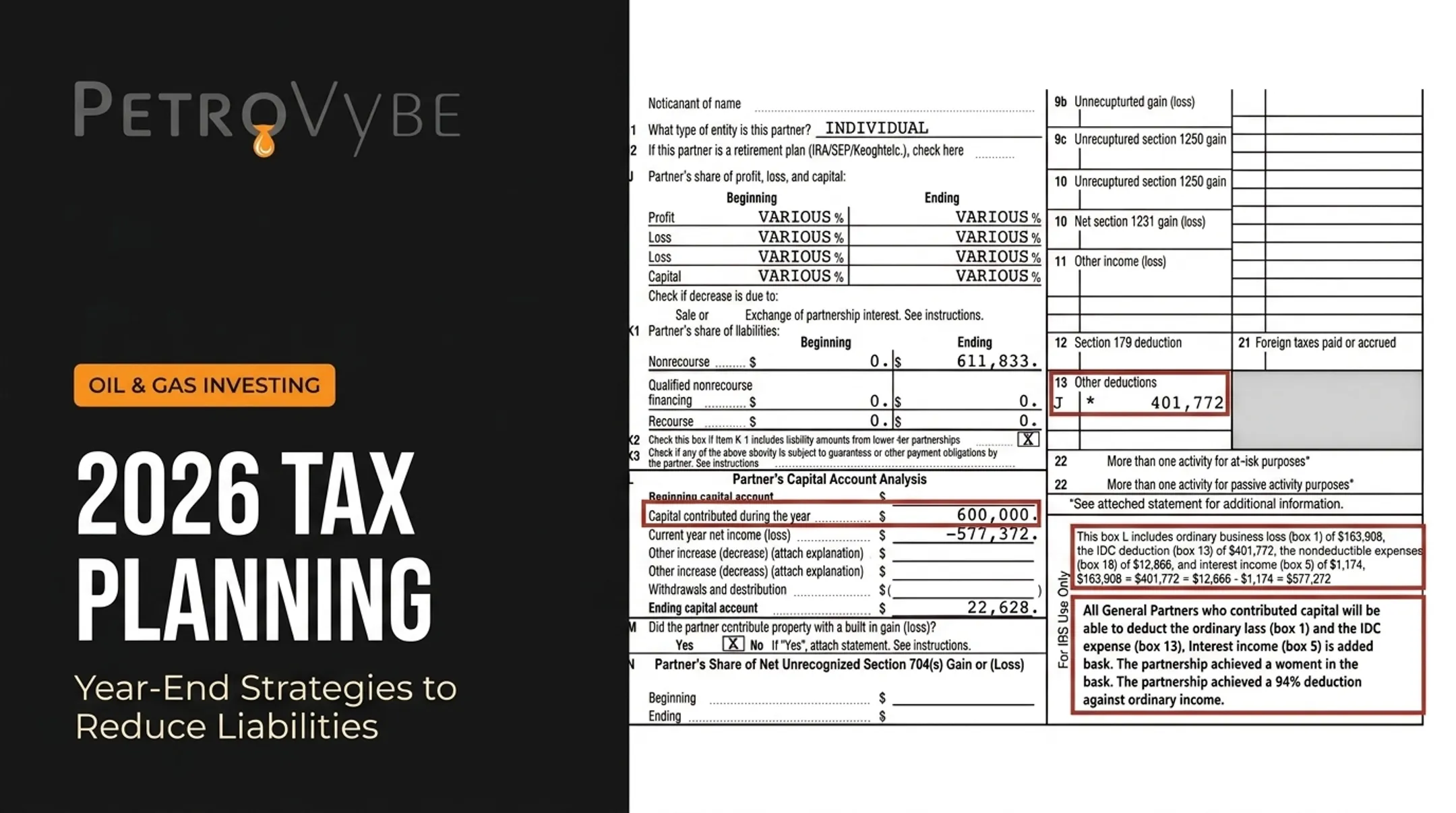
- Donate appreciated assets instead of cash: You avoid capital gains while claiming a fair-market-value deduction, per IRS Publication 526 This is where PetroVybe's model fits decision-stage planning. PetroVybe ONE structures direct working interests in natural gas development so Intangible Drilling Costs (typically 60–80% of invested capital) are deductible against active income in the year incurred. In 2024, PetroVybe partners saw a 94% deduction against active income; in 2025, it was 91%. A redacted 2025 K-1 example shows a $600,000 contribution generating $401,772 in deductions, roughly 67% of the investment.
Strategies That Reduce Tax Burden by Changing How Assets Are Managed
Decisions made once aren't enough. Ongoing management determines whether those decisions hold up.
- Document material participation hours consistently, not just at tax time. The IRS allows any reasonable method of substantiation, and "reasonable" means actual records, not memory
- Run annual tax reviews, not just year-end ones, modeling multiple income and liquidity scenarios so surprises don't catch you off guard
- Use tax-loss harvesting and asset location: Keep tax-inefficient holdings in deferred accounts, and mind the wash-sale rule under IRS Publication 550
- Coordinate your CPA, attorney, and financial advisor so planning stays integrated instead of siloed For direct energy investments specifically, expect K-1 tax documents and access to a data room with offering materials, but understand that most sponsors (PetroVybe included) don't provide a dedicated audit-defense package. That's a gap you need to close with your own advisory team, not assume is handled for you.
Strategies That Reduce Tax Burden by Changing the Surrounding Context
Sometimes the biggest lever is the vehicle itself, not how hard you work the paperwork.
- Diversify beyond stocks, bonds, and real estate into alternative assets with built-in tax efficiency. Private natural gas development is a clear example, with upfront deductions against active income rather than passive-only treatment
- Reassess estate planning tools now: the higher estate tax exemption is scheduled to sunset and revert to lower thresholds. Gifts made under the current exemption will not be clawed back, per IRS anti-clawback guidance
- Evaluate residency and state tax exposure: Texas, Florida, and Nevada have no broad individual income tax, which matters for high earners who can choose where they live PetroVybe's structure illustrates the point. The tax advantage comes from the investment itself: a direct working interest with built-in active-income treatment under IRC 469(c)(3), not a passive fund position that depends on the investor working harder to qualify.

Conclusion
Reducing your tax burden starts with identifying where liability originates: income type, entity structure, and timing. Address each one deliberately.
Strategies that hold up over time share three traits:
- Real documentation behind every position
- Genuine economic substance in the underlying activity
- Continuous review instead of a once-a-year scramble
Tools like IDC deductions on direct working interests remain powerful when the investment itself has substance—not when the paperwork is the strategy.
Frequently Asked Questions
What are some advanced tax strategies for high-income earners?
Entity restructuring, timing major income events, maximizing cash balance or defined benefit contributions, and active-income offsets like oil and gas working interests all reduce exposure. The right mix depends on your income type and timeline.
What are the best tax strategies?
There's no universal "best." It depends on whether your income is W2, capital gains, or passive. Combining proactive structuring with documented, IRS-compliant deductions tends to be the most durable approach.
How much can advanced tax planning actually save a high-income earner?
Savings vary widely based on income mix and strategy. One anonymized $600,000 investment generated $401,772 in deductions (about 67%), but actual tax savings depend on your rate and situation. Model your numbers with a tax advisor.
Is investing in oil and gas a legitimate tax strategy?
Yes. Under IRC Section 469(c)(3), a working interest in oil or gas held without limited liability protection is exempt from passive activity loss rules, letting IDC deductions offset active income when properly structured.
What is the risk of using aggressive tax strategies?
The main risks are audit exposure and inadequate documentation. Deductions need genuine economic substance and records (material participation hours, business purpose, and proper filings) to survive scrutiny.
When should high-income earners start advanced tax planning?
Before the income spike happens, not after. Planning ahead of bonuses, asset sales, or other liquidity events gives you far more options than reacting once the tax bill arrives.