Field development sits at the critical midpoint between discovering hydrocarbons and generating revenue. It's also one of the least understood phases by outsiders, investors, and even some industry newcomers. Exploration gets the headlines. Production gets the cash flow. Development gets overlooked, despite being where most of the value is either created or destroyed.
This guide walks through every phase of the development lifecycle, breaks down the Field Development Plan process, and covers realistic timelines. Along the way, it reveals what the process actually shows about evaluating a development partner before you commit capital.
Key Takeaways
- Field development bridges exploration and first production, often taking years to complete
- A Field Development Plan (FDP) sets well count, facilities, and economics before capital commitment
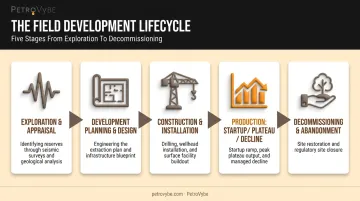
- The full lifecycle spans five stages: exploration, planning, construction, production, and decommissioning
- Horizontal and multilateral drilling now account for over 90% of Lower 48 oil and gas production
- FDP decisions directly shape long-term returns for operators and capital partners
What Is Oil and Gas Field Development?
Field development begins after a discovery is confirmed and appraised, and it ends when the field is ready to produce hydrocarbons commercially. Everything between those two points, the engineering, the planning, the construction, is development.
This distinction matters more than most people realize:
- Exploration searches for hydrocarbons through seismic surveys and wildcat wells
- Development takes a confirmed discovery and turns it into producing infrastructure
- Production is what happens after development succeeds
Exploration answers a simple question: is anything here? Development must answer a much harder one: how do we extract it profitably, safely, and at scale? A Field Development Plan governs every development project, without exception; that document is the blueprint for the entire undertaking, and we'll break it down in detail shortly.
The Complete Lifecycle of an Oil and Gas Field
Every field, from a small onshore program to a supergiant offshore complex, moves through the same five stages. What changes is the timeline, the personnel required, and the capital at stake at each step.
Exploration and Appraisal
Geologists and geophysicists use seismic surveys, geological modeling, and appraisal wells to confirm hydrocarbon presence before any development capital moves. This stage answers the fundamental questions: how big is the reservoir, what's the fluid composition, and is it commercially viable?
High-impact wildcat success rates hovered around 23% in 2024 and climbed to 38% in 2025, according to Rystad Energy data. That volatility is exactly why appraisal work matters. It separates promising prospects from expensive mistakes before construction begins.
Development Planning and Design
This is where the Field Development Plan gets formalized. Engineers settle on well placement, facility selection, and economic modeling. We'll cover the FDP in full detail in the next section, but this stage is the project's decision point. Get it wrong here, and no amount of drilling skill later fixes it.
Construction and Installation
Site preparation, drilling production wells, installing wellheads, storage tanks, pipelines, and processing equipment all happen here. Commissioning and functional testing close out the stage before first production.
This phase carries the heaviest short-term capital burden. Onshore wells in the US have historically run in the low millions, while complex offshore wells can run into the hundreds of millions, depending on depth and reservoir characteristics.
Production: Startup, Plateau, and Decline
Production unfolds in three sub-phases:
- Startup - ramping output over roughly 2-3 years as wells and facilities reach design capacity
- Plateau - stable peak production, frequently extended through water or gas injection
- Decline - natural output reduction as reservoir pressure falls
Recovery potential varies enormously by reservoir type, which is why blanket percentages don't tell the full story:
| Reservoir Type | Recovery Factor | Source |
|---|---|---|
| Oil, primary recovery | ~10% of oil in place | US Department of Energy |
| Oil, secondary methods | 20%-40% | US DOE |
| Oil, enhanced/tertiary | 30%-60%+ | US DOE |
| Dry gas, volumetric reservoir | 80%-90% | SPE |
| Dry gas, water-drive reservoir | 50%-70% | SPE |
Decline rates vary just as widely. The IEA's 2025 analysis puts conventional oil decline at an average of 5.6% annually and conventional gas at 6.8%, but supergiant fields decline as slowly as 2.7%, while small fields can fall more than 11.6% a year. Field size and drive mechanism, not a single industry rule, determine the curve.
Decommissioning and Abandonment
When production stops being economical, operators plug wells, dismantle surface facilities, and restore the site under regulatory requirements.
Some depleted reservoirs get a second life as CO2 storage sites. That path requires separate regulatory approval under EPA Class VI rules rather than a simple continuation of the production permit.
The Field Development Plan (FDP): The Blueprint Behind Every Project
No development proceeds without an FDP. Regulators require it. Investors demand it. And for good reason: it's the document that turns geological promise into a fundable, executable project.
Core components of an FDP typically include:
- Production profile forecasting (oil, gas, and water output year by year)
- Well count and placement strategy
- Facility design and recovery technique selection
- Full economic viability calculations, including breakeven pricing and payback timing
FDPs aren't static. They get refined iteratively through additional appraisal and delineation wells until the technical and economic case is solid enough to justify final investment. Projects that fail this test get abandoned before major capital moves, which is exactly the point of the exercise.
FDP quality correlates directly with project success. Flawed well placement or an undersized facility can permanently cap recoverable reserves, no matter how good the reservoir is underneath. This is where the human element of development becomes impossible to ignore.
Experienced geoscience teams with strong historical success rates are one of the biggest differentiators between FDPs that outperform projections and those that fall short.
At PetroVybe, Chief Geophysicist Michael Stamatedes has posted a 75.2% well success rate across a 48-year career, well above the industry peer average, which PetroVybe cites at below 40%. That gap matters because every well location decision in an FDP compounds across the life of the field.
How Long Does It Take to Develop an Oil Field? Timeline and Cost Factors
Timelines vary more than most outside the industry expect. Many onshore, moderately complex projects move from planning through first production in roughly 5-10 years. But that's not universal.
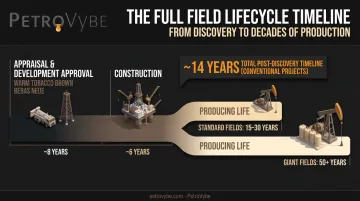
The IEA's global analysis of conventional fields shows appraisal and development approval alone averaging about 8 years, with construction adding another 6 years on top, pushing total post-discovery timelines closer to 14 years for many conventional projects. Add the initial license-to-discovery period, and total field development can stretch toward two decades for large or complex fields.
Producing life spans stretch far longer: standard fields typically produce for 15-30 years, while giant fields can produce for 50+ years — Saudi Aramco's Ghawar field, for example, has pulled from a single well for 73 years.
Cost and timeline both hinge on a handful of variables:
- Location - onshore projects are cheaper and faster than offshore or deepwater
- Reservoir complexity - deeper, more heterogeneous reservoirs require more appraisal work
- Well count - more wells mean more capital, but often better recovery
- Facility scale - larger processing infrastructure extends construction timelines
Cost ranges swing widely too. EIA data from a 2014 cost study put average US onshore wells around $6 million, while select Gulf of Mexico deepwater wells ran $70 million to $230 million.
Front-End Engineering Design (FEED) studies help narrow that uncertainty. Under AACE's Class 3 estimating standard, a mature FEED study typically brings accuracy to roughly -10% to -20% on the low side and +10% to +30% on the high side, not a flat guarantee, but a meaningful tightening of risk before final investment decisions.
For investors evaluating potential projects, these variables shape more than construction schedules; they determine when distributions begin and how long capital stays committed before payout.
Modern Technology and What Field Development Means for Investors
Drilling technology has reshaped field economics over the past fifteen years. Horizontal, multilateral, and extended-reach drilling now dominate US production. As of December 2024, horizontal wells supplied 94% of Lower 48 oil production and 92% of gas production, according to EIA data.
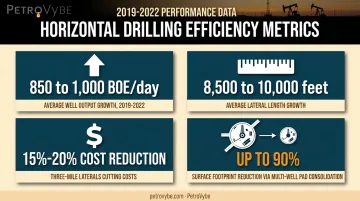
The efficiency gains are concrete:
- Average Permian well output rose from 850 BOE/day in 2019 to 1,000 BOE/day in 2022
- Average lateral lengths grew from 8,500 feet to 10,000 feet over the same period
- Three-mile laterals cut drilling and completion costs by 15%-20% compared to shorter horizontals
- Multi-well pad consolidation reduces surface footprint by up to 90% versus conventional vertical spacing
Horizontal wells decline faster than vertical wells, though. That's why the industry needed roughly 11,700 new horizontal wells in 2024 just to offset Lower 48 declines. Productivity gains don't eliminate the need for continuous drilling; they simply make each dollar of drilling capital work harder.
Execution separates strong field development projects from mediocre ones, and PetroVybe's leadership reflects that track record:
- President and COO Blaine Yeary scaled a $5 billion asset from zero to 35,000 BOEPD over eight years
- Chief Geophysicist Michael Stamatedes has led exploration work resulting in **over 3 TCF of natural gas discoveries** and 270 BCF plus 15 MMBO produced, backed by a 75.2% well success rate
That kind of track record is what determines whether an FDP's projections hold up once drilling starts.
Field development carries a structural financial angle too. Intangible drilling costs incurred during construction and drilling can qualify for deductions against active income under 26 CFR 1.612-4, instead of being limited to passive income offsets like most real estate deductions.
PetroVybe's own partners saw this play out directly: 94% of invested capital deducted against active income in 2024, followed by 91% in 2025.
Through PetroVybe ONE, accredited investors with a minimum of $100,000 in liquidity can access this structure directly, with distributions targeted to build over a projected 10-year hold period. As with any tax position, individual results depend on personal circumstances, so PetroVybe recommends investors consult their own tax professional before proceeding.
Frequently Asked Questions
What is a field development plan in oil and gas?
A Field Development Plan is the master document covering production forecasts, well design, facility selection, and full economic viability. It's required before development capital gets committed.
How long does it take to develop an oil field?
Many onshore projects move from planning to first production in 5-10 years, though complex or offshore fields often take longer. Total producing life typically spans 15-30 years, with giant fields lasting 50 years or more.
What are the main stages of oil and gas field development?
The five stages are exploration/appraisal, development planning, construction and installation, production, and decommissioning. Each stage carries distinct timelines, costs, and personnel needs.
Who is responsible for creating a field development plan?
Geologists, geophysicists, reservoir engineers, and production engineers collaborate to build the FDP. Their combined expertise shapes well placement, facility sizing, and the project's economic case.
What is the difference between exploration and field development?
Exploration searches for hydrocarbons using seismic surveys and wildcat wells. Development involves engineering and constructing the infrastructure needed to produce a confirmed discovery commercially.
Why does field development expertise matter for oil and gas investors?
Strong technical execution during development directly shapes recoverable reserves, project timelines, and ultimately investor returns. Weak well placement or undersized facilities can permanently cap a project's upside.