This article is general education, not investment, tax, or legal advice. Oil and gas still power roughly three-quarters of American life, even as wind turbines and solar panels grab headlines. From the gas heating your home to the diesel moving your groceries, hydrocarbons remain the backbone of US energy security and economic growth.
Most discussions stay abstract, though: jobs, GDP, geopolitics. But the real impact shows up somewhere more personal, your winter heating bill, your investment portfolio, your April tax return. This article breaks down those practical advantages across three lenses: the economy, your energy costs, and your investment options.
TL;DR
- Oil and gas supply 74% of US energy consumption, supporting 10.8 million jobs
- Domestic production keeps consumer energy costs lower and strengthens national security
- Natural gas beats other fossil fuels on cost, reliability, and emissions
- Direct oil and gas investment offers unique tax deductions unavailable in most asset classes
- Upstream oil and gas positions can cut active-income taxes while adding real-asset exposure tied to rising power demand
What Is Oil and Gas Development?
Oil and gas development means finding, extracting, and producing hydrocarbons used for fuel, electricity generation, and manufacturing. It breaks into three segments:
- Upstream: Exploration and drilling (locating reserves and bringing wells online)
- Midstream: Pipeline and transport infrastructure
- Downstream: Refining into usable products
Together these stages supply fuel and power across the U.S. economy. Upstream is where production economics start—and where direct participants capture tax treatment, cash flow, and asset growth most directly.
Key Advantages of Oil and Gas
These advantages operate at two levels: macro (national economy, energy security) and micro (your household bill, your portfolio return). Each ties to something measurable, whether that's dollars saved, revenue generated, or reliability during a crisis.
Economic and Energy Security Benefits
Oil and gas isn't just an industry. It's an economic engine. The numbers are substantial:
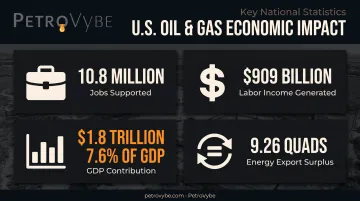
- 10.8 million jobs supported directly and indirectly, roughly 5.4% of total US employment
- $909 billion in labor income generated
- Nearly $1.8 trillion, or 7.6% of GDP, contributed to the economy (API/PwC 2023 study)
- The US posted 9.26 quads more energy exports than imports in 2024, a record trade surplus Domestic production also keeps a lid on consumer costs. A 2020 government analysis estimated shale-driven gas price declines saved American families roughly $2,500 per year for a household of four, primarily through lower natural gas prices. Why it matters most: During supply shocks from wars, OPEC production cuts, and pipeline disruptions, domestic production insulates American households and businesses from price spikes that hit import-dependent economies far harder.
Natural Gas Cost, Reliability, and Cleaner-Burning Advantages
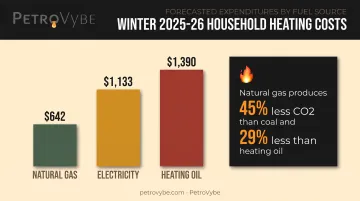
Natural gas wins on nearly every practical metric compared to oil, coal, or electricity. Cost comparison for winter 2025-26, according to EIA forecasts:
| Fuel type | Forecasted household expenditure |
|---|---|
| Natural gas | $642 |
| Electricity | $1,133 |
| Heating oil | $1,390 |
| That's more than double for heating oil versus gas. Even accounting for regional variation and appliance efficiency, the gap is real and consistent year over year, according to EIA's Winter Fuels Outlook. | |
| Reliability tells a similar story. Natural gas travels through underground pipelines, largely immune to the storm damage that cripples above-ground electric grids. When Hurricane Sandy hit the Northeast, electric outages affected 8.66 million customers. Gas service saw no major regional interruption. | |
| Emissions matter too. Per EIA's own combustion coefficients, natural gas produces: |
- 45% less CO2 than coal
- 29% less CO2 than heating oil That's per equivalent unit of energy burned, based on EIA emissions data. Gas isn't zero-emission. It's not solar or wind. But compared to the fossil fuels it most often replaces, it's the pragmatic middle ground, cheaper, more dependable during severe weather, and cleaner-burning.
Tax Efficiency and Passive Income for Investors
This is where oil and gas stops being an abstract economic story and becomes a personal financial tool. Direct participation in an oil and gas drilling program lets investors deduct Intangible Drilling Costs (IDCs) and claim percentage depletion. Both can offset active income, including W-2 wages and capital gains. That's a rare structure. Most asset classes don't offer deductions against ordinary income at this scale. Here's how PetroVybe structures this for its accredited investor partners:
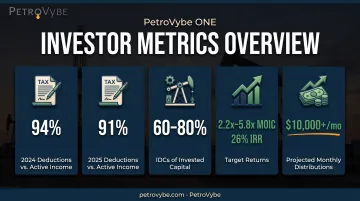
- 2025 partners deducted 94% against active income. Prior result; not a promise of any future deduction.
- IDCs typically represent a first-year deduction target of approximately 70–80% of invested capital in a new drilling project, passed through via Schedule K-1
- The 10-year target sits at a MOIC of 2.2x to 5.8x and roughly 26% IRR
- Quarterly distributions are projected to peak above $10,000/month during production The company's "Protect and Scale" structure uses an 80/20 profit split favoring investors, with reinvested cash flow designed to unlock roughly $5 of capital for every $1 contributed. Why it matters: A high-income W-2 earner facing a heavy tax bill can offset a meaningful chunk of active income while building a tangible, production-based asset. Stocks and index funds simply can't replicate that mix of upfront deduction and long-term cash flow—which is why family offices and capital allocators keep returning to direct oil and gas participation. This treatment requires the investor to elect general partner status in the Subscription Agreement and may be limited in a given year by the excess business loss limitation under IRC §461(l).
What Happens When These Advantages Are Overlooked
Ignore domestic production, and the US leans harder on volatile foreign supply. Prices swing with every geopolitical headline instead of staying anchored to stable domestic output.
That same gap shows up in portfolios. Investors who skip tax-advantaged energy structures face a higher effective tax rate on active income, full stop. There's no equivalent mechanism in most public-market portfolios.
Operators feel it next. Businesses without a natural gas strategy or reliable energy plan expose themselves to:
- Higher, more volatile operating costs
- Greater outage risk during severe weather events
- Less predictable long-term budgeting
None of this is theoretical. It shows up in energy bills, tax drag on active income, and budgets that keep missing the mark.
How to Get the Most Value from Oil and Gas Advantages
Oil and gas advantages only hold if the operator, reserves, and tax structure check out. For accredited investors, value comes from diligence—not the brochure.
Use this checklist before you commit capital:
- Check the operator's track record. Look for real production growth on producing assets, not just acreage claims. PetroVybe's platform, for example, grew from zero to roughly 1,300 BOEPD across about 400 wells on 58,000 acres in Lavaca County, Texas.
- Verify third-party reserve validation. Independent engineering marks separate asset-backed value from internal estimates. PetroVybe's reserves carry a $48MM PV-09 valuation from a licensed third-party firm, prepared by Lee Keeling & Associates, Tulsa, March 2026.
- Review the technical team's hit rate. Well selection skill compounds returns over a multi-year hold. PetroVybe's Chief Geophysicist has a documented 75.2% career hit rate, versus an industry peer average below 40%. Disclaimer: these results were achieved at prior companies.
- Confirm the tax deduction structure in writing. IDC eligibility, K-1 timing, and depletion limits change with ownership structure—get the mechanics, not just the headline percentage.
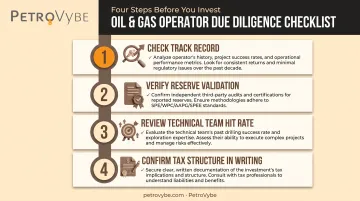
Production growth, engineered reserves, proven well selection, and clear tax treatment are what turn oil and gas advantages into durable investor outcomes.
Conclusion
Oil and gas advantages operate on three levels at once: national economic security, household energy reliability, and investor tax and income benefits. Each compounds when production stays domestic, consistent, and backed by operators who can prove their numbers.
Whether you're comparing a heating bill or evaluating a direct investment opportunity, informed participation is what turns these advantages into real results. Treat it as a long-term strategic choice with operators who can document production, reserves, and tax treatment.
Frequently Asked Questions
Is it cheaper to heat your house with oil or gas?
Natural gas is generally cheaper than heating oil across most US regions, often costing roughly half as much for equivalent heating output. Regional pricing and equipment efficiency can shift the exact gap.
What is the biggest economic benefit of the oil and gas industry?
Job creation and tax revenue stand out most. The industry supports 10.8 million jobs and generates tax dollars that fund schools, roads, and public infrastructure nationwide.
How does natural gas compare to oil in terms of environmental impact?
Natural gas burns cleaner, producing about 45% less CO2 than coal and 29% less than heating oil. It's not as clean as renewables, but it's a meaningful step down from other fossil fuels.
Can everyday investors participate in oil and gas development?
Direct development opportunities are typically limited to accredited investors, those meeting SEC income or net worth thresholds. This access often comes with tax advantages unavailable through public markets.
What tax benefits are unique to oil and gas investments?
Intangible drilling cost deductions and percentage depletion let investors offset a significant portion of active income, including W-2 wages and capital gains, something few other asset classes allow. This treatment requires the investor to elect general partner status in the Subscription Agreement and may be limited in a given year by the excess business loss limitation under IRC §461(l).
Why is domestic oil and gas production important for energy security?
Domestic production reduces reliance on foreign supply chains, insulating American consumers and businesses from geopolitical price shocks and supply disruptions abroad.
Informational requests only. PetroVybe projects are offered solely to verified accredited investors. Submitting this form does not create an investment or advisory relationship.