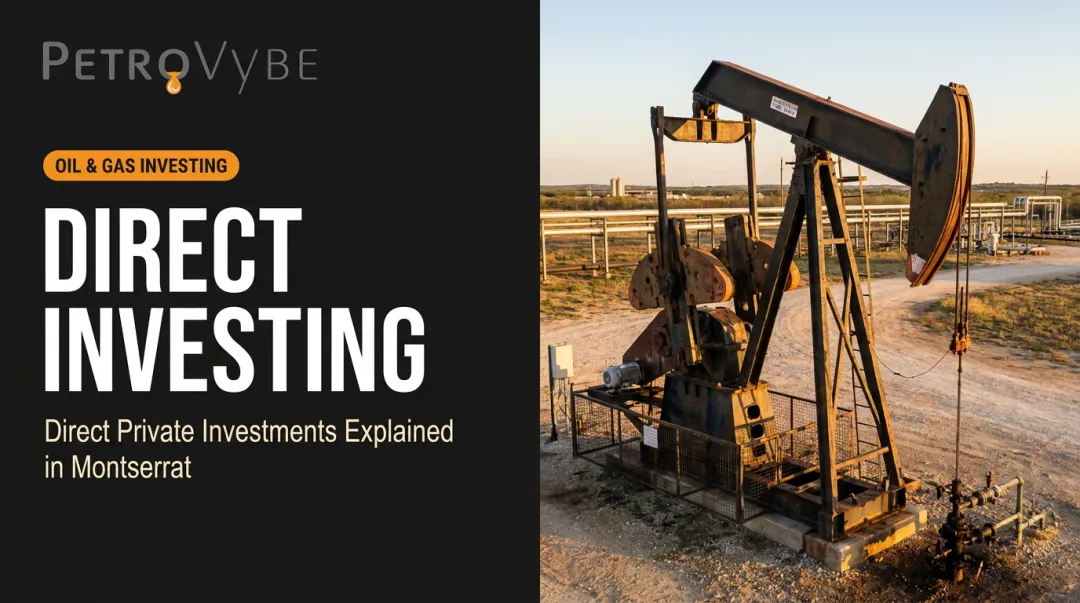
This article is general education, not investment, tax, or legal advice. Accredited investors are increasingly skipping traditional Wall Street funds altogether. Instead of parking capital in a blind pool managed by a distant fund manager, they're putting money directly into specific companies, projects, and assets they can actually evaluate.
Why the shift? High fees, murky reporting, and zero control over individual investment decisions. Traditional pooled funds often stack layer upon layer of fees, and investors rarely know exactly what their capital is funding until quarterly reports arrive.
Direct private investment funds solve this by connecting capital straight to the asset. This guide breaks down what these structures are, how they stack up against fund-of-funds and traditional private equity, and how sector-specific opportunities like natural gas development fit into the picture.
Key Takeaways
- Direct funds give investors a stake in one specific asset or project, not shares in a diversified blind pool
- Fewer intermediary layers deliver better transparency and stronger net returns
- Oil and gas development offers tax advantages, including IDC deductions few other asset classes match
- Operator track record and third-party validation separate credible opportunities from risky bets
What Are Direct Private Investment Funds?
A direct private investment fund channels investor capital into one identified private company, project, or asset, such as a specific natural gas leasehold, rather than spreading it across dozens of unnamed holdings.
Most direct funds use a general partner (GP) / limited partner (LP) structure. The GP manages operations and makes day-to-day decisions; LPs commit capital and receive a defined share of profits. This differs sharply from a "fund of funds," where a manager invests your money into other funds, adding a layer of management between you and the actual asset.
Key Characteristics
- Investors typically hold a direct interest, sometimes a working interest, in the underlying asset rather than a paper claim on a diversified portfolio
- No intermediary layer means reporting tracks how that specific asset performs
- Capital concentrates in one known company, project, or asset, so returns follow that asset instead of a blended book
The Reg D private placement market alone saw $2,391.5 billion sold in 2025, according to SEC data. For accredited investors, that figure marks private capital as a mainstream alternative to public markets, not a niche side bet.
Types of Direct Private Investment Funds
Not all direct investments look alike. Preqin identifies several structural categories:
- Equity-based direct investments: investors share in profits and asset appreciation, common in oil and gas working interests
- Debt-based direct investments: capital flows as loans (promissory notes) to project operators rather than ownership stakes
- Sector-specific development funds: narrow focus on one industry, like natural gas, real estate, or infrastructure
- Generalist direct private equity: broader mandate across industries
Where PetroVybe Fits
PetroVybe's development structure is equity-based and sector-specific. The company develops natural gas assets in the Gulf Coast Basin—a 58,000-acre position in Lavaca County, Texas—with roughly 400 producing legacy wells and 57-plus planned new wells.
That is the upstream entry point where value is created: buy undervalued production, optimize it, and drill new locations from geological data rather than guesswork.
Direct Investment Funds vs. Fund of Funds vs. Traditional Private Equity
The biggest difference between these structures comes down to fees and how many hands touch your capital before it reaches an actual asset.
Preqin's 2017 fund-terms study found traditional private equity funds charging management fees near 2.00%, with 82% of funds also collecting a 20% carried interest. Fund-of-funds structures add another layer: Preqin found a separate 0.89% mean fee at the FoF level, stacked on top of whatever the underlying managers already charge.
| Structure | Ownership | Fee Layers | Transparency | Typical Minimum |
|---|---|---|---|---|
| Direct private fund | Direct stake in named asset | Single GP-level fee (structure varies by offering) | Asset-level reporting | Often $100,000+ |
| Traditional PE fund | Pooled portfolio companies | ~2% management + 20% carry | Portfolio-level reporting | $250,000+ |
| Fund of funds | Underlying funds' holdings | FoF fee + underlying fund fees | Two steps removed from assets | Varies, often high |
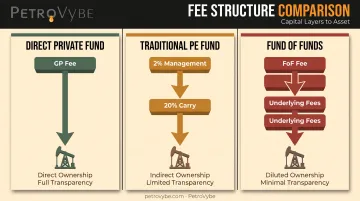
Direct investing generally demands more hands-on due diligence up front, since you are underwriting a named asset rather than a diversified pool. In return, you face fewer fee layers on net returns and full visibility into what your capital is doing.
Why Accredited Investors Choose Direct Private Investment Funds
Three forces are pulling capital toward direct structures: return potential, diversification, and tax treatment.
Returns and Diversification
Cambridge Associates' US private equity benchmark reported pooled horizon returns ranging from 6.42% over one year to 15.08% annualized over ten years. That range covers 1,801 funds tracked through March 2026. Direct structures aim to capture similar or better performance without the extra fee drag of intermediated vehicles.
Direct investments also add exposure beyond stocks, bonds, and REITs—tangible, income-producing assets that move independently of public market swings.
Tax Efficiency: The IDC Advantage
This is where natural gas development stands apart. IRS rules permit investors holding a working or operating interest to deduct Intangible Drilling Costs (IDCs) currently against income, including active W-2 earnings and capital gains, subject to specific limitations. This treatment requires the investor to elect general partner status in the Subscription Agreement and may be limited in a given year by the excess business loss limitation under IRC §461(l).
PetroVybe's documented results:
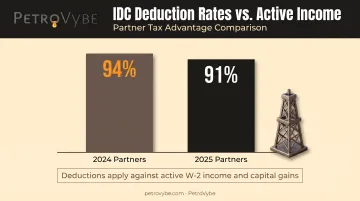
- 2025 partners: 94% deduction against active income. This treatment requires the investor to elect general partner status in the Subscription Agreement and may be limited in a given year by the excess business loss limitation under IRC §461(l). Prior result; not a promise of any future deduction.
That's a materially different tax outcome than most passive fund structures, which typically can't touch active income at all.
The AI Demand Angle
Natural gas remains the largest single fuel source for U.S. grid power. The EIA's higher-demand scenario projects gas-fired generation could climb 7.3%, or 123 billion kilowatt-hours, between 2025 and 2027, driven partly by data center electricity consumption. EIA also projects data centers could account for 22-33% of commercial electricity use by 2050.
PetroVybe's Gulf Coast Basin development targets a 2.2x-5.8x MOIC and roughly 26% IRR over a 10-year hold, with the underlying thesis tied to this rising electricity demand. These are forward-looking projections, not guarantees.
Risks and Due Diligence Considerations
Direct private investments come with real trade-offs. Understand them before committing capital.
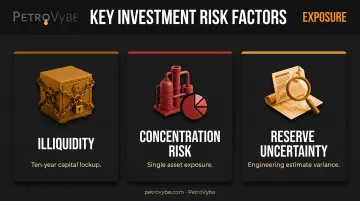
- Illiquidity: No secondary market exists for most direct interests. Expect to hold for years, not months.
- Concentration risk: One asset, one operator. Unlike a diversified fund, there's no built-in buffer if that specific project underperforms.
- Reserve uncertainty: Estimates can miss the mark. The SEC requires "reasonable certainty" for reserve figures, and third-party engineering reports are the industry benchmark for validating those numbers.
What Credible Due Diligence Looks Like
Before committing, verify:
- Operator track record — Has the team executed similar projects before?
- Independent reserve reports — Is there a licensed engineering firm's valuation behind the numbers?
- Regulatory licensing — Does the operator hold proper state licensing (in Texas, that's Railroad Commission authorization)?
- Third-party audits — Has an independent CPA firm reviewed the financials?
PetroVybe, for example, publishes a $48 million PV-09 proved-reserves valuation from a licensed third-party engineering firm, a clean 2025 audit from independent auditor Weaver, and a 5.0 rating across 8 verified reviews on Invest Clearly. Prepared by Lee Keeling & Associates, Tulsa, March 2026.
Layered third-party validation like that is the bar to apply to any operator before you commit capital.
How to Get Started with Direct Private Investment Funds
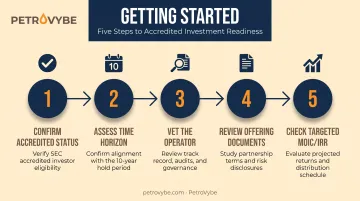
Ready to move from research to action? Follow this sequence:
- Confirm accredited status. You'll need net worth above $1 million (excluding primary residence) or income above $200,000 individually ($300,000 jointly) for the past two years.
- Assess your time horizon. Direct funds typically require 5+ year commitments; some, like natural gas development programs, target 10-year holds.
- Vet the operator. Look at team experience, historical performance, and how transparently they report.
- Review offering documents. Read the PPM, LPA, and Subscription Agreement in full—these govern fees, risk factors, and minimum requirements.
- Check targeted MOIC/IRR. Understand what return range the operator is projecting and what assumptions drive it.
Sector-specific programs, such as PetroVybe's natural gas development structure across East Texas and Gulf Coast Basins, offer a concrete path into direct private investing. Partners can also access tax treatment available through oil and gas development interests, including IDC and depletion allowances.
Frequently Asked Questions
How much do you need to invest to earn $1,000 a month?
The amount depends entirely on the target yield. At a 12% annualized cash yield, you'd need roughly $100,000. Higher cash-flowing assets like producing natural gas wells can sometimes require less capital.
What are the four types of investment funds?
The broad categories are open-end (mutual) funds, closed-end funds, hedge funds, and private equity/direct investment funds. Direct funds differ from the first three by giving investors ownership in a specific named asset rather than a pooled, professionally traded portfolio.
What is the difference between direct investment and indirect investment?
Direct investment means owning a stake in a specific company or asset with visibility into its performance. Indirect investment means relying on a fund manager who pools your capital with others' and makes allocation decisions on your behalf.
Are direct private investment funds only for accredited investors?
Generally, yes. Most direct private funds rely on SEC private placement exemptions under Regulation D, which typically require investors to meet accredited investor income or net worth thresholds.
What returns can investors expect from direct private investment funds?
Returns vary significantly by asset class, operator, and structure. Rather than relying on generic benchmarks, review the specific targeted MOIC and IRR figures disclosed in each offering's documentation.
How liquid are direct private investment funds?
Not very. These investments generally lack a secondary market and require multi-year holding periods. Make sure your investment horizon aligns with the fund's stated term before committing capital.
Informational requests only. PetroVybe projects are offered solely to verified accredited investors. Submitting this form does not create an investment or advisory relationship.