

Introduction
Ask most people what a "trust fund" is, and you'll get an image straight out of pop culture: a twenty-something living off a monthly check, never having worked a day in their life.
That image isn't wrong, exactly. It's just incomplete.
A family trust fund is one of the more precise legal tools available for transferring wealth privately, sidestepping probate court, and controlling exactly how and when heirs receive their inheritance. Families with modest estates use them. So do families with eight-figure net worths.
Despite that broad appeal, many people struggle with the basic mechanics: who actually controls the money, how distributions get triggered, and what it costs to set one up in the first place. This guide breaks down what a family trust fund is, how it legally functions, a step-by-step setup process, realistic costs, and how to choose assets that actually grow inside a trust.
Key Takeaways
- A family trust fund pairs the legal trust structure with the assets it holds, managed by a trustee for named beneficiaries
- Setup typically requires an attorney and runs $1,000 to $3,000+ depending on complexity
- Revocable trusts favor flexibility; irrevocable trusts favor tax and creditor protection
- The assets used to fund the trust determine its long-term growth and income potential
What Is a Family Trust Fund?
A family trust fund is a legal arrangement where a grantor transfers assets into a trust to be managed and eventually distributed to family beneficiaries according to specific written instructions. It's not a bank account. It's not a single check. It's a legal container with rules attached.
Here's where the terminology gets muddled: "the trust" refers to the legal structure itself, while "the fund" refers to the actual assets sitting inside it — cash, real estate, investments, whatever's been transferred in. People use the terms interchangeably, but the distinction matters when you're reading legal documents.
Three roles make a trust function:
- Grantor — creates the trust and transfers assets into it (also called the settlor or trustor)
- Trustee — the fiduciary who manages those assets and administers the trust's terms
- Beneficiaries — the family members who ultimately benefit from the trust
There's also a timing distinction worth knowing. A living trust (or inter vivos trust) is created and takes effect while the grantor is still alive. A testamentary trust is created through a will and only springs into existence after the grantor's death, meaning it still has to go through probate first, which defeats one of the main reasons people set up trusts in the first place.
Revocable vs. Irrevocable Family Trust Funds
This is the fork in the road for every family trust decision.
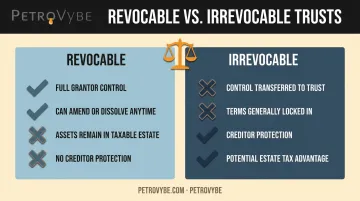
Revocable trusts let the grantor keep full control. You can amend the terms, swap beneficiaries, or dissolve the entire thing whenever you want. The tradeoff: because you retain that control, the assets are still part of your taxable estate, and they're not shielded from your creditors.
Irrevocable trusts work in reverse. Once assets go in, you generally can't pull them back out or change the terms unilaterally. In exchange, you get creditor protection and potential estate tax advantages.
Here's the catch most people miss: irrevocability alone doesn't guarantee an estate tax benefit. It depends heavily on how much you're actually protecting.
For 2026, the federal estate tax exemption sits at $15 million per person, up from $13.99 million in 2025. Unless your estate exceeds that threshold, the irrevocable trust's estate tax value is largely theoretical. The creditor protection and control features are usually the real draw.
How Does a Family Trust Fund Work?
Once the trust document exists, it's worthless until it's actually funded.
Funding the trust means retitling assets (real estate, bank accounts, brokerage holdings) so the trust itself becomes the legal owner. Skip this step, and the asset stays outside the trust, subject to probate regardless of what your trust document says.
From there, the trustee takes over. Fiduciary duties include:
- Managing and investing trust assets prudently
- Keeping detailed records of transactions and distributions
- Filing any required trust tax returns
- Acting solely in the beneficiaries' interest, not their own
How Distributions Actually Happen
Beneficiaries don't just log into an account and withdraw funds. Distributions flow through the trustee, according to whatever terms the trust document spells out:
- Lump sum: one full distribution, often at trust termination
- Scheduled periodic payments: monthly or annual disbursements
- Milestone-based releases: triggered by turning a certain age, graduating college, or getting married

Timing also depends on whether someone is an income beneficiary (receives earnings the trust generates) or a principal beneficiary (receives the underlying assets themselves, often later). Whichever method applies, each payout carries tax implications that shape how the trust and its beneficiaries report income.
Tax Mechanics, Briefly
If it's a grantor trust (most revocable trusts), the income gets reported on the grantor's personal tax return, and nothing changes from a tax filing standpoint.
Non-grantor trusts are taxed as separate entities, and the brackets compress fast. For 2026, a non-grantor trust hits the top 37% federal bracket once retained taxable income exceeds just $16,000.
Compare that to an individual, who doesn't reach 37% until income tops $640,600 (single filer). This is exactly why trustees often distribute income out to beneficiaries rather than letting it accumulate inside the trust.
When the trust terminates, per whatever end date or condition the document specifies, remaining assets get distributed to beneficiaries according to those final instructions.
Step-by-Step Guide to Setting Up a Family Trust Fund
Setting one up isn't complicated in concept. It just requires sequencing.
Define your goals and pick a trust type. Work with an attorney or financial advisor to determine whether revocable, irrevocable, or a specialized trust fits your family's situation.
Select a trustee. Options include yourself (with named successors), a trusted family member, or a professional/corporate trustee. Corporate trustees add cost but reduce family conflict and administrative burden.
Draft the trust agreement. This document details beneficiaries, the asset inventory, distribution rules, and any conditions like age milestones or education requirements.
Execute and sign. Follow your state's notarization and witnessing requirements. Skip this step, and the trust isn't legally binding no matter how well it's drafted.
Fund the trust. Formally retitle assets into the trust's name.
Review every three to five years, or after major life events like marriage, birth, death, or relocation, to keep beneficiaries, trustees, and asset allocations current.

What does this actually cost? According to Nolo, attorney-drafted living trusts typically run $1,000 to $2,000, rarely dropping below $1,200 to $1,500.
Costs scale with complexity:
- Broader estate plans with multiple documents often run $2,000 to $3,000 or more
- Attorneys bill $250 to $500 per hour, with rates climbing for high net worth, blended families, foreign property, or unusual distribution terms
- DIY software costs $100 to $350, though it carries more risk for complex estates
Types of Family Trusts to Know
Beyond the revocable/irrevocable split, several specialized trust types address specific family situations:
- Spendthrift trust: restricts a beneficiary's ability to access principal directly, protecting assets from creditors and poor spending decisions
- Special needs trust: supplements care for a disabled beneficiary without disqualifying them from means-tested benefits like SSI or Medicaid
- Generation-skipping trust: transfers wealth directly to grandchildren, potentially subject to generation-skipping transfer tax
- Bypass/marital trust: an A-B trust pairing used to maximize estate tax exclusions across both spouses
- Charitable trust: directs assets to a charitable cause, either before (charitable lead) or after (charitable remainder) benefiting family members
Most comprehensive estate plans layer two or three of these together, such as a spendthrift provision built into a generation-skipping trust. Matching the right combination to your family's asset profile is exactly the kind of decision that warrants sitting down with an estate planning attorney rather than guessing.
Choosing the Right Assets to Fund Your Trust
Not all assets belong inside a trust the same way. Conventional funding sources include:
- Real estate (primary residences, rental property)
- Bank and brokerage accounts
- Business interests
- Life insurance policies
Increasingly, high-income families are also funding trusts with income-generating alternative assets designed for tax efficiency and compounding growth over long hold periods.
One example: private natural gas and energy development investments offered to accredited investors through companies like PetroVybe. These structures can generate substantial upfront tax deductions against active income through the Intangible Drilling Cost deduction, which, unlike most passive real estate deductions, isn't restricted to passive income only.
PetroVybe's partners saw deductions of 94% in 2024 and 91% in 2025 against W-2 earnings and capital gains. The company's flagship natural gas project operates in Lavaca County, Texas, with a $100,000 minimum investment and mandatory accredited investor verification.

That combination of a large early deduction and monthly passive distributions during the production phase can make sense inside a longer-term trust structure built for compounding rather than near-term liquidity.
That said, illiquid or alternative holdings should be balanced against liquid assets. Trusts often need to meet near-term distribution obligations, and locking too much capital into a 10-year hold period can leave a trustee short on cash when beneficiaries need it. Suitability for these asset classes should always be reviewed with a financial advisor, given accreditation requirements and the risk profile involved.
Benefits and Drawbacks of a Family Trust Fund
| Benefits | Drawbacks |
|---|---|
| Avoids probate for funded assets | Setup and ongoing administrative costs |
| Keeps estate details private | Loss of control with irrevocable structures |
| Protects assets from creditors (irrevocable) | Compressed, higher trust tax brackets |
| Controls distribution timing and conditions | Continual recordkeeping burden |
| Enables incapacity planning via successor trustee | Assets never funded into the trust can still hit probate |
The right call depends on the size and complexity of your estate. Pairing an estate planning attorney with a tax or financial advisor gives you both the legal structure and the numbers to weigh these tradeoffs properly, rather than guessing at what fits.
Frequently Asked Questions
How much money do you need to establish a family trust fund?
There's no strict legal minimum. Attorney fees typically run $1,000 to $3,000+, and trusts become cost-effective relative to simpler alternatives once an estate includes real estate or exceeds roughly $100,000 to $300,000 in assets.
How does a family trust fund work?
A grantor transfers assets into a trust, a trustee manages those assets under fiduciary duty, and beneficiaries receive distributions according to the trust document's terms.
How do you get money from a family trust fund?
The trustee issues distributions per the trust's terms, such as scheduled payments, lump sums, or milestone-based releases. Beneficiaries don't access trust assets directly.
What's the difference between a family trust and a family trust fund?
"Trust" refers to the legal structure itself; "trust fund" typically refers to the assets held within it. In everyday use, people treat the terms as interchangeable.
Can you set up a family trust fund without an attorney?
DIY and online services exist for simple, low-value estates. Complex estates involving multiple properties, blended families, or business interests typically warrant professional legal help to avoid costly drafting errors.
Are distributions from a family trust fund taxable?
Principal distributions are generally not taxed to the beneficiary. Income distributions, reported on a Schedule K-1, are usually taxable to the beneficiary who receives them.