This article is general education, not investment, tax, or legal advice. The United States produces more crude oil than any nation on earth. Wells scattered from the Permian Basin in Texas to the North Slope of Alaska now generate the energy backbone of the American economy.
Many people struggle to understand how a well actually moves from a geological survey to a producing asset, or which regions truly dominate US output. That confusion matters more now than ever. US natural gas production hit a new record in 2025, and demand from AI data centers is reshaping how investors think about gas wells.
This guide breaks down the largest producing fields, ranks the top states, walks through the well lifecycle, and covers where drilling activity is headed next.
Key Takeaways
- Texas alone produced 5.75 million barrels per day in 2025, more than double New Mexico's output
- The Permian Basin supplies 48% of all US crude oil production, though growth is slowing
- Every well follows five stages: exploration, permitting, drilling, completion, then plugging
- NGL-focused natural gas wells are drawing capital tied to AI-driven electricity demand
What Are Oil and Gas Wells and How Do They Work?
Oil and gas wells are drilled into sedimentary rock formations that trapped hydrocarbons millions of years ago. Heat and pressure slowly converted buried organic material into oil and gas, which then migrated into porous rock layers until an impermeable cap sealed it in place.
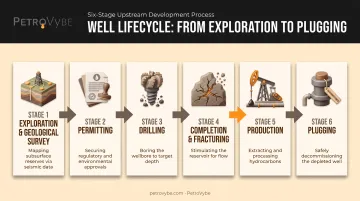
Getting that trapped resource to the surface follows a consistent lifecycle:
- Exploration and geological survey: Seismic data and rock analysis identify likely hydrocarbon deposits
- Permitting: Operators secure state or federal approval before touching the ground
- Drilling: Crews bore down to the target formation, often followed by horizontal drilling through the reservoir
- Completion: Includes hydraulic fracturing when needed, opening pathways for oil and gas to flow
- Production: The well produces for years, sometimes decades
- Plugging: Once output declines below economic thresholds, the well is sealed and abandoned
The first US oil well was drilled by Edwin Drake in Titusville, Pennsylvania, striking oil at just 69.5 feet on August 27, 1859. Compare that to today's horizontal wells, which can extend two miles laterally through a shale formation before completion crews even begin fracturing the rock.
Conventional vs. Unconventional Wells
Conventional wells tap oil and gas that has migrated into a trap and sits ready to flow. Unconventional wells target "continuous" resources locked inside the source rock itself, requiring hydraulic fracturing to release hydrocarbons. The USGS classifies shale gas, shale oil, tight gas, and tight oil under this unconventional category.
Types of Wells by Product
Not every well produces the same thing:
- Oil wells primarily yield crude oil, with gas and liquids as byproducts
- Dry gas wells produce natural gas with most liquid hydrocarbons already removed
- NGL/wet gas wells produce raw gas containing ethane, propane, butanes, and pentanes alongside methane
NGL pricing has long sat between crude oil and dry gas, which is why liquids-rich wells draw operators who prioritize margin over pure volume.
The Largest Oil and Gas Basins and Fields in the US
A handful of basins account for the overwhelming majority of American production.
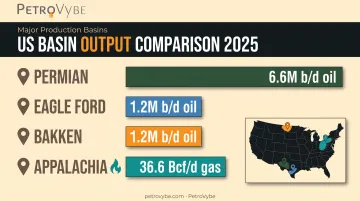
The Permian Basin (spanning West Texas and southeastern New Mexico) leads US production by a wide margin. It produced 6.6 million barrels per day of crude oil in 2025, up 280,000 barrels per day from the prior year, and 27.7 billion cubic feet per day of marketed gas, according to the EIA's 2025 production report. That's nearly half the nation's entire crude output from one basin.
Other major fields round out the picture:
| Basin | 2025 Output | Notes |
|---|---|---|
| Permian | 6.6M b/d oil | Growing |
| Eagle Ford | 1.2M b/d oil | Up slightly |
| Bakken | 1.2M b/d oil | Declining |
| Appalachia | 36.6 Bcf/d gas | ~31% of US gas |
The Gulf Coast Basin, where PetroVybe operates its South Texas projects, holds significant untapped potential. USGS assessments show roughly 2,000 wells have already targeted the Bossier Formation in the onshore Gulf Coast region, with more undiscovered resources believed to remain.
Federal Land Production Is Climbing
Federal acreage now contributes a much larger share of national supply. Onshore oil production on federal lands hit a record 1.7 million barrels per day in 2024, six times higher than 2008 levels, driven mostly by federal Permian acreage in New Mexico. Federal gas output also climbed from 3.2 Tcf in 2020 to 4.2 Tcf in 2024.
Beyond federal tracts, national reserve totals still set the long-term backdrop. The US held about 46 billion barrels of proved crude reserves and 584 trillion cubic feet of proved gas reserves at the end of 2024, though both figures dipped slightly from the prior year.
Which US States Produce the Most Oil and Gas?
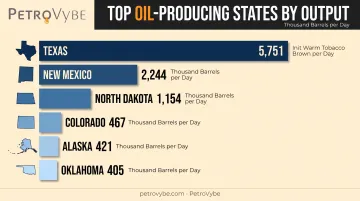
Texas leads US crude production by a wide margin.
| State | 2025 Crude Oil (thousand b/d) |
|---|---|
| Texas | 5,751 |
| New Mexico | 2,244 |
| North Dakota | 1,154 |
| Colorado | 467 |
| Alaska | 421 |
| Oklahoma | 405 |
Texas and New Mexico combined produced roughly 7.99 million barrels per day, more than double the output of the next four states put together. Texas built that lead on Permian Basin infrastructure, pipeline takeaway capacity, and a well count that dwarfs every other producing state.
On natural gas, Pennsylvania, Texas, and Louisiana lead annual output. Pennsylvania alone produced about 7.4 Tcf recently, roughly 2% below the prior year.
Longer-term shifts put today’s rankings in perspective:
- Alaska oil peaked near 2 million b/d in 1988 and now sits around 421,000 b/d as fields mature
- California fell from a 394-million-barrel annual peak in 1985 to under 100 million barrels in 2025
- Legacy basins outside the Permian show how infrastructure and new drilling access decide who stays on top
Is the US Drilling New Oil and Gas Wells? Current Trends
Drilling continues, but the pace has slowed noticeably in legacy basins.
Baker Hughes counted 588 active US rigs in August 2026, down slightly week-over-week but up year-over-year. EIA reports average monthly Lower-48 rig activity fell 5% in 2025 as WTI crude dropped from $77 a barrel in 2024 to roughly $65 in 2025.
Several factors sit behind the slowdown:
- Lower per-barrel prices squeeze drilling economics in mature basins
- Producers are prioritizing shareholder returns over aggressive new drilling
- Shale executives (per Reuters) won't greenlight $100-oil drilling plans without sustained high prices—not a short spike
Permitting has not stopped—it has relocated. Texas's Railroad Commission issued 655 permits for new oil or gas wells in May 2026 alone.
Policy could further reshape where capital goes. Proposed changes include:
- Interior: cut statewide well bonds from $500,000 to $25,000
- Interior: shorten public comment periods from 90 days to 10
- House legislation: lower the federal onshore royalty rate to 12.5%
None of these are finalized rules.
Despite the pullback in the Permian and Bakken, gas-focused work continues in East Texas and the Gulf Coast Basin. Operators there are chasing liquids-rich production—not pure volume growth.
Why US Natural Gas Wells Are Gaining Investor Attention
Data-center growth is pulling US natural gas back into the spotlight for accredited investors.
The IEA projects that data centers will drive nearly half of all US electricity demand growth through 2030. Natural gas is expected to supply more than 130 terawatt-hours of that additional generation from 2024 through 2030. AI infrastructure needs power around the clock, and gas-fired generation offers the scalability intermittent sources can't match on their own.
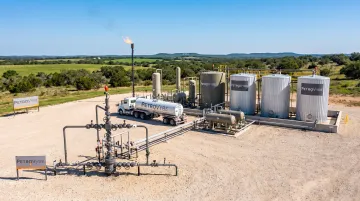
That demand curve is where PetroVybe positions its projects. Operating across East Texas and Gulf Coast Basins, the company focuses on NGL-rich development because liquids often command premium pricing at lower production cost than dry gas alone.
PetroVybe's model gives accredited investors direct exposure through:
- Upfront IDC tax deductions usable against active income, including W-2 earnings and capital gains
- Historical results of 94% tax deductions for 2025 partners. Prior result; not a promise of any future deduction.
- A 58,000-acre Lavaca County position backed by roughly 400 acquired producing wells and 57-plus planned new wells
- Third-party engineering validation, including a $48 million PV-09 proved reserves valuation. Prepared by Lee Keeling & Associates, Tulsa, March 2026. This treatment requires the investor to elect general partner status in the Subscription Agreement and may be limited in a given year by the excess business loss limitation under IRC §461(l).
Well investment carries real geological and market risk. Third-party engineering validation and an experienced geological team—PetroVybe's Chief Geophysicist has a 48-year track record and a 75.2% success rate in profitable location selection—help separate disciplined projects from speculative ones. Disclaimer: these results were achieved at prior companies.
Participation requires accredited investor status and a minimum $100,000 investment, structured through a private placement partnership rather than public markets.
Frequently Asked Questions
Is the US drilling new oil wells?
Yes, but activity has slowed in mature basins like the Permian due to lower prices and market uncertainty. Gas-focused regions such as East Texas and the Gulf Coast Basin continue to see steady new well permitting.
What state is richest in oil?
Texas leads by a wide margin, producing 5.75 million barrels per day in 2025. New Mexico ranks second at 2.24 million barrels per day, driven largely by Permian Basin acreage.
How long does an oil or gas well typically produce before it's plugged?
Production spans anywhere from a few years to several decades, depending on reservoir size and decline curve. Once output falls below economic thresholds, operators plug and abandon the well.
What is the difference between an oil well and a natural gas well?
Oil wells primarily yield crude, while gas wells produce methane, either as "dry gas" or liquids-rich "wet gas." Wet gas wells contain NGLs like ethane and propane, which typically command higher prices than dry gas alone.
Can everyday investors buy into oil and gas wells?
Direct well investment is generally limited to accredited investors through private development partnerships. PetroVybe offers this access. Participation begins at one unit of $100,000, with add-on subscriptions from $25,000. Required accredited status verification.
Why is natural gas important for the AI boom?
AI data centers require constant, scalable power, and natural gas is projected to supply the largest share of new US electricity generation for data centers through 2030. That growing demand is driving more investor interest in gas-focused well development.
Informational requests only. PetroVybe projects are offered solely to verified accredited investors. Submitting this form does not create an investment or advisory relationship.