

This article is general education, not investment, tax, or legal advice. An accredited investor gets a call about an opportunity in a South Texas natural gas development project. Weeks later, a document lands in their inbox: "Limited Partnership Interest Purchase Agreement." They've reviewed subscription agreements before. This is different.
LP interests are now a common way to raise capital for asset-heavy projects, from commercial real estate to oil and gas development. Whether you're buying into a producing partnership or selling an existing stake, the purchase agreement is where ownership, tax attributes, and risk actually change hands.
This guide breaks down what the agreement covers, the clauses that matter most, transfer restrictions you can't ignore, tax consequences on both sides, and a due diligence checklist before you sign anything.
Key Takeaways
- The agreement transfers ownership rights, future distributions, and tax attributes from seller to buyer
- Most partnership agreements require GP consent and ROFR clearance before any sale closes
- Buyers typically pay less than stated net asset value due to lack-of-control and lack-of-marketability discounts
- Outside basis, debt relief, and Section 754 elections can shift tax outcomes for both parties
- Review the underlying LPA line by line before signing any purchase agreement
What Is a Limited Partnership Interest Purchase Agreement?
This agreement is the legal contract that transfers a limited partner's ownership stake from a seller to a buyer. It's a separate document from the partnership agreement (LPA) itself, which governs how the partnership operates.
Unlike a stock purchase, buying an LP interest means inheriting more than an ownership number. You take on:
- Pass-through tax attributes tied to the interest
- Existing capital account balances
- Obligations the seller previously held within the partnership
Full assignment and assignee interest are not the same thing. Under Delaware's Revised Uniform Limited Partnership Act, an assignment transfers economic rights—distributions and allocations—but does not automatically make the buyer a full partner with voting rights. Formal admission under the Delaware Code Title 6, Chapter 17 is still required. Buyers who assume a signed purchase agreement alone confers full partnership status are often wrong.
In oil and gas development partnerships specifically, this agreement usually covers your proportional interest in wells, reserves, and future distributions, not a physical asset transfer. You're buying a claim on cash flow, not a deed.
Key Clauses Typically Found in the Agreement
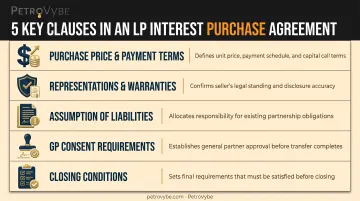
A well-drafted purchase agreement includes:
- Purchase price and payment terms: lump sum, installments, or earnout structures
- Representations and warranties: seller confirms clear title and no competing claims
- Assumption of liabilities: buyer takes on specified partnership obligations going forward
- GP consent requirements: closing often depends on general partner approval
- Closing conditions: assignment instruments, certificates, and related documents needed to finalize
Real filings follow the same pattern. A 2007 SEC-filed oil-and-gas LP purchase agreement named the interest sold, stated the cash price, and required a separate assignment instrument tied to the underlying LPA. The GP joined specific provisions so the transfer would satisfy the partnership’s requirements.
Transfer Restrictions: Why LP Interests Aren't Freely Sellable
Most limited partnership agreements restrict transfers by design. Those restrictions protect remaining partners and preserve the GP's control over who joins the deal.
GP Consent and Right of First Refusal
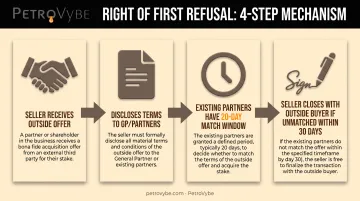
Under Delaware law, an interest is assignable in whole or in part unless the LPA says otherwise. Texas follows the same default rule under its Business Organizations Code Section 153.251. Most LPAs do say otherwise. Here's the typical mechanism:
- Seller receives a bona fide offer from an outside buyer
- Seller must disclose the interest, price, and buyer to the GP or existing partners
- Existing partners get a window (often 20 days) to match the offer
- If no one matches, the seller has a set period (often 30 days) to close with the outside buyer on the disclosed terms Many LPAs also reset the right of first refusal if the closing window lapses without a completed sale. Buyer qualification standards also apply. GPs commonly require buyers to meet accredited investor thresholds or pass KYC/suitability screening before approving a transfer. Violating these restrictions can invalidate the transfer outright, trigger default provisions, or expose the parties to a lawsuit.
Valuation and Pricing: What Determines the Purchase Price
LP interests don't trade on an open exchange. That absence of a liquid market shapes pricing more than anything else.
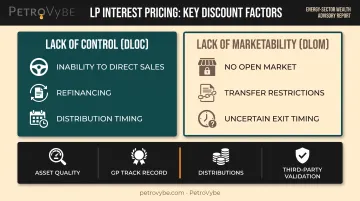
Buyers typically apply two discounts against the partnership's stated net asset value:
- Lack of control (DLOC): A limited partner can't direct asset sales, refinancing, or distribution timing
- Lack of marketability (DLOM): No open market exists, transfer restrictions limit buyers, and exit timing is uncertain
These aren't theoretical. In Estate of Jones (T.C. Memo. 2019-101), the Tax Court accepted a 35% DLOM for interests in a timber operating partnership.
The court pointed to unanimous-consent requirements, rights of first refusal, and no voting rights for assignees. That outcome is case-specific, not an industry standard, but it shows how far these discounts can move price.
Beyond the discounts, buyers weigh:
- Asset quality and remaining reserve life
- GP track record and operational history
- Current and projected distributions
- Third-party validation of underlying assets
Partnerships backed by independent reserve reports tend to command less-discounted pricing, because buyers face less uncertainty.
PetroVybe's ONE partnership, for example, references a $48 million PV-09 proved-reserves valuation from a licensed third-party engineering firm, plus a clean 2025 independent audit. Prepared by Lee Keeling & Associates, Tulsa, March 2026. That level of transparency cuts the guesswork buyers otherwise have to price in.
Tax Considerations for Buyers and Sellers
Tax outcomes on an LP interest sale hinge on details most investors overlook until it's too late.
Seller's Side: Basis, Gain, and Debt Relief
A seller's taxable gain equals the amount realized minus adjusted outside basis. Outside basis isn't static. It moves with contributions, distributions, and allocated income or loss over the life of the investment, per IRS Publication 541.
Here's the part that surprises sellers: relief from partnership liabilities counts as part of the amount realized. If you're exiting a partnership with debt on the books, that debt relief can create unexpected taxable gain, even if no cash changed hands for that portion.
Gain character is not automatically capital gain. Under Section 751, the portion attributable to unrealized receivables, including potential ordinary income from depreciation recapture or deducted intangible drilling costs, gets taxed as ordinary income, not capital gain. This treatment requires the investor to elect general partner status in the Subscription Agreement and may be limited in a given year by the excess business loss limitation under IRC §461(l).
Buyer's Side: The Section 754 Election
If the partnership makes a Section 754 election, the buyer may get a basis step-up under Section 743(b). This adjustment aligns the buyer's outside basis with their share of inside basis, but it applies only to that specific buyer, not the partnership as a whole.
For natural gas development partnerships specifically, incoming buyers should also evaluate:
- Intangible Drilling Cost (IDC) deductions — often a first-year deduction target of approximately 70–80% of invested capital in new-drilling projects
- Depletion allowances — separate from IDCs, functioning similarly to depreciation
- Passive vs. nonpassive treatment — working-interest deductions may offset active income only when liability isn't limited (IRS Publication 925) This treatment requires the investor to elect general partner status in the Subscription Agreement and may be limited in a given year by the excess business loss limitation under IRC §461(l).
PetroVybe's 2025 partners reported 94% deductions against active income, combining IDCs with depletion allowances. Prior result; not a promise of any future deduction. That matters: not every LP structure lets deductions offset active income such as W-2 earnings or capital gains. This treatment requires the investor to elect general partner status in the Subscription Agreement and may be limited in a given year by the excess business loss limitation under IRC §461(l).
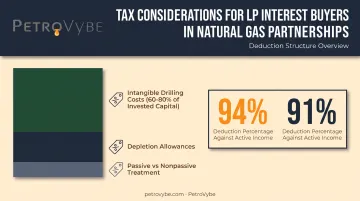
Buyers should confirm working-interest status, any Section 754 election, and active-income treatment before assuming those benefits apply to the purchase.
Due Diligence Checklist Before Signing
Before signing a purchase agreement, request and review:
- Current LPA and amendments — confirms transfer rights, GP consent requirements, and ROFR mechanics
- Three years of K-1s and partnership tax returns — reveals liability allocations, tax-basis capital, and prior Section 751 items
- GP quarterly or annual reports — shows distribution history and operational trends
- Independent reserve report or valuation — third-party engineering validation, not just GP projections
- Operator licensing status — for oil and gas partnerships, verify standing with the relevant state regulator, such as the Texas Railroad Commission's public P-5 query system
Track record and validation matter as much as the paperwork. Investors evaluating direct oil and gas LP opportunities should weigh the general partner's operating history alongside how transparent their reporting is.
PetroVybe, for instance, provides accredited investors with independently engineered valuation reports and audited financials as part of its diligence materials. That level of disclosure is a useful benchmark before you commit capital to any partnership.
Frequently Asked Questions
What is a limited partnership interest?
A limited partnership interest is a limited partner's ownership stake in the partnership. It entitles the holder to a share of profits and distributions, with liability capped at their investment and no management control.
What does a limited partnership agreement look like?
A limited partnership agreement is the governing contract. It covers capital contributions, profit and loss allocation, distribution policies, transfer restrictions, GP authority, and dissolution terms.
Are limited partnership interests freely transferable?
Generally, no. Most agreements require GP consent, a right of first refusal, or buyer qualification standards before a transfer is valid.
How is the purchase price for an LP interest determined?
Price is negotiated. Buyers typically apply discounts for illiquidity and lack of control, then factor in asset performance and the partnership's remaining hold period.
Do I need an attorney to complete an LP interest purchase agreement?
Yes. Legal, tax, and valuation issues are intertwined, so use an attorney or advisor who regularly handles partnership interest transfers.
What happens to my tax obligations after selling my LP interest?
You calculate gain against your outside basis, include any debt relief in the amount realized, and characterize the gain type. Work with a tax professional on the filing details.
Informational requests only. PetroVybe projects are offered solely to verified accredited investors. Submitting this form does not create an investment or advisory relationship.