Here's where most investors get stuck: they confuse "shale oil" with "oil shale," and they assume the only way in is buying stock in a large exploration and production (E&P) company. Neither assumption holds up.
This article breaks down what shale oil actually is, the different ways investors can gain exposure (including direct participation programs), the real benefits and risks involved, and concrete examples of how shale investment plays out at both the mega-merger scale and the single-project scale.
Key Takeaways
- Shale oil, extracted via fracking and horizontal drilling, now drives most U.S. crude production
- Investors can access shale through E&P stocks, ETFs, or direct participation, each with distinct risk and tax profiles
- Direct drilling participation can offer major tax advantages against active income via Intangible Drilling Cost (IDC) deductions
- Because shale wells decline faster than conventional ones, operator track record and reinvestment strategy drive long-term returns more than oil prices
What Is Shale Oil? Understanding the Basics
Shale oil, technically called tight oil or light tight oil, is crude trapped in low-permeability rock formations. It won't flow to the surface on its own, which is why it sat untouched for decades until drilling technology caught up.
Oil shale is something else entirely. It's rock containing kerogen, an organic material that hasn't fully matured into crude oil. Turning kerogen into usable fuel requires heating it to extreme temperatures in a process called retorting, which is expensive and energy-intensive.
Extracting shale oil at scale required two breakthrough technologies:
- Hydraulic fracturing – pumping high-pressure fluid into rock to create fractures that release trapped oil
- Horizontal drilling – drilling sideways through a formation to expose far more rock to a single wellbore than vertical drilling ever could
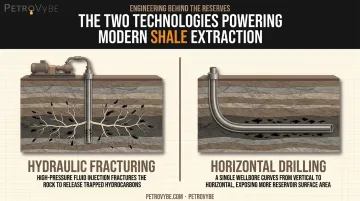
By 2016, hydraulically fractured horizontal wells accounted for 69% of new U.S. oil and gas wells and 83% of total drilled footage. This technology is now the industry standard.
Why the Distinction Matters for Investors
Shale oil and oil shale have completely different investment economics. Shale wells have known decline curves, established break-even costs, and decades of production data across U.S. basins. Oil shale projects remain largely uneconomic outside of a handful of countries, with Estonia standing as one of the few places where kerogen mining has operated at scale since 1916.
If you're researching "how much is oil shale worth," the answer is: not much, commercially, in the U.S. today. Nearly all investable "shale" activity refers to tight oil, not kerogen rock.
Ways to Invest in Shale Oil
Most investors default to buying shares in a large E&P company. It's the most accessible route, and for good reason.
Public E&P stocks come with a mix of upside and limits:
- Daily liquidity through any brokerage account
- Diversification across the company's entire asset portfolio
- No direct control over drilling decisions or well selection
- Indirect exposure: you own a slice of the whole company, not any single project
Energy-focused ETFs work similarly but spread risk further. An ETF tracks a basket of producers rather than one company or one well, which reduces single-issuer risk but doesn't remove sector-wide exposure to oil prices. It's a lower-effort option for investors who want energy exposure without picking individual stocks.
Neither option gets you close to actual well-level economics. That's where direct participation comes in.
Direct Participation Programs and Working Interests
A direct participation program (DPP) lets accredited investors take a working interest directly in a drilling project. Instead of owning a piece of a public company's stock, you own a piece of the actual wells.
Firms like PetroVybe structure this access around early-stage natural gas and NGL development projects in South Texas and the Gulf Coast Basin. These offerings connect investors directly to project-level economics, including production, decline curves, and reinvestment strategy, rather than diluting that exposure across a large corporate portfolio.
This structure also opens the door to tax treatment unavailable to passive stockholders, largely through IDC deductions we'll cover in the next section.
Before committing capital to any direct participation opportunity, evaluate these factors:
- The operator's track record on prior projects
- Geological expertise behind well-location decisions
- Whether reserves have been validated by independent, third-party engineering
- The specific basin and its production history
Here's how the three routes stack up:
| Factor | Public E&P Stock | Energy ETF | Direct Participation |
|---|---|---|---|
| Liquidity | High (daily trading) | High (daily trading) | Low (often multi-year hold) |
| Control | None | None | Working interest in specific wells |
| Tax treatment | Standard dividend/capital gains | Standard dividend/capital gains | IDC deductions against active income |
| Minimum investment | Cost of one share | Cost of one share | Typically $100,000+, accredited investors only |
Benefits of Shale Oil Investment
Faster Capital Return and Scalability
Shale wells produce at a much faster initial rate than conventional wells, meaning capital gets returned to operators (and investors) sooner. A March 2026 Dallas Fed energy survey of 80 E&P firms found new-well break-evens averaging $64 per barrel of WTI, ranging from $59 in the Permian Delaware to $68 in smaller shale regions.
That range matters. It tells you break-even costs vary significantly by basin, so evaluating a specific project's location beats relying on a single national number.
Shale also scales faster than conventional oil. Operators can ramp drilling up or down in response to price signals in months, not the years required for conventional megaprojects like deepwater platforms. That flexibility is part of why shale reshaped global oil markets so quickly after 2010.
Tax Efficiency Through IDC Deductions
This is where direct participation separates itself from every other route on this list. Intangible Drilling Costs, covering labor, chemicals, and other non-salvageable drilling expenses, are deductible against active income, including W-2 wages and capital gains. Real estate depreciation can't do that unless you qualify as a full-time real estate professional.
PetroVybe's own results illustrate the scale of this benefit:
- 2024 partners received a 91% tax deduction against active income
- 2025 partners received a 94% tax deduction against active income
- A $100,000 investment typically generates a $60,000–$80,000 IDC deduction, taken fully in Year 1 or spread over five years via K-1

Passive Income and Diversification
Direct participation programs are structured to require no ongoing time commitment. You're not managing wells or reviewing drilling logs monthly. The return profile is also largely uncorrelated with stocks and bonds, which adds real diversification value to a portfolio otherwise concentrated in equities and fixed income.
Beyond individual returns, shale development supports domestic jobs and infrastructure spending while reducing reliance on imported oil, the same forces that reshaped global oil markets after 2010.
Risks and Challenges of Shale Oil Investment
Shale investment isn't without real risk, and pretending otherwise does investors a disservice.
Price volatility hits shale harder than conventional oil because break-evens sit closer to market prices. When WTI drops, drilling activity slows quickly. The EIA's own forecasts show production growth decelerating sharply under lower-price scenarios, which is exactly why basin selection and operator discipline matter more than macro oil price bets.
Beyond price swings, steep decline curves represent shale's next major risk. EIA data on Eagle Ford wells drilled between 2009 and 2013 showed first-year production declines of 60% to 70%. That's not a typo. A well producing strong output in month one can lose most of that output within twelve months.
What this means practically:
- Continuous drilling capital is required just to maintain flat output
- A single well's early production numbers tell you very little about 5-year or 10-year returns
- Operators without a disciplined reinvestment strategy can see output collapse even in a strong price environment
This is exactly why PetroVybe pairs continuous reinvestment with third-party engineered reserve reports, rather than relying on early production numbers alone.
Beyond price and production risk, environmental and regulatory risk adds another layer. Water usage, emissions monitoring, and permitting requirements all affect project costs and timelines. Texas alone requires chemical disclosure under Statewide Rule 29, and federal methane waste-emissions charges have climbed from $900 per metric ton in 2024 toward $1,500 by 2026. These aren't dealbreakers, but they're real costs that responsible operators build into their economics upfront.
Real-World Examples: Shale Basins and Investment Cases
Three basins dominate U.S. shale production: the Permian Basin (West Texas/New Mexico), the Bakken Formation (North Dakota), and the Eagle Ford Shale (South Texas). All three have long production histories and established pipeline infrastructure. The Permian alone produced 6.6 million barrels per day in 2025, according to EIA data, nearly half of total U.S. crude output.
Consolidation at Scale
Large public companies have spent the last two years consolidating aggressively into core shale acreage:
- ExxonMobil–Pioneer Natural Resources: An all-stock deal valued at $59.5 billion, targeting combined Permian production near 2 million barrels of oil equivalent per day by 2027
- Diamondback Energy–Endeavor Energy Resources: Roughly $26 billion, adding 838,000 net Permian acres and an estimated $550 million in annual synergies
- ConocoPhillips–Shell Delaware Basin: $9.5 billion acquisition adding roughly 225,000 net Delaware Basin acres
- ConocoPhillips–Marathon Oil: $22.5 billion enterprise-value acquisition adding Eagle Ford and Bakken inventory
These deals share a common thread: contiguous acreage and operational efficiency drive the value more than raw barrel counts.
Smaller-Scale Direct Participation
Not every shale opportunity requires billions in capital. PetroVybe's development project in Lavaca County, Texas, spans a 58,000-acre position with roughly 400 acquired producing wells and 57-plus planned new wells across the South Texas and Gulf Coast Basin. The project's reserves carry a $48 million third-party PV-9 engineering valuation, with a clean 2025 independent audit backing the numbers.
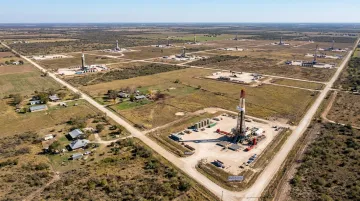
The parallel to the mega-mergers above is direct: operational discipline and geological expertise drive returns whether you're closing a $59.5 billion deal or developing a few dozen wells in a single Texas county. Investors evaluating either type of opportunity should look for the same signals: contiguous acreage, independent reserve validation, and experienced operators.
Frequently Asked Questions
Is shale oil profitable?
Profitability depends on oil prices, well efficiency, and cost structure. Shale offers faster production cycles than conventional oil, but individual well economics decline quickly, making operator selection the most important variable.
How much is oil shale worth?
Oil shale (kerogen-bearing rock) is a distinct resource from shale oil, and its extraction remains costly and largely uneconomic outside a few countries like Estonia. Most current "shale" investment activity refers to shale oil, or tight oil, not oil shale.
Is shale oil declining?
Annual growth rates have slowed compared to the 2010s boom decade. Major agencies still project U.S. shale output to remain historically high through the 2030s, with growth continuing at a more moderate pace.
What is the difference between shale oil and oil shale?
Shale oil is light crude trapped in tight rock, extracted through fracking and horizontal drilling. Oil shale contains kerogen requiring energy-intensive retorting, making the two fundamentally different investment propositions.
How can I invest in shale oil directly?
Accredited investors can participate directly through working interest or direct participation programs offered by operators like PetroVybe, which provide access to specific drilling projects along with associated IDC tax benefits.
What are the biggest risks of investing in shale oil?
The primary risks are price volatility, rapid first-year well decline rates (often 60-70%), and regulatory or environmental scrutiny around water use and emissions. Evaluate these against operator track record before committing capital.