The reality is considerably messier. The historical record on windfall profits taxes shows a consistent pattern: revenues fall short of projections, domestic production declines, and investment shifts to more hospitable jurisdictions. That pattern has repeated from the 1980 US Crude Oil Windfall Profit Tax through the EU's 2022 solidarity contribution to today's UK Energy Profits Levy.
This article covers what a windfall profits tax on oil actually is, how the major historical examples played out, what the economic research shows, and what it means for investors evaluating direct exposure to oil and gas development.
Key Takeaways
- A windfall profits tax targets profits above a defined "normal" baseline, typically triggered by geopolitical events or supply shocks
- The 1980 US Windfall Profit Tax raised ~$80 billion gross against a $393 billion projection — and was linked to reduced domestic production
- Windfall taxes consistently deter investment and accelerate domestic production decline
- The UK and EU implemented windfall taxes post-2022 — revenues largely missed projections
- Direct participation in oil and gas development operates under a structurally different tax framework than the corporate profits these taxes target
What Is a Windfall Profits Tax on Oil?
A windfall profits tax is a levy applied to profits that exceed a defined "normal" baseline — profits that arose from external economic conditions rather than a company's own operational improvements or strategic decisions.
This distinguishes it from standard corporate income tax, which applies uniformly to all profits each year. A windfall tax only applies to the portion of profits above a threshold, which might be defined as:
- Average profits over a prior multi-year period
- Profits above a certain price per barrel
- Profits exceeding a fixed percentage above historical averages (e.g., the EU's 120% benchmark)
Why Oil Companies Are the Frequent Target
Oil and gas companies face windfall tax proposals more than any other industry. The reason is structural: commodity prices are driven by geopolitical events and supply disruptions that no individual company controls. When Russia's invasion of Ukraine pushed crude prices sharply higher in 2022, global oil and gas producer net income effectively doubled to approximately $4 trillion, according to the IEA — a figure driven entirely by external events, not operational breakthroughs.
That dynamic makes the profits easy to characterize as "unearned." Three factors consistently put oil companies in the political crosshairs:
- Price volatility: Crude prices swing on events no producer controls — wars, OPEC decisions, shipping disruptions
- Profit visibility: Record earnings get reported publicly and create immediate political pressure
- Concentrated gains: A handful of large integrated majors capture a disproportionate share of windfalls
The result is recurring legislative pressure whenever prices spike.
The Definitional Problem
The concept of "supernormal" or "excess" profit is genuinely hard to pin down in a cyclical industry. Oil prices briefly went negative in April 2020 — WTI futures settled at -$37.63 per barrel — meaning the same companies now characterized as profiteering were losing billions just two years earlier.
A year of high profits often compensates for years of heavy losses. This cyclicality sits at the center of the economic case against windfall taxes — and it directly shapes how companies respond to them. When producers anticipate that exceptional returns will be taxed away, they pull back on the capital expenditures and new drilling that would otherwise follow a price spike. The tax meant to capture "excess" profit can end up suppressing the investment cycle that brings prices back down.
A Brief History of Windfall Taxes on Oil
WWI and WWII: The Pattern Established
The US turned to excess profits taxes during both World War I and World War II as wartime revenue tools, establishing a durable pattern: in times of crisis, governments reach for windfall taxation. These measures were temporary, justified by extraordinary circumstances. Once the emergency passed, they were repealed.
The 1980 Crude Oil Windfall Profit Tax
The most consequential US example remains the Crude Oil Windfall Profit Tax (WPT), enacted under President Carter on April 2, 1980 (Public Law 96-223). Despite the name, it was technically an excise tax — applied to the difference between the market price of a barrel of domestic oil and a legislated base price — not a tax on company accounting profit.
The revenue results were striking in how far they missed projections:
| Metric | Projected | Actual |
|---|---|---|
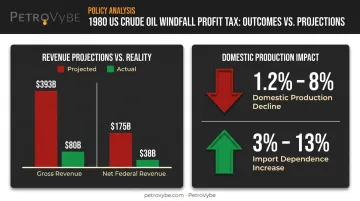
| Gross Revenue (1980–1988) | ~$393 billion | ~$80 billion |
| Net Federal Revenue | ~$175 billion | ~$38 billion |
The shortfall happened partly because the tax was deductible against income tax, and partly because oil prices fell well below the levels assumed when the projections were made.
The production effects were equally significant. Congressional Research Service analysis estimated the WPT may have reduced domestic oil production by 1.2% to 8% over eight years — roughly 320 million to 1.27 billion barrels — while increasing US dependence on imported oil by 3% to 13%.
The mechanism was direct: by taxing the margin on domestic production while leaving imported oil untaxed, the WPT made domestic drilling less economically attractive than importing.
The WPT was repealed in 1988 (Public Law 100-418). That combination — underperforming revenue targets and measurable production losses — is why the WPT resurfaces in nearly every subsequent windfall tax debate as the primary evidence against.
The 2022 Resurgence
Four decades after the WPT's repeal, the policy question returned — this time globally. Russia's invasion of Ukraine in February 2022 triggered the broadest wave of windfall tax proposals since the 1980s. Major Western oil companies more than doubled their combined 2022 profits to $219 billion, with Exxon alone reporting $56 billion — a record at the time. Governments moved quickly:
- US: H.R.7061 introduced March 2022; Biden characterized oil profits as "war profiteering" in October 2022
- UK: Energy Profits Levy announced May 2022, initially at 25%
- EU: Council Regulation 2022/1854 adopted October 2022, establishing the fossil-sector solidarity contribution
How a Windfall Oil Tax Is Structured and Who Pays
The structure of a windfall tax matters enormously — different designs produce very different economic effects.
Two Primary Structural Approaches
1. Profit-based windfall taxes apply a surcharge to profits exceeding a defined historical baseline. The EU's solidarity contribution used this approach: profits more than 20% above the average of fiscal years 2018–2021 were subject to a minimum 33% surcharge. Companies needed to derive at least 75% of turnover from qualifying oil, gas, coal, or refining activities to fall within scope.
2. Price-based excise taxes apply to the difference between market price and a set base price per barrel — the structure the 1980 US WPT used. These don't directly measure profits at all, which is why the WPT's name was technically a misnomer.
Each design has different implications for who pays, what can be deducted, and how investment decisions are affected.
Investment Allowances: The Critical Variable
Several windfall tax designs included investment allowances, letting companies reduce their liability by reinvesting profits in qualifying domestic projects. The UK's Energy Profits Levy originally included a 29% general investment allowance — intended to sustain continued North Sea development.
In late 2024, the UK eliminated that allowance while also raising the EPL rate to 38%, bringing the combined headline rate on North Sea upstream profits to 78%. That decision dramatically increased the effective burden on producers and accelerated concerns about North Sea investment viability.
The Italy and Spain Design Failures
Not all windfall tax designs used standard profit measures. Italy's initial 2022 levy was based on changes in VAT transaction balances rather than taxable profit — a design the Constitutional Court later found partly unlawful. Spain applied a levy based on 1.2% of domestic net turnover for large energy companies, with Repsol estimating a €450 million charge for 2022 activities alone.
The structural problems with both national designs make clear that "windfall tax" is a broad category, not a single coherent mechanism — and the differences in design determine everything about who pays, how much, and with what consequences for investment.
The Economic Consequences: Production, Investment, and Jobs
Revenue Shortfalls: A Consistent Pattern
The 1980 US WPT's revenue shortfall is not an outlier. The pattern recurs:
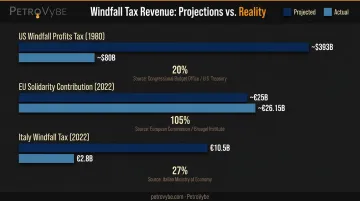
- EU solidarity contribution: The European Commission originally estimated approximately €25 billion; the final reported collection was €26.15 billion — slightly above estimate, but representing only a fraction of the roughly €340 billion total cost of EU energy support measures
- Italy 2022: Collected approximately €2.8 billion against an expected €10.5 billion — less than 27% of the projected figure
- Legal challenges, design revisions, and falling commodity prices all contribute to the consistent gap between projection and reality
Investment Chilling and Production Decline
Windfall taxes reduce after-tax returns on capital-intensive projects, creating an incentive to defer or relocate spending to more predictable tax environments. The North Sea provides the clearest current example.
Offshore Energies UK (OEUK) estimated in a September 2024 scenario that approximately 35,000 jobs were at risk from projects that would not proceed under the current levy regime — an industry forecast, not an observed figure, but grounded in specific project-level assessments. North Sea producers have publicly signaled they are looking beyond the UK for future investment as a direct result of the tax burden.
The Clean Energy Paradox
That capital flight doesn't stop at oil and gas. Many major producers are also among the largest investors in renewable energy — meaning windfall taxes reduce available capital across the entire energy investment portfolio, not just traditional drilling.
Spain's Repsol provides a concrete example. After facing the Spanish windfall levy, Repsol froze green hydrogen projects in Spain in 2024 and signaled its next electrolyser would be built in Portugal instead. The company warned that continued taxation put €16.5 billion of planned Spanish investment at risk — across both fossil fuel and clean energy projects.
The Case For and Against Windfall Taxes on Oil
The Arguments in Favor
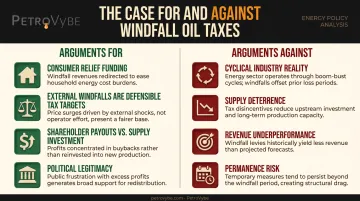
- Consumer relief funding: Proceeds can be directed to household energy subsidies — the EU explicitly intended the solidarity contribution to help with energy bills during the 2022 crisis
- External windfalls: Profits generated by geopolitical events rather than company innovation or risk-taking are a defensible tax target from a fairness standpoint
- Shareholder payouts vs. production: Major Western oil companies distributed approximately $110 billion in combined dividends and share repurchases in 2022 — a figure critics cited as evidence companies were enriching shareholders instead of expanding supply
- Political legitimacy: UN Secretary-General Antonio Guterres called record oil profits "immoral" in August 2022 and urged governments to act
The counterarguments carry equal weight — and for long-term energy investors, they tend to matter more.
The Arguments Against
- Cyclical industry reality: Companies lost billions in 2020 when WTI briefly went negative. High-profit years offset multi-year losses — taxing only the upside without compensating the downside distorts investment decisions
- Supply deterrence: Reducing profitability discourages long-term capital investment, which constrains future supply — often worsening the very price spikes that triggered the tax
- Revenue underperformance: Windfall tax revenues consistently fall short of projections while compliance costs and legal uncertainty remain high
- Permanence risk: Taxes designed as temporary emergency measures tend to persist. The UK's EPL was extended from 2025 to 2030; Spain and Hungary stretched their solidarity contributions past the EU's 2023 endpoint. That unpredictability compounds the investment deterrent beyond the tax rate itself.
Global Windfall Tax Policy: Where Things Stand Today
United States
The US has not enacted a federal windfall profits tax since the 1988 repeal. The Big Oil Windfall Profits Tax Act (H.R.7061, introduced March 2022) was referred to the House Ways and Means Committee and has not passed. A Senate companion bill (S.408) was introduced in 2023 and also stalled. As of this writing, no federal windfall tax has been enacted.
California passed SB X1-2 in March 2023 — not a fixed-rate profits tax, but a law authorizing the California Energy Commission to set a maximum gross gasoline-refining margin and civil penalty. Implementation was still ongoing in early 2025.
United Kingdom
The UK's Energy Profits Levy currently stands at 38%, applied on top of an existing 40% headline rate, producing a combined effective rate of 78% on North Sea upstream profits. It runs through March 31, 2030, with an early sunset mechanism if oil and gas prices stay below defined thresholds for six consecutive months.
Post-2030, the UK government has confirmed an Oil and Gas Price Mechanism will apply a 35% additional rate on revenue above $90/barrel for oil or 90p/therm for gas.
European Union
The EU solidarity contribution collected €26.15 billion across member states for tax years 2022–2023. The policy has formally concluded, but five EU finance ministers have since called for a new windfall tax tied to more recent energy price movements. The debate over EU-level windfall taxes hasn't ended.
For US-based oil and gas investors, this global patchwork matters: how governments tax energy profits abroad shapes capital flows, investment competition, and the relative attractiveness of domestic upstream positions — all factors that bear directly on long-term project economics.
Current Policy Snapshot
| Jurisdiction | Status | Key Rate | Expiry |
|---|---|---|---|
| United States (Federal) | No windfall tax enacted | — | — |
| California | Margin cap + civil penalty (SB X1-2) | Set by regulator | Ongoing |
| United Kingdom | Energy Profits Levy active | 78% combined effective rate | March 31, 2030 |
| European Union | Solidarity contribution concluded | Varied by member state | Ended (2022–2023) |
What This Means for Oil & Gas Investors
Windfall taxes are a real policy risk for publicly traded oil and gas companies — particularly those with concentrated domestic production. When a corporate-level windfall tax is assessed, it reduces after-tax earnings before any of that income reaches shareholders. Investors in an Exxon or Chevron have no direct mechanism to offset or avoid that corporate-level hit.
Direct participation in oil and gas development operates under a structurally different framework. A partnership like PetroVybe — which structures investor access as a direct working interest in oil and natural gas development projects rather than equity in a corporation — passes income, losses, and deductions directly to investor partners through K-1 reporting. The corporate tax layer that windfall taxes target doesn't exist in the same way.
The IDC Advantage
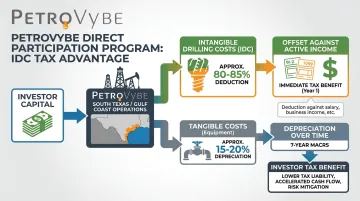
For accredited investors in direct participation programs, the relevant tax mechanism is the Intangible Drilling Cost (IDC) deduction under IRC §263(c). This deduction — which has been embedded in US tax law since 1913 — allows investors to deduct 60–80% of invested capital in qualifying oil and gas development in the year costs are incurred.
The structural distinction that matters most: for passive investors in oil and gas working interests held directly or through entities that don't limit liability, the IDC deduction is not restricted to passive income. It can be applied against:
- W-2 earnings
- Capital gains
- Other active income sources
This is structurally different from most passive investment deductions, which can only offset passive income. PetroVybe's partners have achieved 94% tax deductions against active income in 2025 and 91% in 2024 — with a projected first-year deduction of approximately 70% of invested capital for new partners.
The demand fundamentals for domestic gas development remain strong. Industry forecasts project up to 8.5 Bcf/d of additional US natural gas demand by 2030 driven by AI data center electricity consumption alone — alongside domestic energy security priorities and record US ethane exports. That demand picture holds even in a higher-tax-risk environment.
There's also a built-in irony worth noting: windfall taxes follow high commodity prices, and high commodity prices are precisely when production is most profitable. Investors evaluating that tradeoff need to understand not just the tax risk, but which layer of the investment structure those taxes actually reach.
For accredited investors carrying significant W-2 or capital gains tax liabilities, PetroVybe's direct participation program in South Texas and the Gulf Coast Basin offers a concrete starting point. The windfall tax debate is a corporate-equity problem. The IDC deduction is an investor-level solution — and the two operate on separate tracks.
Frequently Asked Questions
What is an oil windfall?
An oil windfall refers to exceptionally high profits earned by oil companies due to external factors — geopolitical conflicts, supply disruptions, or demand swings — rather than the company's own strategic decisions or operational improvements.
How does a windfall oil tax work?
A windfall oil tax applies a surcharge to profits that exceed a defined "normal" baseline — either a historical average profit level or a set price-per-barrel threshold. Only profits above that threshold are subject to the additional tax, so companies retain a portion of their excess profits even after paying the levy.
Who benefits from a windfall oil tax?
Governments and consumers are the intended beneficiaries — proceeds typically fund consumer energy relief or general government programs. In practice, revenues frequently fall short of projections, and the chilling effect on investment can ultimately reduce domestic supply and push prices higher over time.
What was the windfall tax for oil in 1980?
The 1980 Crude Oil Windfall Profit Tax was an excise tax on the difference between the market price of domestic oil and a legislated base price. It raised approximately $80 billion between 1980 and 1988 — far below the $393 billion projected — and was repealed after research linked it to reduced domestic production.
Has the US ever passed a windfall profits tax on oil companies?
Yes — once. The 1980 Crude Oil Windfall Profit Tax ran until 1988 before repeal. More recent proposals, including the Big Oil Windfall Profits Tax Act introduced in 2022 and reintroduced in 2023, have not passed Congress.
Do windfall profits taxes reduce oil production?
Historical evidence suggests yes. The 1980 US WPT was linked to a 1.2%–8% reduction in domestic oil production over eight years and a 3%–13% increase in import dependence, per Congressional Research Service analysis. More recently, the UK's extended Energy Profits Levy has been cited by North Sea producers as a factor accelerating domestic production decline and investment reallocation abroad.
Disclosure: PetroVybe and its team members are not licensed financial advisors, and nothing on this website constitutes financial or investment advice or a recommendation to buy, sell, or hold any investment. PetroVybe and its team members are not tax advisors, accountants, or tax strategists, and nothing on this website constitutes tax advice or a tax strategy. PetroVybe and its team members are not attorneys, and nothing on this website constitutes legal advice. All content is provided for general informational purposes only. You should consult your own independent financial advisor, tax professional, and legal counsel before making any decision.