
That mismatch creates real cash-flow headaches for retirees and anyone building a passive-income stream. It's gotten more urgent lately, too. Consumer prices rose 2.9% in the twelve months ending December 2024, according to the Bureau of Labor Statistics, and years of elevated interest rates have pushed more people to hunt for cash flow that actually matches their bills.
This guide breaks down 12 proven monthly income investments, one alternative option for accredited investors, and how to combine them into a portfolio that fits your life.
Key Takeaways
- Monthly income investments prioritize regular cash flow, not just long-term growth
- Options span FDIC-insured savings accounts to higher-yield REITs, annuities, and private energy development
- The right choice depends on your risk tolerance, liquidity needs, and tax bracket
- Blending multiple income sources smooths out volatility and helps offset inflation
What Is Monthly Income Investing (and Why It Matters)
Monthly income investing means directing capital into assets specifically structured to pay out on a recurring monthly schedule, rather than the quarterly or annual timing common to most stocks and bonds. The goal is building cash flow you can actually plan a budget around, not just growth.
This approach matters most to three groups:
- Retirees replacing a steady paycheck with investment income
- High-income earners looking to diversify beyond growth-focused stock portfolios
- Anyone who wants predictable cash for expenses or reinvestment
It's a bigger deal than most people realize. About 50% of retirees received interest, dividend, or rental income in 2024, rising to 54% among retirees 65 and older, according to the Federal Reserve's 2025 household economic well-being report. Income-generating assets are a mainstream part of how Americans actually fund retirement.
12 Investments That Pay Monthly Income
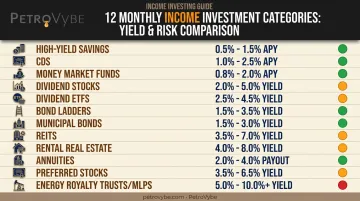
These options span the full risk spectrum, from FDIC-insured cash accounts to market-based securities and real assets. Most investors end up blending several rather than relying on just one.
High-Yield Savings Accounts
These accounts pay interest monthly, offer full liquidity, and carry FDIC or NCUA insurance up to $250,000 per depositor. Top APYs have hovered around 4.0%-4.5% through 2025. The tradeoff: rates rarely outpace inflation over the long run, making these better for emergency cash than wealth building.
Certificates of Deposit (CDs)
CDs lock money for a fixed term in exchange for a higher, guaranteed rate than a savings account, with many banks offering monthly interest payouts. Top short-term CDs paid roughly 4.0%-4.5% APY in late 2025. Early withdrawal typically forfeits at least several days' interest, sometimes more depending on the institution.
Money Market Funds/Accounts
Money market funds invest in short-term, low-risk instruments like Treasury bills and commercial paper. Vanguard's Federal Money Market Fund posted monthly income returns between 3.90% and 4.15% across late 2025. Bank-based money market accounts carry FDIC insurance; money market mutual funds do not, since they're securities rather than deposits.
Dividend-Paying Stocks
Most dividend stocks pay quarterly, though a handful pay monthly. Either way, they combine cash flow with potential price appreciation. Dividends have contributed roughly 31% of the S&P 500's total return since 1926, according to S&P Dow Jones Indices. But payouts aren't guaranteed: 176 U.S. common stocks cut dividends in 2025 alone.
Dividend ETFs & Income Mutual Funds
Funds like VYM and SCHD pool dozens of dividend-paying stocks into one diversified holding, run by professional managers for a fraction of a percent in fees. Recent yields on well-known funds ranged from about 2.5% to 3.3%, offering steadier income than picking individual stocks.
Bond Ladders (Corporate & Treasury Bonds)
A bond ladder staggers maturities so a portion of your portfolio matures and reinvests every few months, creating predictable cash flow in any rate environment. Treasury yields sat between 4.16% and 4.86% across various maturities at the end of 2024. Corporate bonds pay more but carry credit risk.
Municipal Bonds
Municipal bond interest is generally exempt from federal income tax, and sometimes state and local tax too. That tax break comes at a cost: yields tend to run lower than taxable bonds, with recent municipal fund yields in the 2.7%-2.9% range. For high earners, the after-tax return can still beat taxable alternatives.
Real Estate Investment Trusts (REITs)
REITs are legally required to distribute at least 90% of taxable income to shareholders, and many pay monthly. This structure gives investors real estate exposure without the hassle of owning property directly. Equity REITs yielded about 3.96% on average at the end of 2024, while mortgage REITs yielded a much higher 12.65%, reflecting their added risk.
Rental Real Estate
Owning a rental property means monthly rent checks, potential appreciation, and depreciation tax benefits. It also means vacancy risk and hands-on management. National rental vacancy rates hovered around 7.0%-7.2% throughout 2025, and average cap rates ran from 5.2% to 6.4% depending on property type.
Annuities
An annuity converts a lump sum into guaranteed income, sometimes monthly, backed by an insurance company's claims-paying ability. Deferred annuities often allow penalty-free withdrawals up to 10% annually, but surrender charges apply beyond that. Distributions are taxed as ordinary income, and early withdrawals before age 59½ can trigger a 10% penalty.
Preferred Stocks
Preferred shares pay fixed dividends like a bond but trade like a stock, ranking ahead of common shareholders for payouts. A widely held preferred stock ETF recently showed yields between 5.6% and 6.5%. Dividends can be deferred or skipped, though, and many issues are callable when rates fall.
Energy Royalty Trusts & MLPs
These publicly traded vehicles pass through oil and gas royalty or pipeline income to unit holders. Royalty trusts often pay monthly; MLPs typically pay quarterly. Both are highly sensitive to commodity prices: Henry Hub natural gas prices swung between $1.49 and $3.18 per MMBtu in 2024 alone, and distributions move with them.
Beyond Traditional Options: Direct Natural Gas Development Income
Everything above involves buying a security: a share, a unit, a fund. Accredited investors looking for something structurally different often look toward private working-interest development programs instead.
How Direct Development Differs From MLPs
A publicly traded royalty trust or MLP gives you exposure to an already-producing, market-priced asset. Direct participation in a development project puts you into the production and cash flow of the project itself, at the point before value has been fully priced in, not a security layered on top of it.
This structural difference matters most at tax time. Intangible Drilling Cost (IDC) deductions in oil and gas development can offset a substantial share of the investment against active income, including W-2 wages and capital gains, in year one. That's a meaningful departure from nearly everything else on this list, where deductions (if any) are typically limited to passive income.
The PetroVybe Example
PetroVybe, a Texas-based natural gas development company operating in the South Texas Gulf Coast Basin, gives accredited investors direct access to this asset class. A few specifics worth knowing:
- Partners in 2024 received a 91% tax deduction against active income; the 2025 cohort saw that climb to 94%
- The company's Chief Geophysicist has logged a 75.2% well-success rate over a 48-year career, against an industry peer average below 40%
- Monthly passive distributions to investors are projected to peak above $10,000 per month once wells hit full production
- The current project spans roughly 400 producing wells plus 57+ planned new wells across a 58,000-acre basin in Lavaca County
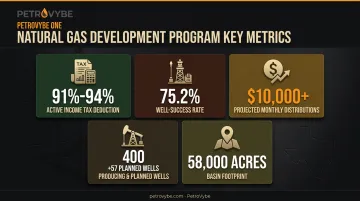
Rather than a fixed monthly check, this model targets a specific return over a multi-year hold: as producing wells generate revenue, distributions compound alongside a targeted MOIC and IRR.
Who This Fits (and Who It Doesn't)
This works alongside the 12 options above, not instead of them. It's a diversifier that requires:
- Accredited investor status, per SEC requirements
- $100,000+ in liquidity, with capital wired upon signing offering documents
- Patience: first distributions typically arrive 2-3 years after investment, with full return horizons stretching 5-10 years
If you need income next month, this isn't the vehicle. If you're sitting on a large tax bill and want long-term compounding alongside it, it's worth a conversation.
How to Choose the Right Mix (and Mistakes to Avoid)
Building a monthly income portfolio starts with a few honest questions:
- How much monthly income do you need to cover expenses or reach your goals?
- What's your risk tolerance: can you stomach a REIT's price swings, or do you need CD-level stability?
- How liquid do you need to be in the next 1-3 years?
- What's your tax bracket, and would tax-exempt munis or IDC deductions meaningfully help?
Most investors do best blending a few categories: cash for stability, bonds for predictability, dividend stocks or REITs for growth, and possibly one alternative asset for diversification and tax efficiency.
Three mistakes show up constantly:
- Chasing yield without checking sustainability. A REIT or MLP paying an unusually high yield is often signaling distress, not opportunity.
- Ignoring tax drag. Interest income gets taxed at ordinary rates. Municipal bonds and IDC-eligible development investments exist precisely to reduce that drag.
- Over-concentrating in illiquid assets. Locking too much capital away (without keeping cash reserves for emergencies) turns a good investment into a liquidity trap.
Frequently Asked Questions
Which investment is best for monthly income?
There is no single best option. It depends on your risk tolerance, liquidity needs, and tax situation. A blended portfolio of 2-3 of the options above usually outperforms relying on just one.
How much money do I need to start generating meaningful monthly income?
It varies widely. You can open a high-yield savings account or dividend ETF with a few hundred dollars. Accredited-investor alternatives like private energy development typically require $100,000 or more in liquidity.
Are monthly income investments taxed differently than growth investments?
Interest income is taxed as ordinary income. Qualified dividends get preferential capital-gains rates. Municipal bond income is often tax-exempt, and certain alternative assets like oil and gas development offer upfront IDC deductions.
What is the safest investment that pays monthly income?
High-yield savings accounts, CDs, and Treasury-backed instruments are considered the safest options, backed by federal insurance or government guarantees. The tradeoff is lower yield relative to inflation.
Can accredited investors access alternative monthly or passive income investments beyond stocks and REITs?
Yes. Accredited investors can access private placements such as PetroVybe's direct oil and gas development programs, which offer tax-advantaged passive income and long-term asset growth outside public markets.
How many different income investments should I hold for good diversification?
Aim for at least 3-4 asset categories: cash, fixed income, equities or REITs, and possibly one alternative asset. This balances safety, yield, and tax efficiency without over-relying on any single source.
Conclusion
Monthly income investing means shifting your focus from pure growth to reliable, recurring cash flow, built across a mix of asset types rather than a single bet. Savings accounts and CDs provide safety. Dividend stocks, REITs, and bond ladders deliver yield and growth. Alternatives like natural gas development add tax efficiency and long-term compounding for investors who qualify.
The right combination depends entirely on your goals, risk tolerance, and tax situation. Before committing meaningful capital anywhere on this list, talk to a financial or tax advisor who can help you finalize the mix that actually fits your life.